

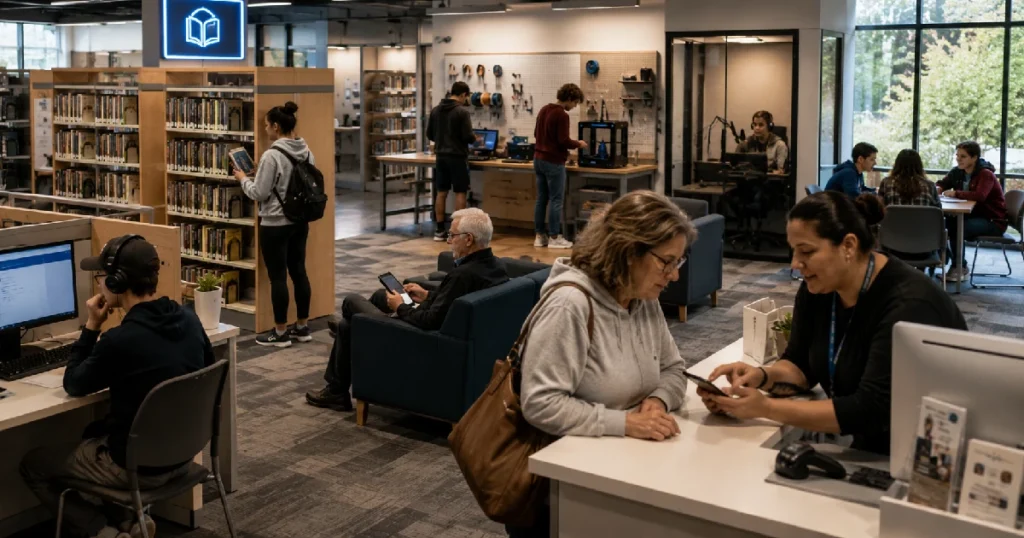
Silence is no longer the first thing you notice when you walk into most public libraries on a weekday morning. Somewhere in the rear is a 3D printer. Teens wearing headphones in a row. A retired man using one of the public computers to watch a language lesson. A woman is being assisted by a front desk employee in using an e-book lending app on her phone. The building still has the same smell, which is a combination of institutional carpet and old paper, but what’s going on inside has subtly changed in ways that most people didn’t notice for ten years.
Libraries have previously been deemed obsolete. With every new technological advancement, such as the internet, e-readers, smartphones, and now AI-powered search tools that can summarize, curate, and retrieve information more quickly than any card catalogue ever could, the prediction tends to come true. The obituary has always been issued too soon. Although it’s still unclear if that trend will last forever, current developments within public libraries indicate that the establishments are changing more quickly and creatively than most casual observers would anticipate.
One of the more unexpected developments is the rise of maker spaces. Unused reading rooms in both urban and suburban libraries have been transformed into workshops furnished with soldering stations, sewing machines, podcast recording booths, and laser cutters. The reasoning isn’t immediately clear until you consider it: people have always used libraries to access resources that they couldn’t afford on their own. The price of a 3D printer is several hundred dollars. The cost of a professional recording setup is significantly higher. The concept of shared access to these tools is identical to that of shared access to books, and it appears that there is a genuine need for this type of resource in the community. The rooms are utilized.
Even ten years ago, the growth of digital collections would have seemed unthinkable. These days, the majority of large public library systems provide e-books, audiobooks, streaming documentaries, digital magazines, and scholarly databases that can be checked out from home using a library card. Millions of people now use their library without ever going inside the building thanks to platforms like Hoopla and Libby. That is not an indication of deterioration. It’s an indication of reach. Through digital services, online education, and community-focused programming, Valley Cottage Library reflects the changing role of libraries. This combination enables a single institution to serve both the student who never leaves her apartment but downloads three audiobooks a week and the retired neighbor who visits every Tuesday.
However, the tension is genuine and deserving of a name. Libraries have always been associated with a particular concept: a peaceful, impartial, and physically accessible space where anyone can sit, read, and simply be without having to make any purchases. It’s possible that an aggressive push toward programming, technology, and digital-first services could undermine that genuinely valuable social contract—not on purpose, but through the gradual accumulation of noise, screens, and activity that alters the building’s atmosphere. Some librarians publicly express concern over this. Others believe that the concern is unfounded because the library’s identity has always been more adaptable than its reputation implies. Everybody has a point.
Libraries are also receiving AI search tools, and this is likely where the most intriguing questions are still emerging. In certain systems, assisted search—AI tools that assist users in finding resources, navigating databases, or summarizing difficult subjects—is already being tested. It’s really unclear what that will ultimately mean for the reference librarian’s job. The optimistic interpretation is that librarians can concentrate on deeper guidance, reader advisory, and community work while AI takes care of the mechanical retrieval. The less hopeful interpretation is that fewer librarians are employed. Anyone who says otherwise is probably overconfident, and it’s too early to tell where this will go.
The library’s identity as a community meeting place appears to be more established, and if anything, it is becoming more important rather than less. The library continues to be one of the few places where a person can just be without any financial pressure in a time when most public spaces require a purchase, coffee shops subtly expect you to buy something every hour, and urban parks have been squeezed by development. That’s a big deal. The library’s continued existence as a free, open, and unconditional resource begins to seem less like a charming holdover and more like something worth consciously preserving as cities struggle with isolation, housing instability, and the collapse of third places—spaces between home and work where people used to congregate.
There won’t likely be a single answer to the question of what libraries will become in the next ten years. Due to local budgets, demographics, and the unique interests of their library directors and boards, different communities will steer the institution in different directions. Some people will become more reliant on technology. Some will intensify their reading programs and physical collections. Adding a maker space on one side and a peaceful reading garden on the other, running AI-assisted cataloguing, and creating handwritten story time posters in the same week are all likely to be messier and more interesting than either pole. It turns out that libraries are changing more quickly than most people realize. Simply put, they usually do it covertly.