

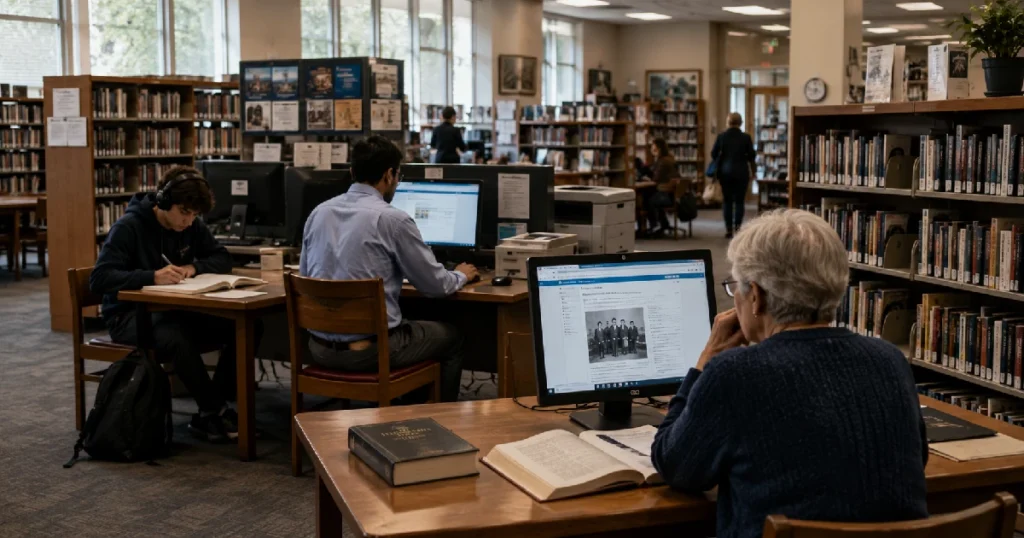
When you enter a public library on a Tuesday afternoon, something happens. An older woman slowly browsing a genealogy database, a man in a dress shirt filling out what appears to be a job application on one of the public terminals, a teenager plugged into headphones at a corner table, the faint smell of aging paper, and the fluorescent hum overhead. No one is bothering anyone. No one is being asked to purchase anything. The majority of people drive right by this area, which may be the last genuinely free area in American public life.
For many years, libraries have been seen as places to go if you’re a student or don’t have enough money for books. Even though that framing was once accurate, it has deteriorated over time. Today’s public libraries actually perform far more complex and, to be honest, far more impressive tasks. career guidance. help with tax preparation. services for notaries. referrals for mental health services. resume workshops. training in digital literacy for senior citizens. libraries of seeds. programs for lending tools. Toddler story time and adult GED preparation are located just down the hall. Valley Cottage Library is not an exception to the rule that local libraries enhance civic engagement, education, and culture. Thousands of communities around the nation use the same template.
The discrepancy between what libraries are and how they are discussed in public is difficult to ignore. The true purpose of a branch located in a rural county seat or a mid-sized suburb is rarely captured in political discussions regarding library funding. The topic of books and whether or not particular titles belong on shelves frequently comes up in conversation; these arguments may be valid, but they completely miss the bigger picture. For the fiction section, the man at the computer terminal is not present. He is printing a cover letter for a position in a warehouse. The woman who is going through genealogical records is not an academic. As a retired nurse, she is attempting to locate her grandfather’s immigration documents. The library is doing something both massive and silent at the same time.
The odd element here is trust. Every year, public libraries are ranked at or close to the top of trusted institutions by Gallup, the American Library Association, and Pew Research surveys. You trust the library in the same way that you trust a fair referee, but not in the same way that you trust a close friend: you think the library isn’t attempting to take advantage of you. That neutrality seems almost radical in a time when trust in government agencies, media outlets, and even hospitals has broken along partisan lines. Libraries are not politically affiliated. They don’t have a model for advertising. They don’t make money off of your focus. All they do is open the doors.
They weren’t given that trust. It was gradually constructed through perseverance. Over time, a neighborhood is trained to believe that at least one institution will be present without restrictions when a branch library opens at 9 a.m. on weekdays and never charges admission. Library usage increases when the economy declines and people lose their jobs. Families visit the children’s section when schools discontinue programs. Many libraries maintained 24-hour digital lending services and provided phone assistance to users navigating online government assistance portals during the early months of the pandemic when physical branches were closed. Although it is less noticeable than a headline, that type of institutional dependability builds up in the public’s awareness.
The data shows that libraries are also economic infrastructure, which is surprising to those who haven’t given it much thought. A library’s free internet terminals can make the difference between someone applying for a job and someone not applying at all in areas with uneven broadband access. A student finishing an online course, a small business owner filing taxes, or an immigrant using translation tools for a citizenship exam are all examples of digital access through a library. Libraries are frequently the first thing to be cut when municipal funds are tight, in part because the financial benefits of that type of access are not clearly visible in any budget line. The value is diffuse, but the cost is obvious.
It’s hard not to feel that libraries are one of the truly underappreciated pillars of civic life when you watch all of this happen: the career fairs held in meeting rooms, the bilingual story hours, the after-school coding clubs. They lack the political symbolism of schools and the architectural reverence of courthouses. Unlike universities, they don’t draw billionaire donors. They simply keep the doors open and the lights on, and they do so with an institutional patience that most public bodies have long since given up.
In a structural sense, all of this is load-bearing. When you remove it, things change but the collapse doesn’t happen right away. There is nowhere for the man with the cover letter to print. There’s nowhere quiet for the teenager wearing headphones to study. The database is inaccessible to the woman looking for her grandfather. little things. Manageable on an individual basis. Collectively, people’s ability to overcome challenging times begins to deteriorate in ways that are difficult to quantify and even more difficult to undo.
Squeezed between competing demands and infrastructure costs, it’s still unclear if local governments truly understand the value of funding a library system. Perhaps they do. Perhaps they simply don’t express it verbally, similar to how you don’t always recognize the foundations of a home you’ve lived in for a long time. In any case, the library maintains its hours. The doors remain unlocked. Everyone inside is getting exactly what they came for on any given Tuesday afternoon—no purchases are required.