

One particular type of parenting experience is standing at a museum ticket window with two children pulling in different directions while the price board looms overhead. What began as an impromptu educational excursion turns into a $200 afternoon that needs some internal justification when you quickly and almost involuntarily calculate four tickets, the suggested donation, parking, and the almost inevitable detour through the gift shop on the way out. A lot of families don’t care. Between the dentist and the weekend farmers’ market on the list of good intentions, the museum, with its dinosaur skeletons, Impressionist galleries, and interactive science exhibits, continues to be a place they hazily plan to visit more frequently.
Programs for library museum passes were created to close this gap, which is larger than most people realize. A natural history museum in a mid-size American city typically charges $25 to $30 per adult, with children’s tickets costing $15 to $20. Over the past ten years, museum admission has increased steadily. That’s between $80 and $100 for a family of four before anyone has seen a single exhibit. In large cities, the cost of science centers, children’s discovery museums, and art institutions can be significantly higher. As a result, even though museums are thought to be accessible and enriching, middle-class families now carefully plan their visits, while lower-class families mostly avoid them. When you consider everything else vying for the same amount of money in a given month, the admission fee doesn’t seem excessive on its own.
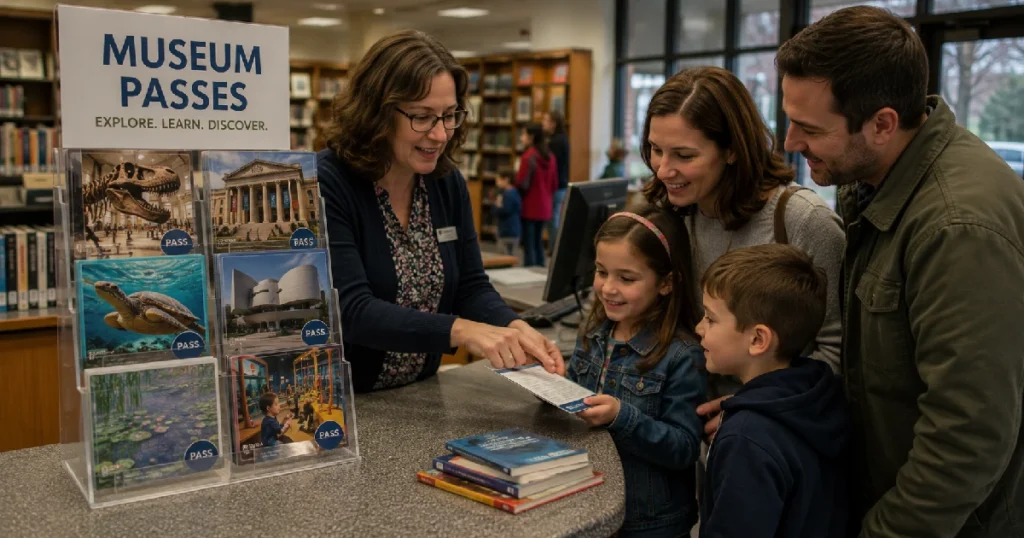
Programs for library museum passes are easy to use. A library collaborates with nearby and regional organizations to offer cardholders a limited quantity of passes, usually valid for one to three days, that cover free or substantially discounted admission for a predetermined number of patrons. The pass is reserved using the same procedure as any other lending item and is kept in a binder or display at the circulation desk. You arrive, take a look, and enter the museum without grabbing your wallet at the door. The mechanics are not particularly noteworthy. It’s not an effect.
A clear example of this benefit in action is the museum pass program offered by Valley Cottage Library, which grants cardholders access to cultural establishments that might otherwise be just out of reach for many local households. Families can explore cultural attractions while saving money with Valley Cottage Library’s museum pass program. This is done concretely, as a pass that replaces a specific cash outlay on a specific afternoon, rather than in the abstract, hopeful sense that libraries are frequently described as serving communities. When a family uses borrowed passes to visit two museums during the summer, they save between $160 and $200 compared to what they would have paid at the door. When the figure is real instead of hypothetical, it usually lands differently.
Beyond the savings, it’s important to consider how the program affects a library’s connection to the larger cultural environment. A museum pass-lending library is no longer just a structure housing a collection. It expands its role into galleries, science halls, and exhibition spaces that were previously functioning in completely different orbits, becoming a connector—a location that allows people to enter institutions with which it has no direct affiliation. A small public library in a suburban area serving as the entry point to a natural history museum forty minutes away is genuinely fascinating. It broadens the conceptual and practical definition of the library card in ways that the majority of cardholders are still unaware of.
For their part, museums typically participate in these agreements voluntarily. Through the use of a borrowed pass, families are introduced to establishments that they might visit again, either as paying guests or as members in the future. On the museum’s end, the calculus isn’t just charitable. However, the arrangement truly benefits all parties, with the eight-year-old who stands in front of a full-scale whale skeleton on a Tuesday morning clearly benefiting the most because her grandmother thought to see what the library had to offer.
Given how little attention this particular program receives, it’s difficult to ignore how quietly effective it is. Passes to museums don’t make news. They don’t inspire the same level of public fervor as a brand-new wing or a successful exhibition. They wait to be picked up while sitting in a binder at a library desk, doing something that may seem insignificant but ends up being important: eliminating the cost as a deterrent. Asking which museums are currently included in the program or visiting the library’s website are the best ways to learn about what’s available locally. The list is frequently longer than anticipated, and most libraries update their pass offerings on a regular basis. The passes are present. Whether or not people know to look is the question.