
One interpretation of literary history views the novel as a sophisticated form of entertainment, a container for narrative, character, and prose style that is read in private before being put back on the shelf. Then there is the real version, in which some novels so perfectly matched their time that they were burned by governments, prosecuted by courts, and seized from soldiers’ bags by generals. Critics’ favorite books weren’t always the ones that made it onto those lists. They were the ones who made statements that had previously been forbidden.
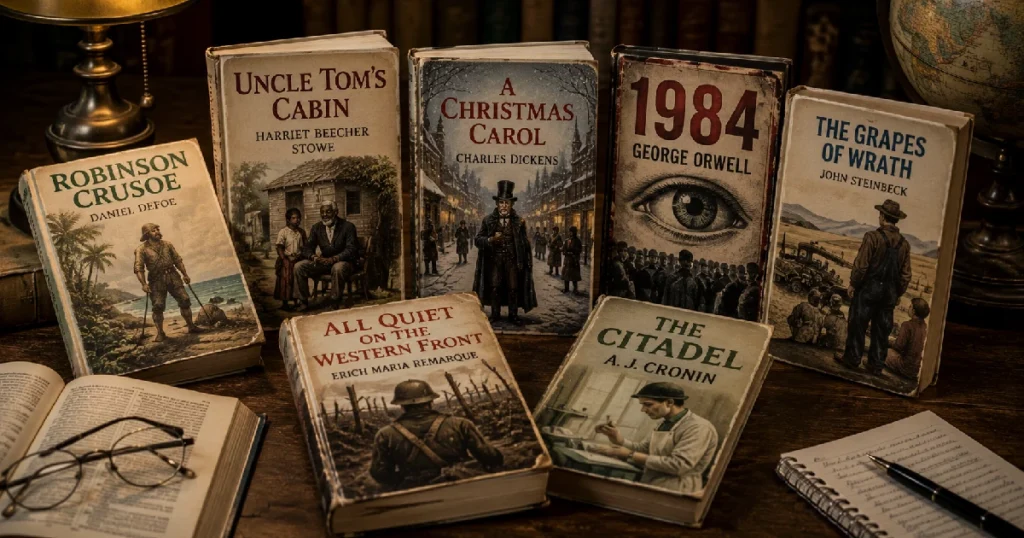
When Robinson Crusoe first appeared in 1719, it was a tale of survival and loneliness, but Daniel Defoe’s creation served as the model for a whole genre of literature. No book in the Western tradition had been printed in more versions or translated into more languages by the end of the nineteenth century. The novel had a seriousness that could not be explained by pure adventure because of the moral current that ran through it—Crusoe’s slow realization of his own presumptions about humanity and civilization. Defoe was presenting an argument without identifying it as such, which proved to be the most effective way for fiction to evoke strong emotions in readers.
In 1851, Harriet Beecher Stowe took a more direct approach with Uncle Tom’s Cabin. It brought the realities of American slavery into the homes of those who could afford to ignore it, making it the best-selling book of the nineteenth century. Although the book had flaws that subsequent generations have correctly pointed out—Stowe’s portrayals reflect the limitations of her time and distance—it had a significant and indisputable impact on public awareness, which helped to create the pressure that ultimately made abolition politically feasible. For a work of fiction, that is a huge accomplishment. Additionally, it’s the kind of result that was unpredictable when Stowe first started writing it.
Similar work was done in England by Charles Dickens, who wrote several novels during the Victorian era. Dickens’s entire project is encapsulated in a few lines in the scene from A Christmas Carol where the Ghost of Christmas Present pulls back his robe to reveal two miserable children, Ignorance and Want, and warns that the boy in particular should be feared. He was giving the people the wealthy classes had decided not to see faces and voices through fiction. Over the course of a career’s worth of novels, that work changed what Victorian society deemed acceptable to overlook.
Big Brother, doublethink, the memory hole, and the thought police are just a few of the ideas that have never returned to the English language thanks to George Orwell’s 1984, which was published in 1949 while Orwell was gravely ill on the Scottish island of Jura. The novel was set in a world that was already solidifying into two surveillance and control systems, four years after the conclusion of a war waged against precisely the kind of totalitarianism it portrayed. Orwell was naming something that already existed rather than forecasting the future, which may be why the book continues to have new significance whenever a powerful person decides that uncomfortable facts should be changed or eliminated. The vocabulary of 1984 comes to mind almost instantly when watching any news cycle in the twenty-first century.
It’s difficult to ignore how many of these novels initially encountered animosity from organizations that were aware of what they were doing. The Nazis outlawed and set fire to All Quiet on the Western Front prior to World War II because Remarque’s candid portrayal of soldiers devastated by battle struck the regime as precisely the kind of truth it needed to repress. Before a jury found Penguin Books not guilty in 1961, Lady Chatterley’s Lover was prosecuted for obscenity in Britain. The publisher dedicated the second edition of the book to the twelve jurors whose decision ultimately allowed the book to be published legally. People with a direct stake in the exploitation Steinbeck described publicly burned The Grapes of Wrath in California. Generally speaking, books that create that level of institutional fear are doing something right.
The work of A.J. Cronin The 1937 book The Citadel is not as well known as it should be. Since Cronin was a doctor at the time, the book exposed the corruption and inequity of British medical practice. Its case for a free public health service is widely acknowledged as having influenced the political environment that gave rise to the National Health Service ten years later. There is not enough discussion of the impact of fiction on the design of a national healthcare system.
From Defoe in the early eighteenth century to Solzhenitsyn’s One Day in the Life of Ivan Denisovich in 1962, all of these novels share the refusal to allow the powerful to define what is real. They immersed readers in experiences—such as slavery, poverty, war, totalitarianism, and persecution—that official narratives sought to keep hidden, and reading produced a kind of witness that was challenging to leave. The best of them continue to do so. If you pick up 1984, To Kill a Mockingbird, or The Grapes of Wrath today, they read more like descriptions of ongoing pressures than like historical accounts. That is the unique characteristic of a book that has earned the right to be referred to as a phenomenon: it continued to outlive its subsequent moments rather than capturing its moment.