

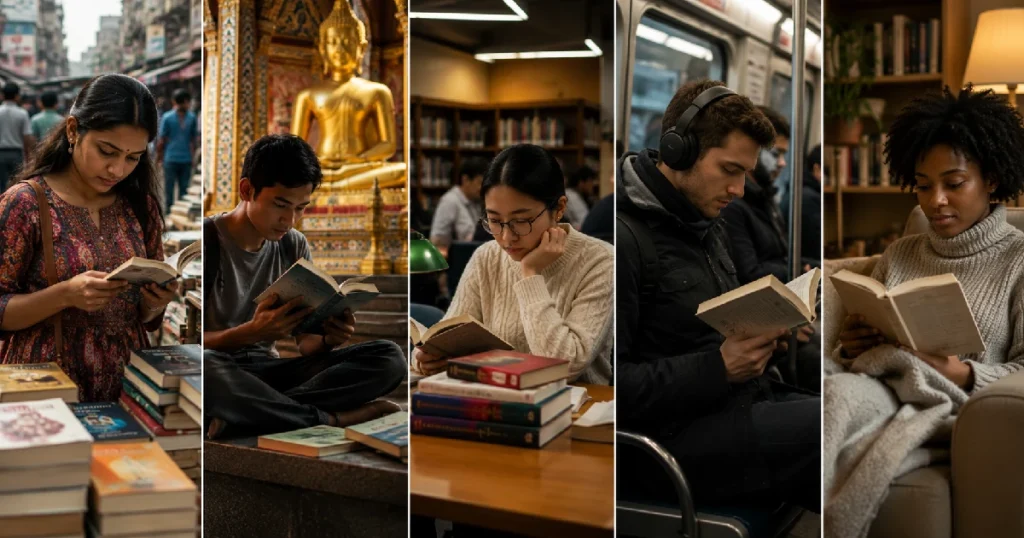
The numbers at the top of the list are not the ones that typically cause the most silent unease in discussions about reading habits around the world. It’s impressive, even remarkable, that India reads more than ten hours a week on average, but it doesn’t hurt. The fact that the United States is ranked 42nd on the global reading chart, behind Thailand, Egypt, and Hungary, with an average of just under six hours per week, is painful for anyone interested in American cultural self-perception. A nation that is home to some of the most renowned publishing houses and literary prizes worldwide, as well as one of the biggest book markets in the world, easily falls into the lower half of the global reading frequency range. It’s worth taking a moment to sit with that tension.
India’s ranking at the top of the list isn’t coincidental, and its population size isn’t the main factor. Thailand comes in second with nine hours and twenty-four minutes per week, while China comes in third with about eight hours. These countries’ rankings are due to institutional and cultural factors that go beyond demographics. The storytelling found in scripture, philosophy, regional literature in dozens of languages, and an academic tradition that views reading as a form of personal seriousness rather than leisure are all aspects of India’s reading culture that predate contemporary literacy campaigns and publishing industries. Indian readers have simultaneous access to both domestic and foreign publishing because the nation has one of the largest English-speaking populations worldwide. The variety of books available—across languages, genres, and price points—tells you something about a market that truly demands variety, whether you’re strolling through a bookstore in Bangalore or perusing a street vendor’s cart in Delhi.
People are often surprised by Thailand’s second-place ranking, and it probably shouldn’t be. Over the past 20 years, the nation has made consistent investments in literacy initiatives and public reading campaigns, and an increasing number of young people have embraced online reading platforms with genuine zeal. In Thai reading culture, manga and comics coexist with literary fiction without the hierarchy that occasionally divides them in Western markets. China, a nation where digital reading has not only complemented print but also produced a whole new genre of literature, is another country where the situation is different. Hundreds of millions of people use mobile reading apps in China, and web serials—stories that are published chapter by chapter straight to phones—have developed into their own publishing ecosystem, producing some of the most popular fiction in the nation in formats that hardly existed fifteen years ago.
The American number, which ranks 42nd on the list with five hours and forty-two minutes per week, is complicated by multiple factors at once. Although the United States produces a huge amount of books and purchases them in large quantities—the publishing industry there is truly enormous—buying and reading are two different activities, and the difference between the two may be greater in America than almost anywhere else. There is a cultural strand in American life that has always been somewhat conflicted about serious reading as a daily practice, and streaming services, social media, gaming, and the general competition for attention have carved out hours that might otherwise go to books. An identifiable American character is the person who hasn’t read a book since high school and can discuss it without feeling ashamed. It’s possible that a sizable segment of the populace views books as something they should read rather than something they actually do.
However, it’s important to recognize that something is changing. Both new titles and backlist books that had been quietly sitting in warehouses for years have seen real sales surges thanks to BookTok, the section of TikTok dedicated to book recommendations, reviews, and reading challenges. The social aspect of books, their community, and the unique pleasure of hearing someone discuss a book with the kind of zeal typically found on television have drawn young readers who might have completely drifted away from them back. For commuters and those who find it challenging to fit in lengthy reading sessions during hectic days, audiobooks have achieved something similar. Although it’s still unclear if these trends will significantly alter the reading hours data, the trend is at least intriguing.
The global ranking demonstrates that, although both are beneficial, reading culture is not solely a function of wealth or educational spending. Even though neither of them is one of the richest countries in Europe, the Czech Republic and Hungary are always near the top of reading lists. The fact that Egypt is on the high-reading list makes me wonder about the ideas that link heavy reading with material comfort. These nations appear to have a similar attitude toward books, viewing them as an integral part of daily life rather than something that should only be pursued by those with the time and desire. Over the course of a week, reading habits such as reading on a commute, reading before bed, and reading an hour before the household wakes up all add up to the kinds of totals that appear in the data.
The infrastructure for all of that is available in the United States. By international standards, the majority of American cities and towns still have well-funded libraries. After years of anticipated decline, physical bookstores have demonstrated true resilience. Both the content and the access are present. The habit itself, the inclination to reach for a book instead of a phone during downtime, is more difficult to create. The reading league table appears to be measuring that reflex wherever it exists.