

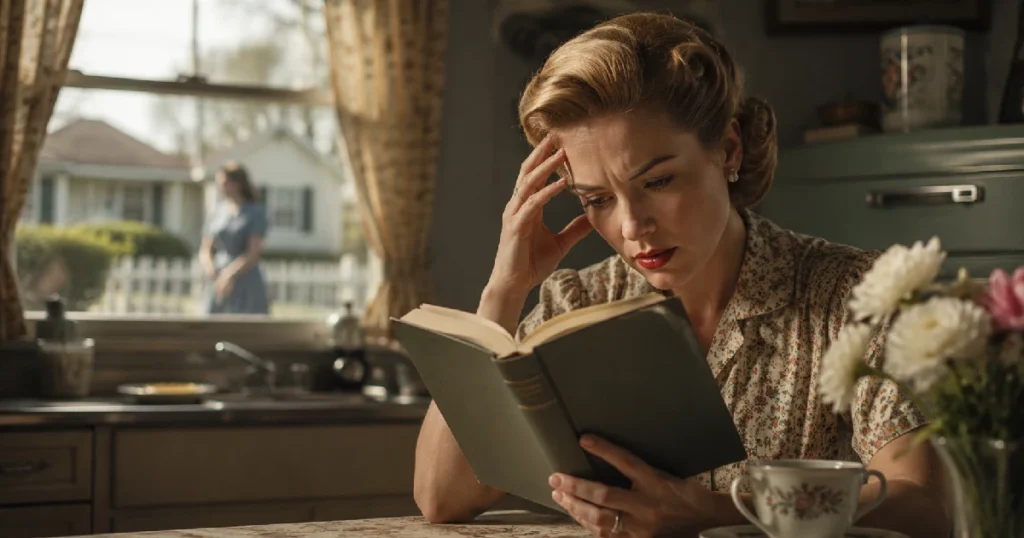
Good fiction creates a certain kind of discomfort that prevents you from putting down a book. As might be expected for a book about women whose voices were routinely disregarded, Meagan Church’s The Mad Wife has been subtly and quietly doing just that to readers.
The story takes place in a 1950s suburb that appears to be pleasant from the outside, with well-kept lawns, casseroles cooling on counters, and neighbors waving from driveways. Lulu Mayfield resides within that image. She is a housewife dealing with postpartum depression in a time when the term was unheard of, postpartum depression was not widely acknowledged, and women who appeared to be too upset, inconvenient, or challenging to handle were treated in very particular ways. Lulu is convinced that something sinister is going on in the house across the street when a new neighbor moves in. It almost doesn’t matter if she is correct or incorrect.
The horror in this book doesn’t originate from anything sudden or supernatural, which is what Church does well and what seems to be irritating readers. It originates from the process. from the cool, collected reasoning of a society that had determined that women’s suffering was a management issue. A gradual sense of dread that persists long after the reading is finished is created by watching that develop on the page in minute details and everyday moments.
The topic of postpartum depression in fiction is not new. However, because of the 1950s setting, Church is able to eliminate the contemporary language and support networks that readers might naturally turn to, leaving Lulu and the reader with nothing to cling to. It doesn’t dramatize or exaggerate the medical gaslighting she experiences. It lands so hard because it is presented in an almost matter-of-fact manner. Church seemed to realize that describing what was typical was the most unsettling thing she could do.
The novel comes at an intriguing cultural moment for American fiction, which is worth mentioning. For many years, literary circles and critics have debated what constitutes a book deserving of serious consideration, including who gets to write it, whose stories are universal, and whose discomfort is significant enough to be published in hardcover. The entire idea of “the great American novel” was subtly coded, shaped by presumptions about whose voice carries authority, as Ursula K. Le Guin once pointed out. The Mad Wife doesn’t present itself as a major work of literature. It is more cautious than that. However, it accomplishes something that lofty declarations frequently fall short of: it makes the reader feel the weight of another person’s reality.
The Mad Wife’s potential audience is still unknown, as is the likelihood that it will become the kind of popular discourse that its themes merit. These kinds of books occasionally find their readers gradually, being passed from person to person who want to give it to someone else and tell them to read it. That’s a different kind of success—quieter but no less significant.
It is not by accident that the novel causes discomfort. Church appears to have realized that it should be uncomfortable to read a story about being ignored, silenced, and not trusted. That is not a weakness. That’s the whole idea.