

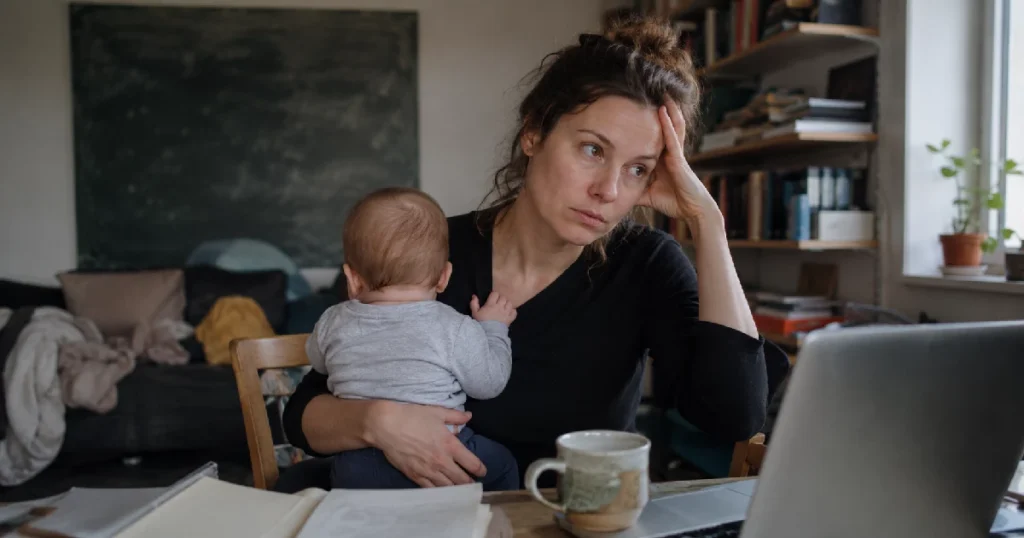
The fact that Rachel Cusk’s A Life’s Work—possibly one of the most brutally honest descriptions of early motherhood ever written—was greeted with anger rather than appreciation upon its publication is telling. The backlash was swift and, perhaps most remarkably, came mostly from other women. Even after twenty years, reading about it still gives me a slight, uneasy shiver.
Cusk was charged with selfishness, pretentiousness, postpartum depression, child-hatred, and—possibly most notably—being “too intellectual” about motherhood. The charge speaks for itself. There is a deeply ingrained, seldom-examined belief that motherhood is solely instinctual and that to look at it critically would be to betray it in some way. And yet Cusk accomplished just that, writing with the kind of accuracy and humor that would have won praise right away if it had been directed at nearly any other topic.
The mother-writer and the literary world have long had a complex relationship. Virginia Woolf made the well-known claim that for a woman to write, she needs both money and a room of her own. That still seems to be the case. There are tales of writers crouched in restroom stalls, leaning against the door as tiny fists pound from the other side, and of novels completed in parked cars. The picture is practically humorous. It is also entirely genuine.
The dishonest version, the sentimental, gauzy, Instagram-ready version, has never been in short supply, which makes the suppression of honest motherhood writing all the more peculiar. Glowing maternal memoirs and gentle parenting manuals have always had a strong market. The other type of writing, which acknowledges weariness, ambivalence, and the silent sorrow of a lost self, has a tendency to stall at the acquisition stage. It appears that publishers have been just as anxious as readers.
Decades ago, Adrienne Rich recognized this. Her portrayal of the ambivalence of motherhood in Of Woman Born, which alternates between tenderness and resentment, between raw nerves and true bliss, is still startlingly direct. She implied that no parenting manual could match the power of honest writing. She was correct, too. Advice is not what comforts a struggling mother. It’s acknowledgment.
Why the literary world takes so long to catch up to what mothers have always known in private is still a mystery. It might be partially due to commercial caution. A market that also purchases a lot of aspirational lifestyle content could become hostile to a book that challenges the myth of maternal joy. Publishers seem to have been weighing the dangers of being dishonest for a long time. Because of this, a lot of the most accurate books about motherhood have either been released quietly, late, or not at all.
Having no children of her own, Simone de Beauvoir saw firsthand how the institution of motherhood, as opposed to motherhood itself, could sap women’s creativity and independence. That distinction is important. It’s one thing to love a child. Another is the social structure based on that love, which calls for silence and self-erasure. There has always been a cost for writers who have refused to remain silent.
The tolerance for complexity is currently changing, albeit slowly. The variety of motherhood writing has increased, as has the willingness to accept contradiction without finding a solution. That is most likely Cusk’s enduring contribution—not because she was the first to speak the truth, but rather because she did so with enough intelligence and accuracy that it was hard to ignore. It’s not a mystery how long it takes for an honest book to find its publisher, its readers, or just its cultural moment. It’s simply the gap between what women experience and what the public is ready to hear.