

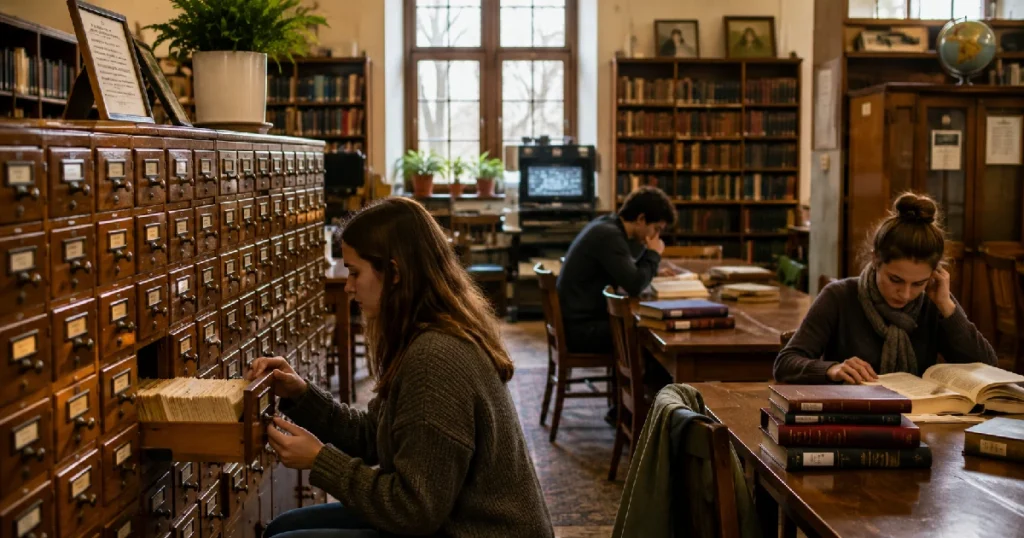
Before everything went online, there was a certain silence in a public library. The walls near the entrance of most branches were lined with wooden card catalog drawers, each with a slightly worn handle. There was a good chance you would find something you weren’t aware you were looking for when you pulled one open and rifled through the little rectangular cards arranged by author, title, and subject. It was ineffective. However, it possessed a quality that is now difficult to identify.
Reading required dedication prior to the internet in a way that seems almost unfamiliar now. Entering a phrase into a search bar was not the only way to find information. In order to find the correct date, you had to navigate those catalog drawers or sit in front of a massive microfilm projector and scroll through old newspapers while the film clicked and jumped. The family encyclopedia, a multi-volume collection of Encyclopaedia Britannica or World Book arranged alphabetically and already a few years out of date when it arrived, was your go-to resource if you needed to look up information for a school report. Everyone was aware of that. No one brought it up.
Finding a particular book was a separate task. You submitted a request and waited if your local branch lacked a title. A used bookstore might use a trade network, which is a slow-moving system of phone calls and paper ads, to inquire about a book that was out of print. You might have to wait weeks or even longer. Both tracking and an estimated delivery window were absent. Eventually, the book either appeared or it didn’t. People endured this with a level of tolerance that is genuinely difficult to comprehend today.
In addition to the content being read, the reading experience itself was unique. There was no specific reason to put down a book at any time without notifications. Paperbacks were carried by people into parks, buses, and waiting areas. The actual book was just one item you brought with you when you left the house, similar to how you would bring a jacket or keys. Since reading wasn’t competing with anything at the time, it’s possible that this influenced concentration in ways we don’t fully understand now. Staring out a window was the only option.
Taking notes while reading necessitated writing. A notebook and pen were necessary for research, or a typewriter if you were taking your work seriously. There was no such thing as copy-and-paste. If a passage was important, you copied it out by hand, which likely helped you remember it better. However, there is an equally alluring and draining aspect to that concept.
Additionally, discovery operated in a different way. No algorithms were used to display titles based on past purchases. You discovered books by word of mouth, by aimlessly perusing shelves, or by a title that drew your attention while you were searching for something else. A recommendation from a librarian was very important. So did a magazine review or a friend’s tattered copy that was thrust into your hands and told you to read it right away. Instead of being engineered out of the system, serendipity was built into it.
All of this would be too simple to romanticize. Additionally, the pre-internet reading world was slower in ways that weren’t always endearing: information was more difficult to confirm, rare books remained rare, access was uneven, and it frequently depended on where you lived and what your local library could afford to stock. You shouldn’t ignore any of that.
Looking back, though, there’s a sense that reading took up a different kind of mental space before it became instantaneous. Going somewhere, looking for something, and waiting for results all required some physical movement. It probably depends on who you ask whether that friction created something useful or just made things more difficult than they needed to be. Even now, it’s still not totally clear.