

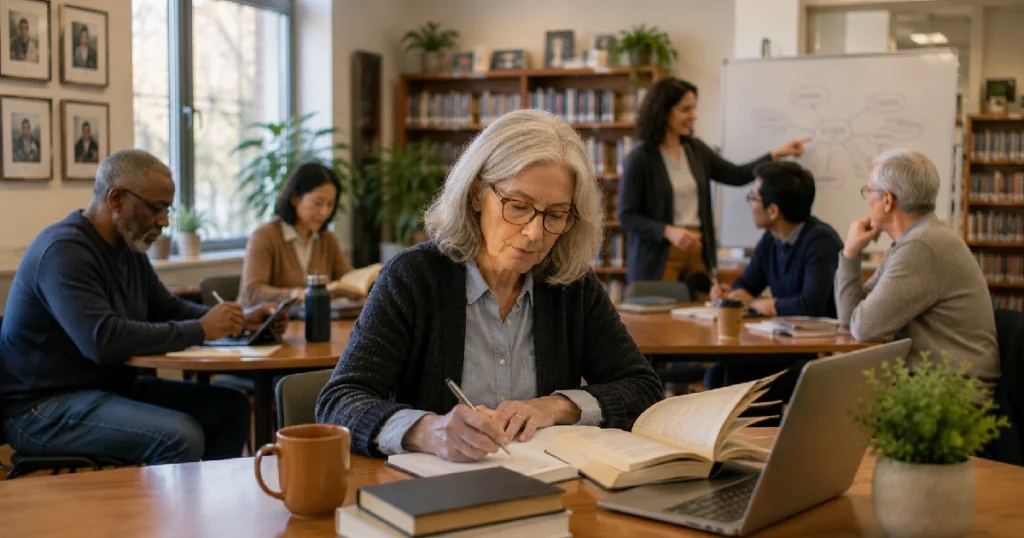
After some time, you start to notice a certain kind of person. They are the ones who enroll in a pottery class at sixty-two because they have never done it before, not because they hope to be skilled. On a Tuesday night, they are reading something complex that has nothing to do with their work. In circumstances where most people have already mentally moved on, they pose follow-up questions. They’re not always the most qualified individuals in the room. However, a certain aspect of their interaction with things—a lightness about ignorance—tends to stick out.
Although they may appear that way from the outside, lifelong learners are not precisely a personality type. More precisely, over time, they have formed habits that compound in a particular way. For starters, curiosity—but not the passive kind. The kind that takes someone from a casual interest to an online course or from a podcast to a collection of books at the library on the same subject is known as the active kind. the tendency to stick with a thread instead of letting it go. The majority of people occasionally experience this impulse. It appears that lifelong learners have built their lives around not ignoring it.
How they deal with ignorance is one of their more intriguing characteristics. Many people feel that knowledge gaps should be quickly covered up or hidden. Lack of knowledge typically registers differently for consistent learners, more as a beginning than a liability. This could be the result of being a novice numerous times in various situations. Every time you pick up a new skill from scratch, you gather proof that the initial confusion is temporary. That probably makes the initial discomfort less bothersome to you.
In actuality, this is frequently rather unremarkable. A retired educator attends a community history class on Saturday mornings. An accountant uses language-learning apps during his lunch break because he has always wanted to learn Portuguese, not because he has any travel plans. A fifty-year-old woman attended a local writing workshop and, despite feeling completely unprepared for the first three sessions, persisted. None of these appear to be significant changes. These are merely minor, frequent decisions to continue moving toward learning rather than away from it. Through adult programming that provides a genuine, regular outlet for the habit, Valley Cottage Library’s programs and resources support the development of a mindset of continuous learning.
Even though they are more difficult to measure than a certification or a skill, the psychological advantages are worth considering. Because they are accustomed to adjusting to new information, people who are lifelong learners typically adjust to change more easily. In a way, change is just another learning curve. That is not insignificant, particularly over the course of a lifetime or a career. According to research in this field, maintaining mental engagement over decades—whether through reading, structured classes, community learning, or even challenging hobbies—is linked to improved cognitive resilience. The direction of the evidence is consistent, though it’s still unclear how much of this is caused by correlation.
Additionally, there is something that develops over time that is difficult to explain without coming across as ambiguous. Field-to-field connections begin to build up. A person who has studied economics, psychology, and history for years begins to see trends that a specialist in one field might overlook. It’s not that they are more knowledgeable about any one subject; rather, the architecture of their knowledge is more expansive, and new information tends to land in more places. These are compounds. It does so slowly.
It’s difficult not to have some respect for those who continue to make this decision year after year without any specific incentive from outside sources. In a time when proficiency and efficiency are the only things that are rewarded, the student who is uncomfortable in the first week of a new class but still shows up for the second is doing something truly countercultural. They are purposefully remaining inquisitive. And that turns out to be very important over decades.