

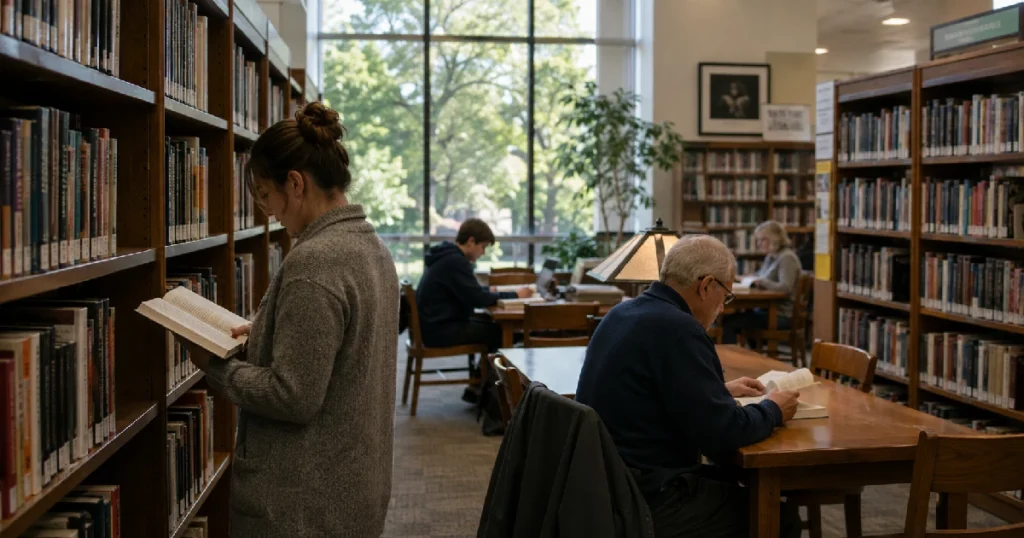
You take a book from the shelf. Twenty minutes later, no advertisement is sent to you. You do some research. No algorithm modifies its representation of you. Most people don’t realize how strange and uncommon that experience has become.
Any time you spend on the internet, you’re creating a legacy that twenty years ago would have seemed unreal. Search engines record queries and link them to locations, devices, and patterns of behavior. In addition to remembering what you watched, streaming services also track how long you watched, when you paused, and what you skipped. Social media creates psychological profiles that are sufficiently detailed to predict preferences you haven’t yet developed consciously. Most of it is invisible. And for the majority of people, it has become background noise, the cost of utilizing otherwise free and genuinely helpful digital services.
Libraries operate in a way that is almost unyielding. The majority of public libraries in the US are either institutionally committed to not keeping records of what their patrons borrow, or they are legally prohibited from doing so. For many years, the American Library Association has upheld patron privacy as a fundamental professional value, and numerous states have enacted legislation that supports this view. The record of you ever borrowing a book is usually erased when you return it. A library does not have a “watch history.” Like many public institutions of its kind, Valley Cottage Library promotes intellectual freedom and privacy in ways that set it apart from many commercial platforms. This is not done as a marketing gimmick, but rather as a policy that directs the institution’s actual operations.
This is not a coincidence. Librarians have long recognized the intimate nature of what people choose to read. It can disclose personal struggles, political convictions, medical concerns, and religious doubts. In a way, a borrowing record is a map of a person’s inner life. Federal agencies attempted in a number of ways to obtain library records in order to track citizens’ reading habits during the 1950s and 1970s. Sometimes at their own peril, librarians resisted. It’s not a very old history. It influenced the profession’s culture.
Think about the type of person who subtly appreciates this. The middle-aged man is investigating a medical diagnosis that he hasn’t yet disclosed to his family and isn’t prepared to have that search recorded anywhere it might appear in an insurance profile. There’s the adolescent investigating identity issues who doesn’t want their name to be permanently linked to those searches by an algorithm. There is the retiree who instinctively believes that what she reads is personal to her. There is nothing wrong with any of these individuals. They simply want to think in private, which was once taken for granted but now needs special protection.
It’s possible that most people enter libraries without giving this much thought. Practical features like free books, a peaceful area, and quick Wi-Fi make it appealing. However, even if it is not investigated, there is something else going on beneath that. The library seems to be one of the few remaining public places where transactions are truly straightforward: you take something, you return it, and the organization doesn’t profit from knowing everything about you in between.
That seems less and less common. Additionally, it may be worth more than people realize.
Libraries were never intended to serve as symbols. They were intended to provide information to the public. However, in a time when information access is nearly always accompanied by surveillance, the library’s traditional dedication to keeping to itself has subtly gained attention. It’s difficult not to notice that a busy reading room is one of the few settings where trust is still the default.