
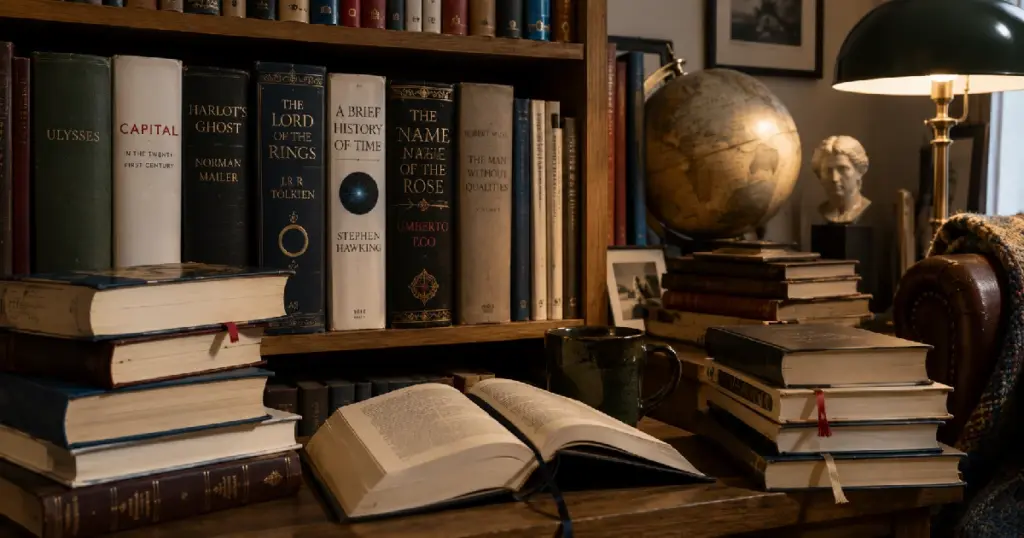
You can find them in practically any house with a bookshelf. The ones that are actually read are not the dog-eared paperbacks with cracked spines and scrawled margins. Instead, focus on the immaculate, thick, upright volumes with dust lightly accumulating on the upper edges. The pages of a copy of Ulysses were still slightly stiff. A bookmark appears on page 30 of Thomas Piketty’s Capital in the Twenty-First Century. All 1,310 pages of Norman Mailer’s Harlot’s Ghost were never opened beyond the first chapter. The trophies of intention are these. The great unread.
The phenomenon is old enough to have a literature of its own. In 2005, Robert Fulford wrote about it in the National Post, pointing out that after Boris Pasternak won the Nobel Prize and Soviet authorities prevented him from accepting it, Dr. Zhivago became the defining example. Fortunes worth of copies were printed by publishers in twelve different countries. Thousands of readers purchased them. Then, as Fulford pointed out dryly, only reviewers appeared to have read it, even though many said it was the next item on their list. That list may be the shortest it has ever been. Fictional blockbusters are purchased like furniture. It retains its value when unread. It appears that money was squandered. Anthony Burgess Former Warner Books president Howard Kaminsky put it plainly. There is one great unread bestseller every year, he claimed, a book so obviously prestigious that millions of people want to own it without really intending to read it. On precisely that basis, he paid half a million dollars for the paperback rights to Umberto Eco’s The Name of the Rose. He couldn’t imagine it being read by anyone. He was certain they would purchase it anyhow. He was correct. Even though that reasoning raises unsettling issues regarding the connection between literary culture and consumer behavior, there is something almost admirably clear-eyed about it.
This is partly due to the fact that some books serve more as social objects than as reading experiences. A carefully selected shelf conveys taste, education, and intellectual aspirations. Whether or not its owner made it past chapter three, Hawking’s A Brief History of Time on the coffee table suggests a mind interested in the nature of the cosmos. No one is using the book. It’s on display. Anthony Burgess, who noted that blockbuster fiction is purchased like furniture and retains its value when unread, had a perfect understanding of this. It begins to appear as though money was squandered, which is both a darkly humorous and likely accurate observation.
Everything is made worse by the expectations issue. Many well-known novels gain notoriety unrelated to their true reading experiences. Somewhere around the lengthy poetry of Tom Bombadil, a pace that modern attention spans were not quite designed for, a reader picks up The Lord of the Rings ready for epic adventure and encounters. Harold Bloom accused technology of undermining the sustained focus required for long-form reading, referring to it as the “triple screen” of computers, television, and movies. It’s still unclear if people’s attention spans were shortened by the screens or if they simply wanted faster stories and the screens allowed them to admit it.
Julius Deutschbauer, a librarian and artist in Vienna, transformed the entire phenomenon into a permanent touring exhibition. He dubbed it the Library of Unread Books and filled it with donated books that had one thing in common: their previous owners had always intended to read them but had never quite succeeded. The curatorial decision to arrange the books alphabetically beneath the names of those who did not read them is subtly devastating. Robert Musil’s Man Without Qualities was donated by poet H.C. Artmann. A copy of Artmann’s collected prose was donated by a psychoanalyst. It turns out that everyone has a Musil gathering dust somewhere; the symmetry is almost too tidy.
Additionally, social media has significantly exacerbated the issue of reading as a marathon. Goodreads goals, yearly book counts, and reading challenges all transform an intrinsically private pastime into a sort of public performance. Starting a lengthy or challenging book begins to feel like a liability when finishing it becomes a data point. The math changes: instead of devoting three weeks to A Game of Thrones, you could add three smaller books to the total for the year. As a result, sometimes the books that are most worthwhile are the ones that are least likely to be picked up.
All of this is intertwined with guilt. In an article for Maclean’s, Paul Wells described himself as a serial book-unfinisher who carried what he called a “dark burden”—the sense that he had let down authors who had dedicated their lives to their work and abandoned characters who had entered his life. Fiction carries an odd moral burden, but it’s also remarkably prevalent. The bookmark, the tangible documentation of an unfulfilled intention, is both an accusation and a promise. It would be necessary to acknowledge something that most readers aren’t prepared to acknowledge in order to completely clear the shelf.
Sometimes the book is actually to blame, which is more difficult to say but maybe worth mentioning. In the Harvard Crimson, Theodore Gioia made the unpopular observation that critics seldom look at the aspects of the work itself that could turn off readers, such as the lengthy world-building, the slow middles, and the dense prose that rewards patience but provides little incentive to develop it. Almost invariably, the discussion shifts to blaming the reader for their lack of discipline, shorter attention spans, and excessive distractions. It’s possible that the well-known unfinished novels were occasionally praised for reasons unrelated to their enjoyment.
Oliver Wendell Holmes was known for finishing every book he began, viewing abandonment as a social transgression akin to leaving a lecture. Now, that ethic seems almost charming. Robert Fulford’s own admission that he keeps eight or nine books partially read at any given time, some of which will stay that way forever, may serve as a more helpful model. He has been working on his copy of Gibbon’s Decline and Fall of the Roman Empire for decades; it has been read in bits and pieces, never completed, and never anticipated. It doesn’t seem to bother him. The idea of a book as a place to return to, unfinished and unhurried, whenever the mood strikes, rather than as a task to be completed, is hard not to find something appealing in that.
