
One type of reader maintains a mental list of books they haven’t finished. They felt genuinely horrified by something in the pages, and they silently concluded that life was too short for that, not because the prose was poor or the plot fell apart. It makes sense as an instinct. Additionally, it’s usually the incorrect one.
Uncomfortable fiction typically accomplishes something significant. Until you sit with it, that statement seems like a platitude. In actuality, it means that if a story makes you want to put it down, it has probably touched a real nerve, a blind spot, or a belief you were unaware you had. There’s nothing wrong with that friction. It’s almost the entire point.
In his essay on the value of storytelling, Neil Gaiman makes the case that fiction employs the “lie” of a story to reveal a more profound human truth, which is by definition uncomfortable. Every significant literary work that has been debated, from Dostoevsky to Toni Morrison to Cormac McCarthy, may have caused someone to put it down out of frustration or distress. And if they had continued, those same readers might have said that those books were the ones that transformed them.When a story makes you want to put it down, it has probably touched on something genuine, such as a blind spot or a belief you were unaware you had.
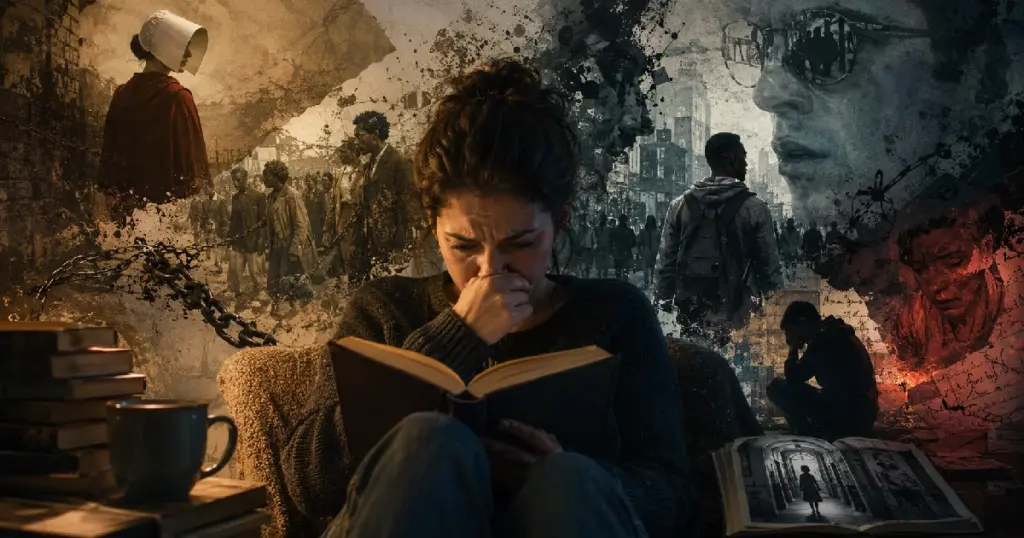
Think about Margaret Atwood’s actions in The Handmaid’s Tale. Instead of writing horror for its own sake, authors should create a recognizable world that is based on historical precedents rather than original ideas and compel readers to sit inside it. Readers’ discomfort isn’t a coincidental part of the novel’s experience. It’s the encounter. Atwood had no intention of entertaining in the traditional sense. She was attempting to give something that people tended to write off as impossible a sense of possibility. Compared to comfort, that is a more difficult and significant task.
In Between the World and Me, Ta-Nehisi Coates took a similar approach. The book is written as a letter to Coates’s son, and it reads as such: it is straightforward, direct, and unconcerned with softening its main point for white readers who might find it challenging. People have said that after reading it, they felt defensive and wanted to criticize the text. It’s important to note that this defensiveness is information. It pinpoints the precise point at which your comprehension and discomfort diverge. The reading is doing its most important work right at that border.
In today’s culture, there’s a feeling that comfort is the standard; art should, at the very least, be enjoyable and uplifting. This premise informs the design of streaming algorithms. You get more of what you already like from recommendation engines. It’s important to consider what we lose when every system in our environment is designed to be as simple as possible. For starters, atrophied difficulty tolerance. For another, a narrowing sense of what is conceivable.
Few authors have a deeper understanding of this than Toni Morrison. It truly hurts to read the book Beloved. It ought to. Morrison never once gives the reader a comfortable distance from the historical horror of slavery through the prism of one woman’s impossible decision. The discomfort is intentional and calibrated; it is essential rather than optional. To read it comfortably would be to misread it. The truth is the challenge.
There is more to the argument for uncomfortable fiction than just aesthetics. It is both pragmatic and moral. Stories that force us to inhabit unfamiliar perspectives — lives shaped by poverty, violence, discrimination, or moral complexity we’d rather not examine — build something that neutral exposure to facts and statistics rarely does. They build actual empathy, the kind that lives in the body and changes behavior. Chimamanda Ngozi Adichie’s Americanah has turned more people into more careful observers of race and privilege than a hundred academic papers on the same subject. Not because it’s more rigorous, but because it’s more human.
“To read Morrison comfortably would be to misread her. The difficulty is the truth.”
Lolita remains one of the most unsettling books in the Western canon, and it remains important for exactly that reason. Nabokov’s prose is seductive almost in spite of itself — it draws you into the worldview of a man doing something monstrous, and it makes you aware, uncomfortably, of how easily language can be used to aestheticize harm. Reading it makes you a more suspicious reader. It makes you slower to be charmed by beautiful sentences at the expense of what those sentences are actually saying. That’s not a small lesson.
It’s still unclear whether most readers who avoid difficult fiction do so from a considered position or simply from habit — the accumulated force of algorithms and social circles and comfortable shelves. What seems fairly evident is that the books most likely to be described as life-changing are also the books most likely to have been, at some point, genuinely hard to read. A Little Life, The Kite Runner, Beloved, Americanah — none of these are pleasant experiences in the conventional sense. All of them leave their readers changed in ways that a pleasant experience rarely does.
The discomfort, in the end, is not incidental. It is the work. A story that never challenges you has confirmed only what you already believed. A story that makes you squirm has introduced you to something true that you didn’t know before — or didn’t want to. That is, quietly and stubbornly, what fiction at its best has always been for.