
Book sales in some categories experienced an unexpected development during the early weeks of the COVID-19 pandemic, when the majority of people were confined to their apartments and receiving news alerts every few minutes. Fiction about crime. novels set after the end of the world. Stories about moral collapse, grief, and survival. They didn’t fall. They ascended. Publishers took notice. The writers took note. I don’t know why, but I keep reaching for the darkest thing on my shelf. This is what anyone who pays attention to online reading communities saw being repeated in slightly different ways.
It seems illogical. A cozy mystery, a romance with a certain happy ending, or a comforting reread from childhood could be the first thing that comes to mind when things get dark. And many readers do just that. However, a sizable portion go in the opposite direction, and they do so on purpose—not because of their emotions, but rather because of them. Understanding why necessitates taking seriously something that is simple to write off as bizarre: the idea that, in certain situations, a book full of sorrow and despair can serve as true solace.
Emotional validation is the most obvious explanation, and it’s easier than it seems. A happy, well-resolved story can feel actively alienating when life is truly challenging—when the anxiety, losses, and uncertainty are real and extend beyond what is comfortable. The joy seems undeserved. The conclusion seems phony. When you are sitting in the knowledge that things don’t always work out and that the authors of those books are also aware of this, there is a particular unease when you read a book that claims everything works out. That’s not what dark fiction promises. For a reader who is truly burdened, that company is not depressing because it sits with the difficulty rather than hurrying past it. I’m relieved. It says, “Yes, this is difficult, and you have every right to feel that way.”
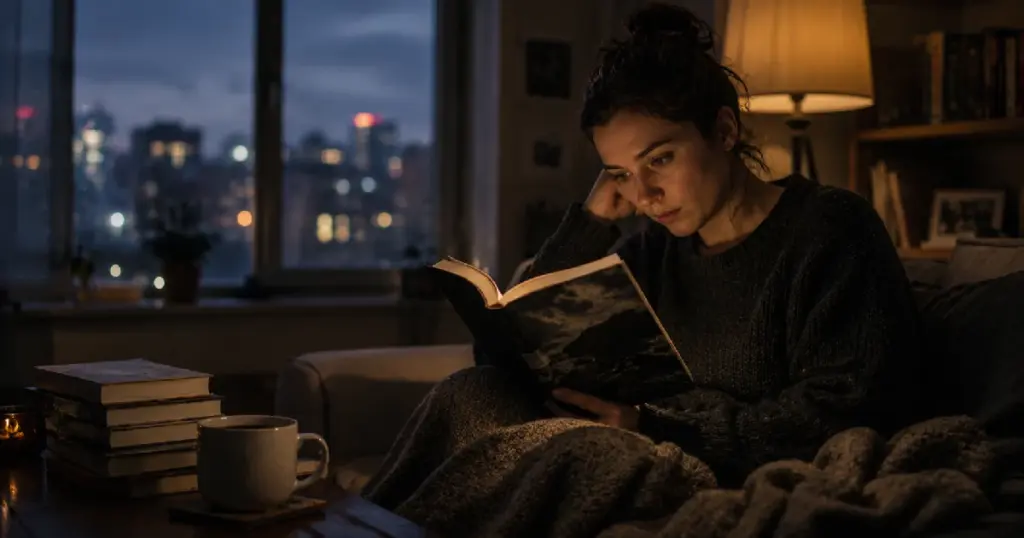
The emotional release that results from experiencing strong emotions in a situation where the stakes are lowered is referred to by psychologists as catharsis. Grief over a fictional character is genuine grief that is handled in a secure manner. Tears shed over the last chapters of The Road or the last pages of A Little Life activate the same brain systems as grief over actual events, so they are not fake tears. However, they have one important distinction: you can close the book. The emotional content is processed without the tangible repercussions that make dealing with actual losses so challenging. This explains why, ironically, readers report feeling lighter after finishing a heartbreaking book. The catharsis is genuine. The restoration is genuine. The mechanism, not the barrier, was the darkness.
Additionally, there is what could be referred to as the “vaccine effect,” which is the theory that exposure to fictionalized depictions of fear and despair causes the mind to become somewhat accustomed to those feelings. One characteristic of generalized anxiety is that it lacks a face, making it difficult to identify and confront. Anxiety becomes tangible enough to study in a novel that gives it a form, such as a plague, a war, or an irreversible loss. By practicing the emotional experience in a safe setting, the reader’s brain develops resilience without actually experiencing the disaster. This may be part of the reason why post-apocalyptic fiction is always in high demand during times of societal stress; the genre gives fears that would otherwise only linger in the background a readable form, and identifying a fear is always the first step toward overcoming it.
There is another aspect of historical continuity that is more difficult to classify. Dickens was unapologetically specific in his depiction of poverty in Victorian England. Tolstoy documented the psychological devastation of young men enmeshed in Napoleon’s conflicts. Every dark era in human history was chronicled by writers of dark fiction, which is still read today. This perseverance conveys a crucial message: this has previously occurred. In the past, people have experienced fear, confusion, uncertainty, and overwhelm under various names in various languages and historical periods. And they managed to get through. The books endure as proof that people persevere and that the experience of hardship is worth documenting because others will identify it as their own. This is not to say that everything works out.
It’s difficult to ignore how a well-written dark novel can meet a reader exactly where they are, providing companionship in the struggle and proof that it is manageable rather than false solace. That’s what readers are discovering when they reach for the most depressing item on their shelf in their darkest moments. not a way out of their emotions. A method of experiencing it that doesn’t require total isolation.