
The typical evening vanishes somewhere between the second autoplay video and the third notification. You didn’t intend to use your phone for ninety minutes. No one ever does. However, the majority of the time, the apps are successful in making intention seem insignificant. This is one of the reasons it seems a little strange to see someone carrying a real book—pages, no screen, no earbuds—on a train or in a café. Almost noticeable. As if they have knowledge that the others in the carriage do not.
It’s difficult to ignore how bizarre that has become. Silent reading, which was once thought to be the most commonplace private activity, now has a subtle air of deliberateness. of opposition, even.
The vast, humming apparatus of apps and algorithms known as the “attention economy,” which is predicated on the idea that your focus is the product, didn’t come with a warning. It came as a convenience. An improved means of remaining informed, amused, and connected. In many respects, it fulfilled that promise, making the world faster, noisier, and more stimulating than any previous generation had to deal with. Because the money has been paid gradually in tiny amounts that are too small to notice on a single day, the cost has been more difficult to see. shorter attention spans. Essays that are lengthy seem tedious. On bedside tables, unfinished novels accumulate something between dust and guilt.
In feeds, threads, captions, and subtitles, we are consuming more words than ever before, but we are comprehending fewer of them. This distinction is more important than it might seem.
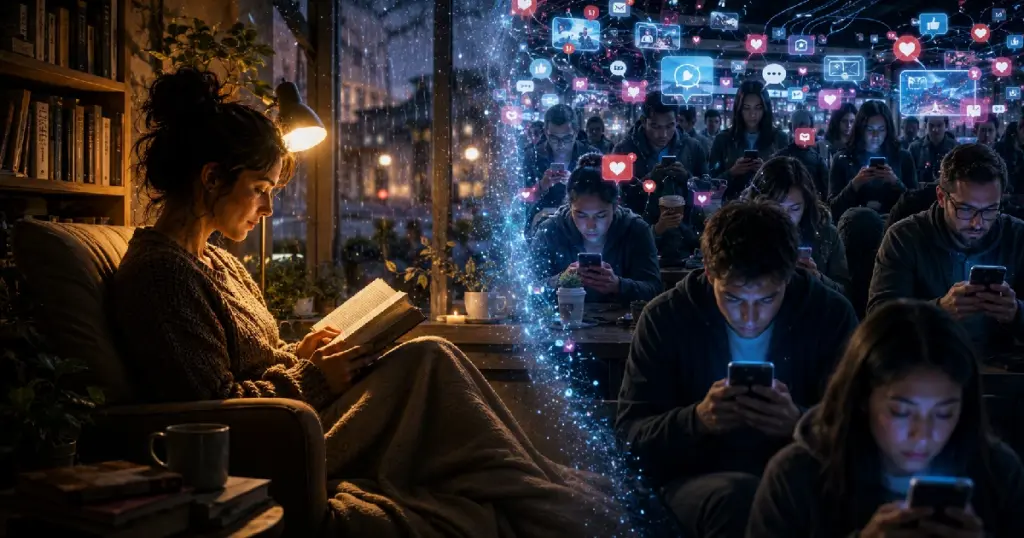
Reading and processing are two different things. You can get a sense of an event’s shape by skimming a news thread. When you read a lengthy piece of journalism or a chapter of a serious novel, you have to keep an argument in your mind over time, follow its evolution, and identify any contradictions or surprises. These experiences are not passive. They make a demand, and doomscrolling teaches the brain to oppose that demand. Immediacy is rewarded by algorithms. Patience is punished by them. According to the feed’s logic, a paragraph that asks you to consider your response before acting is a failure.
This has real-world neurological repercussions. Long periods of silent reading reduce heart rate and cortisol. It develops the kind of sustained cognitive focus that is actually necessary for the majority of jobs, relationships, and civic duties by activating brain regions that visual skimming just doesn’t reach. According to literacy expert Maryanne Wolf, reading deeply enhances our ability to pay attention, feel empathy, and gain insight—not as a metaphor, but as a quantifiable neurological reality. Your brain uses the same areas for processing lived experience when you read fiction in a way that allows you to empathize with a character. You are practicing being human in a significant way.
Additionally, there is the privacy argument, which is often disregarded. In the past, one of the key turning points in the evolution of individual thought was the transition from reading aloud, which was a social, performative act, to reading silently and alone. Your interpretation is your own when you read on your own. It is not curated by anyone. Which paragraph you stay on is not determined by an algorithm. The concepts come to you directly, and your reaction to them is entirely your own. That type of private intellectual space is becoming increasingly uncommon in a time when social pressure and trending content shape and reshape opinions in real time. It might be worth defending.
All of this is complicated by the audiobook question. For many people, especially those with visual impairments or learning differences, listening while driving or cooking seems like a reasonable compromise. However, research consistently demonstrates that, especially when multitasking is involved, text reading results in greater comprehension, retention, and critical engagement than listening for complex material. You can learn about concepts by listening. You learn to think with them through reading. It is not beneficial for readers to pretend that these are the same thing.
In this discussion, nonfiction is viewed as the serious adult option while fiction is undervalued and written off as entertainment. In recent years, the self-help shelf in particular has grown to extraordinary proportions, offering answers, optimization, and clarity. That type of reading has a seductive comfort. However, a novel does not dictate your thoughts. It requires you to sit with characters you might not like, inhabit ambiguity, and follow an argument without knowing where it will end. The point is that discomfort. It’s possible that the very challenge people find in fiction is what makes it so beneficial—not as a means of escape, but rather as intellectual training in precisely the abilities that the feed takes away.
Observing all of this over the last ten years gives me the impression that something truly significant is slipping. Deep literacy is different from literacy in the strict technical sense, where most people can decode words with ease. the capacity to understand a complicated concept without searching for a synopsis. the capacity to endure boredom long enough for it to transform into something more understandable. It turns out that ability is a habit. If you lose it long enough, it begins to seem unreachable.
It doesn’t need a major makeover to be rebuilt. It takes thirty minutes, a phone in a different room, and a book that truly piques your interest. The initial discomfort, such as restlessness and a pull toward the screen, does not indicate that reading is not functioning. Withdrawing from a system that makes money off of your distraction is what it is. Daily perseverance is slower than a trend and quieter than a protest. However, given the current situation, it may be one of the more significant actions one can take.