
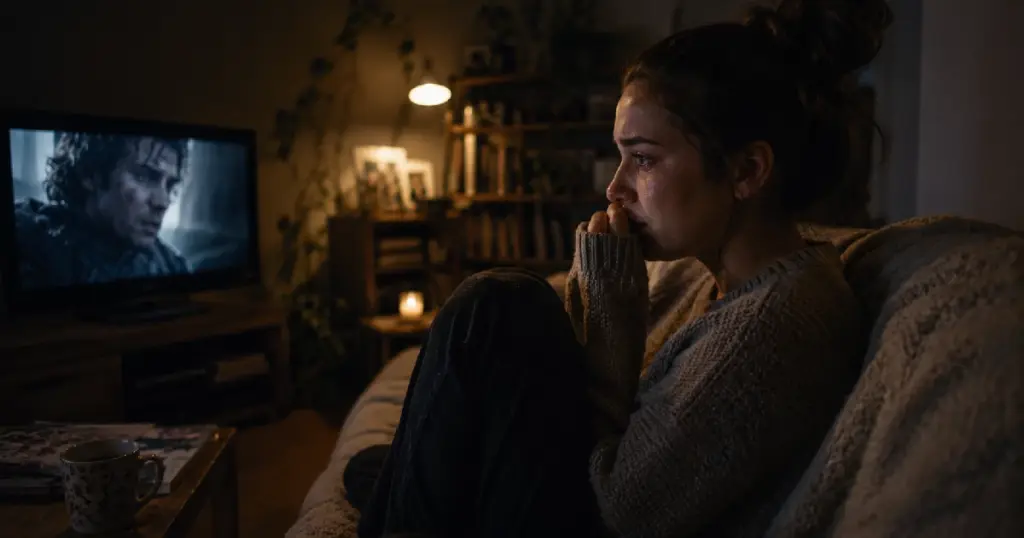
After a tragic conclusion, there is a certain kind of silence. The person seated with it does not immediately move when the book or movie closes. Between the story and the remainder of the evening, they remain in their chair, their bed, or their couch corner. The throat is constricted. The eyes hurt. Nevertheless, they wouldn’t think twice about doing it again if given the option. The majority of them have already done so.
The persistent, somewhat illogical predilection for painful stories is one of the more fascinating aspects of how people interact with fiction. Happy endings are satisfying. Tragic ones persist. And the ones that stick around are nearly always the ones that people claim to be their favorites, the ones they thrust into other people’s hands and insist that they read despite their warnings that they will ruin them. There’s something worth looking at there.
The traditional explanation dates back to Aristotle, who discussed catharsis as the goal of tragedy. This is the notion that witnessing suffering in a controlled, artistic setting enables the audience to let go of an accumulation of emotions that needed to be let out. The original meaning of this word is more akin to purging, a physiological clearing, but it is now used loosely, frequently to mean simply feeling emotions. The Greeks constructed theaters with the express purpose of creating this effect on a large scale. Thousands of people watching characters fall from grace while seated in tiers of stone seats, crying outdoors, and returning home feeling somehow better than when they first arrived. It seems illogical. For the most part, it works.
The idea of negativity bias, or the brain’s known propensity to retain unpleasant memories longer than pleasant ones, is what psychology has added to that picture. According to the theory, it is an evolutionary artifact that was ingrained because recalling dangers and losses was more beneficial for survival than recalling happy times. In a literary context, the effect is quantifiable regardless of the source: happy endings take up less mental space than sad ones. A happy story’s conclusion relieves tension and lets the mind go. There are unanswered questions in a tragic conclusion. Days, weeks, or even years later, characters continue to reappear in the reader’s mind; they are still there, unresolved, and somehow alive in a way that is only possible for fictional characters who have suffered terrible deaths.
The most obvious example of this in modern times is probably Anakin Skywalker. He is a character in a franchise that is well-known for its mythology, sound design, and merchandise, but what people really lament when they revisit his story is the particular human wreckage of a man who began with a great capacity for love and ended up as a machine wearing a father’s guilt as armor. There is more to his tragedy than just his fall. It’s that he was good once, that the fall wasn’t inevitable, and that there were times when he could have made a different decision. Those who completed his story say that weeks later, they were still thinking about him, looking for video of his past life, and lamenting a nonexistent person. Escapism is not what that is. Fiction that delves deeper into issues of fate, choice, and loss that lack a clear solution is the antithesis of escapism.
Happy endings frequently fall short of the honesty found in tragic ones. Even though the genre conventions pretend otherwise, everyone who reads fiction is aware that goodness and cruelty are not always rewarded or punished in real life. A well-resolved story can feel earned, fulfilling, and truly touching. Additionally, it may seem like a minor deception—a tidy façade for situations that reality would have left in disarray. When tragic endings are handled with care, they seem real. The particular truth that loss is real and not always redeemable and that people we love—even fictional ones—can be taken away without a good reason is not a comforting truth or a lesson.
It may seem insignificant, but the safety of that encounter is crucial. In real life, grief does not come with a score, exquisite prose, or the structural grace of a story that has been building for three hundred pages. All of that is accompanied by fictional grief. Researchers measuring physiological reactions to depressing fiction discover real emotional stress, real tears, and real changes in heart rate, so the pain is real, but it’s contained by a cover and a last page. You are free to put it down. When you’re ready, you can come back. In a situation where the loss was never truly yours, you can experience the full weight of loss and come out on the other side having dealt with something that might not have otherwise had a place.
It’s difficult to ignore how infrequently the happy stories are mentioned when reading about the experiences that have changed people. Not because memorable fiction lacks happiness, but rather because the endings that serve as benchmarks—those that people revisit when attempting to articulate their identities and emotions—are nearly invariably the ones that come at a cost. The point is the grief. It remains because of the grief.