
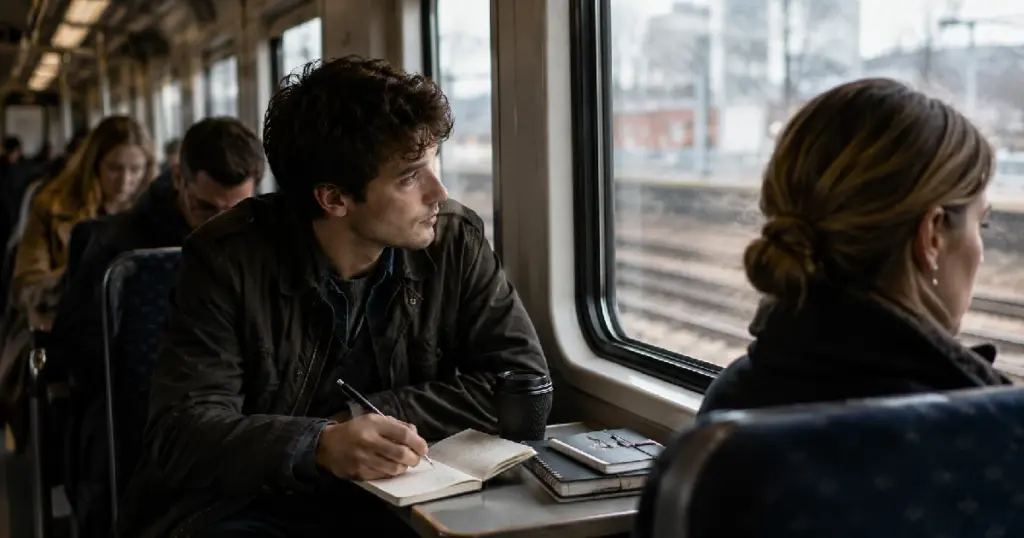
If you’ve ever sat next to a writer on a lengthy train ride, you may have noticed that they are observing things. The way the woman on the other side of the aisle continues to touch her wedding band. The subtle scent of fried food emanating from a coat. the unique way that afternoon light streams in through the window. The majority of passengers are either half asleep or using their phones. The author is in a completely different place—right here, fully present, gathering.
It appears to be passive. It isn’t.
Writing is not a natural talent or a peculiarity of personality. Similar to how a musician learns to hear intervals or a surgeon learns to work without trembling, it is a trained behavior that is developed gradually and purposefully. One of the most successful thriller authors working today, Harlan Coben, does more than just carry a notebook. He has a few with him. There are always more than one pen. snacks. He arrives early for meetings, not to be courteous, but to say a few things before anyone else shows up. That isn’t eccentric. It’s a system.
In writing circles, the notebook is practically a cliche, but its true purpose is undervalued. Indeed, it captures concepts before they fade away, and ideas do fade away more quickly than anyone would like to acknowledge. But more than that, keeping a notebook trains the mind to stay in a particular mode, what Coben calls being “engaged.” It’s a readiness to receive, a low-level awareness. You begin to notice more things that are worth writing down once you start doing so on a regular basis. The perception and the habit support one another.
Years ago, Natalie Goldberg stated unequivocally that authors live twice. Once on the page and once in real time. The actual work takes place in that second life, but it is totally dependent on the caliber of what is acquired in the first. When a writer walks around with their eyes closed, they have nothing to go back to. The raw material is the sensory archive, which consists of the precise, tangible, and unique details of actual experience. The writing floats without it.
When most people attempt to write, this is where they make mistakes. They make a grab for the general. A storm is simply inclement weather. Conflict is all that an argument is. On the street, a stranger is merely background. Through repetition and practice, writers are able to move beyond the category and into the specific. In her notebooks, Carol Ann Duffy lists individual words that strike a chord—not phrases or concepts. Occasionally, a single word opens a memory that she was unaware she still carried. It is not mystical. That’s a technique, and the more you use it, the more dependable it becomes.
The Scottish writer Jules Horne discovered something that is evident when you hear it but is seldom mentioned aloud: musicians rehearse. Athletes work out. Dancers rehearse. Most writers don’t, at least not in an organized manner. They write a novel, receive a ton of criticism on all fronts at once, feel overburdened, and decide whether to continue or not. Horne makes a strong case that the superior model consists of brief, targeted exercises with brief feedback loops. Instead of going through another complete draft, focus on a single technique, such as how time moves through a scene or how a character is introduced, and work it carefully, in short sessions, much like a pianist would practice a challenging passage.
For something as purportedly organic as creative writing, this might sound unduly technical. However, the authors who have attempted it report something akin to a revelation. One of Horne’s pupils was having trouble finishing her ongoing project. Horne advised her to map the emotional changes, metaphorical usage, and pacing of a play’s conclusion that they had been studying. then use some of those structural strategies to write her own conclusion. The pupil did. The room fell silent when she read it aloud to her writing group, just as it does when something lands perfectly. Careful craftsmanship had resulted in something truly poignant.
The technical and observational components are not as distinct as they appear. Story ideas, according to Lee Child, are like atoms; two or three combine to form something stable. The woman in the green coat you saw twice in one day, the dream you had, and the headline in the newspaper are all inert on their own. When combined, they could tell a tale. However, that collision can only occur if you have been collecting, if your notebook is full, and if your mind has been active throughout.
Speaking with working writers about this, I get the impression that they see the world as a kind of continuously running feed that is always available, slightly in the background, and not overwhelming. A coffee cup with chips. A pause before shaking hands. the manner in which someone responds to a query too rapidly. Fiction feels inhabited rather than manufactured because of these details. Sometimes readers are unaware of why a book feels authentic. It is typically the result of the writer being attentive long before they started writing.
It doesn’t take skill to train yourself to notice everything. It calls for a notebook, the self-control to carry it, and the readiness to get there early.