
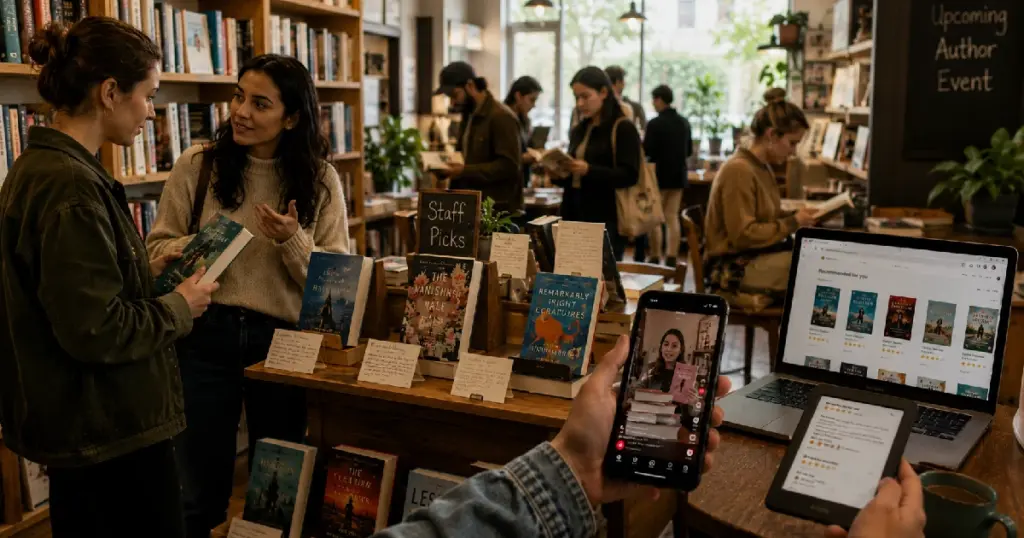
Walk into any independent bookshop on a Saturday afternoon and there’s a decent chance you’ll overhear it: someone leaning toward a shelf, saying “you have to read this one, I couldn’t put it down.” That small, unglamorous moment is still, by a wide margin, how most people find their next book. It is not an algorithm. It is not a targeted advertisement. A friend, standing right there, talking.
To be honest, considering the amount of noise surrounding digital discovery, it’s a little unexpected. However, the data supports it. Roughly 47.5 percent of readers say a personal recommendation led them to their most recent read, with friends carrying more weight than family, and both outperforming everything else combined. It’s possible the publishing industry has spent the last decade chasing viral moments while underestimating something much older and slower: one person telling another person what to read next.
This does not negate the importance of bookstores and libraries, which are undoubtedly still important and rank second only to friends and family as reliable sources. Standing in front of a carefully chosen front table filled with staff recommendations and handwritten index cards outlining a bookseller’s passion for a book has a certain charm. In contrast to a scrolling feed, it is tactile. Online retailers provide their own version of this, such as Amazon’s recommendation engine, which is based solely on click-through and purchase data. However, it’s a colder form of curation, optimized for similar customers’ purchases rather than what an actual, passionate reader truly loved.
Reviews add to the complexity of the situation, but not in the way that most writers believe. Fewer than 14 percent of buyers say a printed newspaper or magazine review actually pushed them toward a purchase, which might sting for authors still hoping for that glowing broadsheet writeup. The majority of consumers check online reviews before purchasing nearly anything, including books, and these reviews are far more influential in general consumer behavior. Investors in traditional media coverage appear to think that sales are still driven by a robust review cycle. The data suggests that belief is increasingly outdated, or at least incomplete.
It’s on social media that things become truly bizarre and disjointed. The BookTok section of TikTok has developed into its own economy, sometimes reviving backlist books years after they were first published and propelling them back onto bestseller lists practically overnight. Instagram still leans visual and slightly older-skewing, its Bookstagram community built around aesthetics as much as opinion. Even though its user base has become more subdued and environmentally conscious, Facebook continues to promote crime and thriller films in a manner that younger platforms do not. It’s hard not to notice how thoroughly genre and platform have become tangled together — romance and young adult fiction thriving on TikTok and Instagram, while fantasy finds a slightly different, more TikTok-leaning audience than Facebook ever offered it.
None of this happens by accident, despite the fact that it seems spontaneous. Through newsletters, small giveaways, and the occasional price drop on a series opener intended to entice readers to purchase the remaining books at full price, authors pursuing visibility are increasingly establishing direct relationships with readers. It’s a strategy borrowed loosely from software companies offering a free trial, repurposed for fiction. Whether it actually works long-term is still being tested, book by book, author by author, with no single formula holding up across every genre.
Watching all of this unfold, there’s a temptation to declare digital discovery has fully replaced the old model. That doesn’t seem quite correct. The algorithm sits on top of the bookshop table, which sits on top of the initial, obstinate mechanism of one reader telling another reader about a book they loved. In reality, this appears more like layering. The platforms are constantly evolving and will likely continue to evolve in ways that no one can currently predict in another five years. But underneath all of it, the oldest signal in publishing, a genuine recommendation from someone you trust, still seems to be doing most of the actual work.
