
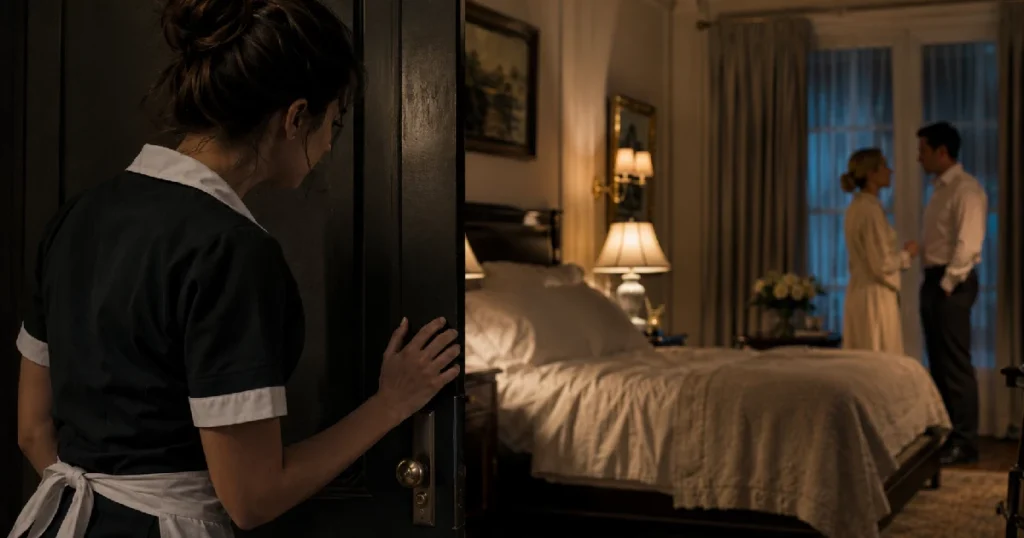
While eating sandwiches in her car, Millie Calloway continues to apply for jobs that she is not hired for. Everywhere she goes, her record follows her—the kind of past that shuts doors before she even touches the handle. She doesn’t ask many questions when the Winchester family offers her a live-in housemaid job without requiring a background check. The house is very beautiful. The salary is genuine. During the interview, Nina, the wife, appeared to be quite friendly. What might go wrong? The Housemaid is what it is because of that rhetorical question and how quickly Freida McFadden responds to it.
There’s a certain kind of dread at the beginning of the book, not the explosive kind, but the slow-building kind that settles behind your sternum around chapter three and stays there. Almost immediately after Millie moves in, Nina’s warmth vanishes and is replaced by something more difficult to describe: erratic accusations, intentional messes left for Millie to find and clean, and wild mood swings that seem almost too planned to be real. Cecelia, the nine-year-old daughter, observes Millie with a disconcerting silence. Then there’s Millie’s room in the attic bedroom, which has a lock on the wrong side of the door. looking outward. The kind of detail you take note of and put away, knowing it has no significance.
McFadden recognizes that the atmosphere must be just as important as the plot, which sets this book apart from the crowded shelf of domestic thrillers it sits next to. The Winchester home is actually lovely and full of the tasteful indicators of a particular kind of wealth; it is never described as gothic or ominous. The engine is that contrast. McFadden skillfully makes use of this gap, increasing the tension through subtle accumulations rather than dramatic confrontations. Something amiss occurring inside something that appears to be perfectly normal is always more unsettling than overt darkness. Something is missing. incorrect date. An extended glance across a kitchen.
And there’s Andrew. Nina’s husband is paying attention, quietly hurting, and obviously exhausted by whatever his marriage has turned into. When someone treats them well when they’re not used to it, Millie notices him in the same way that anyone would. The relationship that emerges between them is handled with more nuance than the genre typically deals with; it’s not tidy or victorious, but rather careless and slightly desperate, the kind of thing that occurs when two people are more trapped than they seem. It’s one of the book’s better strategies, giving what could otherwise be just plot mechanics an emotional boost. Readers were experiencing exactly what McFadden intended when they were genuinely interested in where Millie and Andrew were going and then uneasy when the ground changed.
The true accomplishment of the book is the shift that occurs. The narrative perspective completely changes halfway through. All of the previous information needs to be reconsidered because Nina is now narrating the story. What initially appeared to be cruelty begins to resemble something else. What initially appeared to be paranoia begins to take on a context. It’s the kind of structural move that calls for careful preparation and execution, and McFadden deserves it because part one contains enough retroactive evidence to make the reversal seem genuinely illuminating rather than random. The point is that readers who believed they understood the Winchesters find themselves making quick revisions. Even if you’re a little irritated with yourself for not seeing it sooner, it’s difficult not to admire its architecture.
The story was made more widely known by the Amazon series adaptation, which starred Sydney Sweeney as Millie and Amanda Seyfried as Nina. This has the intriguing effect of making some readers feel as though they already know what happens before they turn the first page. It’s possible that watching before reading actually makes the experience sharper rather than duller by drawing attention to the way McFadden builds toward revelations rather than merely waiting for them to arrive. The interior access to Millie’s suspicion, her self-doubt, and her very particular method of observing the people around her for clues are all aspects of the prose that the screen version is unable to fully capture.
Literary fiction is what the book isn’t, and it’s honest enough not to pretend to be. It’s designed to be fast-paced and suspenseful, and the prose doesn’t stand out on its own. That will be more than enough for some readers. By the last act, others will be able to see the structure’s skeleton. Neither response is incorrect. With a protagonist whose secrets keep up with everyone else’s, a villain who earns your hatred and then complicates it, and a thriller with genuine shock, The Housemaid knows exactly what it set out to do. It outperforms the majority of its rivals in that regard. The late-night reading sessions, the library waiting lists, and the urgent referrals between friends are all not coincidental.