
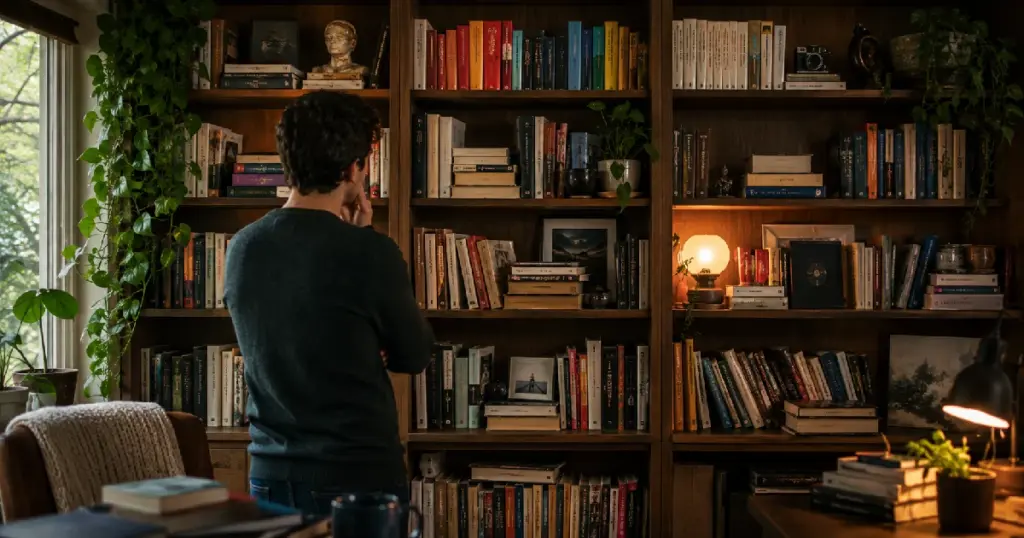
When you first enter someone’s house, it is nearly impossible to ignore the bookshelf, if one exists. It merely holds objects while sitting on the wall, but it conveys information that the host never meant to share. Two airport thrillers and a single copy of Marcus Aurelius. A line of cracked-spine Ottessa Moshfegh novels. Suspiciously unread, self-help titles stand erect. A bookshelf has an intimate and somewhat revealing quality, which is probably why some people have begun to curate them with the same care as a LinkedIn profile.
Strangers post pictures of their shelves on the strangely named r/BookshelvesDetective section of Reddit, inviting the community to examine them. The responses are almost always more perceptive than anticipated, but they can also be cutting at times and generous at others. Remarks like “this shelf belongs to someone who stopped trying new things around 2015” or “you buy books to feel like someone who reads” land with unsettling accuracy. The exercise might be half joke, half real psychology. However, the fact that thousands of people continue to submit pictures indicates that most of us secretly harbor the desire to be read—really read—through our possessions.
Although it has some texture worth looking at, the psychology underlying this isn’t particularly complex. It has long been observed by researchers and personality writers that an individual’s shelf organization is a good indicator of their life organization. A person who keeps everything spine-out, color-codes by genre, and alphabetizes by author’s last name typically works in a world of calendars, checklists, and meticulously planned morning routines. A shelf like that doesn’t just happen. It necessitates reviewing, modifying, and upholding the same routines that appear in every other aspect of a structured person’s life. Depending on who you ask, that may be praiseworthy or subtly draining.
The disorganized shelf conveys a completely different message. Sideways stacked books on top of each other. Murakami leaning against a Scandinavian fungus field guide. Something that might have been read zero or four times and has a broken spine. There is a certain kind of person whose shelf appears to be a record of every direction their curiosity has abruptly drawn them. They are creative, emotionally quick, and nearly inherently resistant to systems. Even when those shelves are disorganized, it’s difficult to ignore a certain warmth. They have a lived-in vibe. utilized. They allude to someone who picked up books on the spur of the moment, read them quickly, and left them exactly where they ended up.
Perhaps the most psychologically charged category of all is the shelf of unread books. Nearly everyone has at least a few: the novels they were given as gifts, the in-depth histories they bought with great care, and the philosophy books they picked up during a fleeting moment when they felt like philosophers. In theory, an unread shelf is a collection of dreams. It reveals more about a person’s future self than their present self. The books simply sit there silently and patiently, marking the sometimes large space between the two. This could be interpreted as depressing. It’s also possible to view it as honest—not all goals must be achieved for them to have significance.
The minimalist shelf is currently experiencing a cultural moment, but it’s hard to tell if this is due to actual philosophy or the way simple, clean surfaces look on Instagram. Twenty books on a shelf, all of which are read, carefully stored, and not ornamental, reveal something genuine about a person who has given careful thought to what they want to carry with them throughout their life. Friendships also tend to exhibit this type of restraint: fewer, closer, and more intentionally maintained. It’s important to consider whether minimalism is an aesthetic or a personality since the two can appear the same from across a room but feel very different inside an apartment.
Compared to, say, a music library or a collection of movies, the bookshelf is particularly revealing because books have cultural significance that other media mostly do not. Keeping a book is a sign of something. Even unopened books. A copy of Infinite Jest on a 28-year-old’s shelf conveys a very particular message, not all of which are positive. A wall of military history, a complete set of Elena Ferrante, or a single Bible next to a dog-eared copy of The Alchemist are all examples of this. Bookshelves are arranged with at least some consideration for the audience because people are aware of this. We don’t always read the books we keep on display. Sometimes they are the books we wish to read or be connected to, which is a form of self-portrait in and of itself, albeit one that is a little more positive than the reality would permit.
The person in front of a bookshelf and the person it describes are actually and frequently at odds. The most intriguing aspect of the entire exercise is that gap. A bookshelf is more than just a representation of your identity. It reveals who you were, who you aspired to be, and the version of yourself that you have chosen to maintain. In most homes, it’s unclear if those three factors align.
