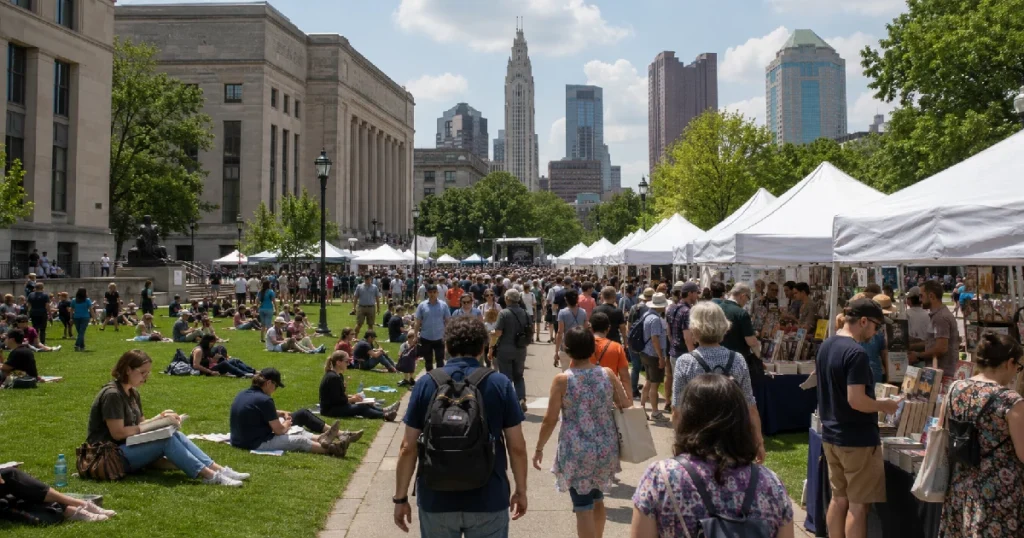
A city that offers a free book festival has something subtly amazing about it. No parking lot ticket booths, no wristbands, and no idea that culture is something you have to pay for. This Saturday, the fourth-year Columbus Book Festival will open at the Main Library on South Grant Avenue with precisely that kind of openness. Observing the preparations in downtown Columbus, it’s easy to feel that this event has figured something out that many larger cities haven’t.
The festival, which takes place on July 11 and 12, extends from the library’s interior into nearby Topiary Park, where outdoor stages and vendor tents will occupy an area that might normally see a few joggers and dog walkers on a typical weekend. More than 200 authors are expected to attend this year, some from well-known publishing houses and some completely self-published. The variety is so great that referring to it as a “book festival” would be akin to referring to the Ohio State Fair as a farmer’s market. There are read-alouds for kids, food vendors, jazz musicians, panel discussions, writing workshops, an author speed-matching event that sounds genuinely chaotic in the best way possible, and at least one honky tonk band. That’s a lot.
Most literary events would be jealous of the headliners alone. Kimberlé Williams Crenshaw, the Columbia law professor who introduced the concept of intersectionality to the world and whose new book “Backtalker” chronicles her journey from Canton, Ohio, to becoming a world-renowned civil rights scholar, will address an enthusiastic audience on Saturday. It’s difficult to ignore the fact that her presence suggests something about what Columbus anticipates from its intellectual life as interest in her session grows in the run-up to the weekend. Second-tier names are not acceptable in this city.
On Saturday, TJ Klune, the author of popular fantasy books like “The House in the Cerulean Sea,” will talk about his most recent book, “We Burned So Bright,” which draws from his personal experience as an LGBTQ+ author creating LGBTQ+ narratives. No author on this year’s roster may have a more devoted readership than Klune, whose readers are known for arriving early and staying late. Paul Tremblay’s talk on his new book, “Dead But Dreaming of Electric Sheep”—an odd, intriguing title that apparently combines dark comedy with eerie fiction—rounds out Saturday’s headliners. It sounds either genuinely brilliant or wildly ambitious. Perhaps both.
The Organization of Chinese American Women recently named Lisa See National Woman of the Year. On Sunday, she will present her most recent book, “Daughters of the Sun and Moon.” See has written extensively researched historical fiction set in China and other countries for decades. Her sessions are known for being generous, with her discussing the research nearly as much as the actual story. The thriller “The Last Thing He Told Me,” written by Laura Dave, concludes the main event weekend with her follow-up, “The First Time I Saw Him.” It probably won’t take much persuasion for thriller readers to attend that one.
Although the star power is truly impressive for a free event, it isn’t what distinguishes the Columbus Book Festival from similar events in other Midwestern cities. It’s the design surrounding the major events, like this year’s Indie Author Alley, which is home to almost 100 small-press and self-published authors from a variety of genres. These kinds of venues don’t always receive the recognition they merit at larger festivals, where independent writers may feel like they’ve been marginalized. Here, the alley feels essential to the festival’s identity, supporting the notion that literature isn’t limited to what comes from big New York publishers in its finished form.
More than 20 local bookstores participate in the festival as partners, such as Gramercy Books in Bexley and The Book Loft in German Village, a Columbus institution with a true labyrinthine quality that first-time visitors frequently find either charming or slightly alarming. The presence of such local booksellers is important. It distinguishes a festival that genuinely creates a reading ecosystem from one that merely encourages reading.
The weekend’s writing workshops cover everything from LGBTQ+ literary representation and faith in fiction to the more pragmatic aspects of manuscript marketing. There are sessions on illustration and publishing as a business. It’s unclear how many novice writers will feel empowered enough to take on a new project after this weekend, but the workshops appear to be intended to give that impression. That is not insignificant.
This festival, which was started by the Columbus Metropolitan Library to commemorate its 150th anniversary in 2023, has expanded more quickly than most organizers likely expected. There’s a feedback loop going on: more readers show up because the author lineup keeps getting stronger, and more authors want to come because more readers show up. Any event’s fourth year is frequently when you can determine whether its initial excitement was merely novelty or if it has true lasting power. It looks a lot like the former based on what’s happening in downtown Columbus this weekend.