
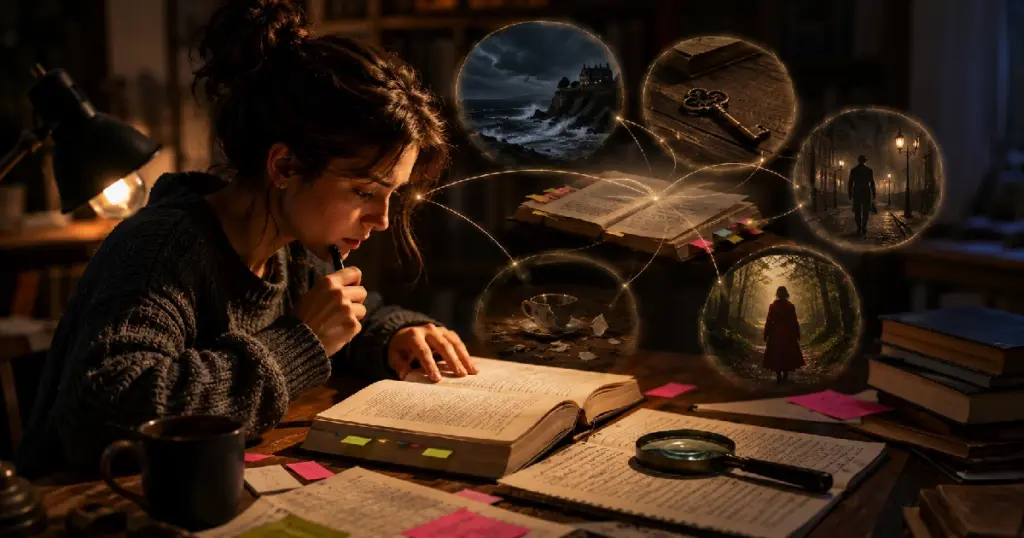
Most readers are unaware of this particular moment. A character’s casual comment about the weather, a particular object placed on a table, or a sentence that seems a little too intentional to be accidental are examples of quiet moments that typically occur in the first few chapters. It is ignored by casual readers. Excellent readers stop, put it away, and bide their time. Years of close reading have taught them that authors don’t arrange things at random. Every little detail is a hint of what’s to come.
This is the first, and possibly most significant, distinction between a reader and a true reader. The typical person following a plot is effectively watching a movie with their eyes closed, picking up on voices but missing the composition, lighting, and framing. As much as they are observing the screen, great readers are also observing the director.
Great books are never really read; they are only reread, according to Vladimir Nabokov, who studied literature more than almost anyone alive in the 20th century. Most people are eager to see what happens when they read a novel for the first time. Although this urgency is understandable, it comes at a cost. In the second or third reading, foreshadowing ceases to be imperceptible, thematic patterns start to show up like shapes in a fog clearing, and you realize that the author has been telling you everything all along and you were simply not paying close enough attention.
It’s intriguing how this behavior goes well beyond fiction. According to most accounts, Warren Buffett reads between 500 and 1,000 pages every day. He doesn’t look for quotes or talking points. He reads to reverse-engineer the argument, to comprehend not only what someone is saying but also why they organized it that way, what they decided to omit, and what presumptions are subtly carrying out the heavy lifting beneath the surface. That type of reading is more akin to questioning than to consumption.
The surface layer of plot or information is what most people read for. Excellent readers read with purpose. They inquire as to why the story starts where it does rather than six months earlier or later, why a sentence is short when the ones around it are long, and why the author selected a specific narrator. These are not scholarly inquiries. They make the difference between reading and comprehending a piece of writing.
Another area where this division is evident is in how imperfect characters are handled. Casual readers tend to disengage from morally complex protagonists because they want a clear-cut hero. However, the most enduring novels feature contradictory, self-centered, self-deceptive, and sometimes monstrous characters. Instead of leaning away, great readers lean in. They recognize that the author’s moral compass is not compromised by a flawed character. That’s the whole idea. The book is often about what a “monster” reveals about the society in which they live or about the reader’s own uneasiness.
Additionally, there seems to be a distinct relationship between great readers and context, particularly the context that is established in the first thirty or so pages of a book. Here, writers subtly establish the world’s rules, establish the emotional tone, and indicate the type of story that will be told. It’s like skipping a movie’s opening sequence because the credits haven’t finished if you rush through these pages to get to the action. The reader who focused on the first few chapters will have a completely different experience by the time something important occurs.
This includes foreshadowing, which is arguably the literary fiction technique that is most misunderstood. It’s easy to see it as a ruse, with the writer concealing a hint that only astute readers will figure out. However, it goes beyond that. Authors use foreshadowing to give readers the impression that a story was inevitable and that there was no other possible conclusion. It’s not common to notice it on the first read. Reading becomes more like a dialogue with the author when you comprehend what it’s doing on a second read.
It’s difficult to ignore how frequently conversations about books on the internet center almost exclusively on whether or not readers enjoyed the characters, whether the conclusion was satisfying, or whether the prose was too slow. These are not incorrect inquiries. However, they are primarily inquiries about the emotional impact of a book rather than its mechanics. Excellent readers inquire about both. They seek to comprehend the emotion and link it to the particular sentences that produced it.

Chloe Olliver is senior editor at vclib.org, where she leads editorial coverage of literary criticism, political commentary, cultural analysis, and the evolving relationship between literature and public life across New York City and beyond. With a career spanning the intersection of literary journalism, political commentary, and educational publishing, Chloe brings both rigorous research discipline, in-depth knowledge, experience, and an accessible editorial voice to subjects that most readers find thought-provoking and culturally significant.