
The fact that a woman most people couldn’t identify wrote one of the most cherished detective series in English literary history is subtly amazing. Born in the English county of Shropshire in 1913, Edith Pargeter wrote under her own name for many years before deciding in 1959 to use a pseudonym for a different type of work. Ellis Peters was her new name. She also created Brother Cadfael, a medieval Welsh monk with a past that most men half his age couldn’t match, under that name.
It wasn’t by accident that Pargeter entered this world. She had a strong connection to Shropshire, the region that would eventually serve as the living backdrop for the Cadfael books. You can practically picture her strolling around the grounds close to Shrewsbury Abbey, gazing up at those ancient stone walls and speculating about the stories they may have absorbed over the ages. The books seem to have been shaped by the location more than any research library could, giving them that unique blend of emotional warmth and historical significance that draws readers back.
She created a truly unique character. In his forties, Cadfael enters the monastery as a former soldier, sailor, and crusader who has had enough of the world, not as a sheltered young man running away from it. Muslims in the Holy Land taught him about herbalism. He didn’t know he had a son. He traveled three continents with memories of women he had loved. By the time he took his vows at Shrewsbury, Cadfael was at last embracing life rather than running away from it. That might be the exact reason why readers find him so trustworthy. He’s already committed errors.
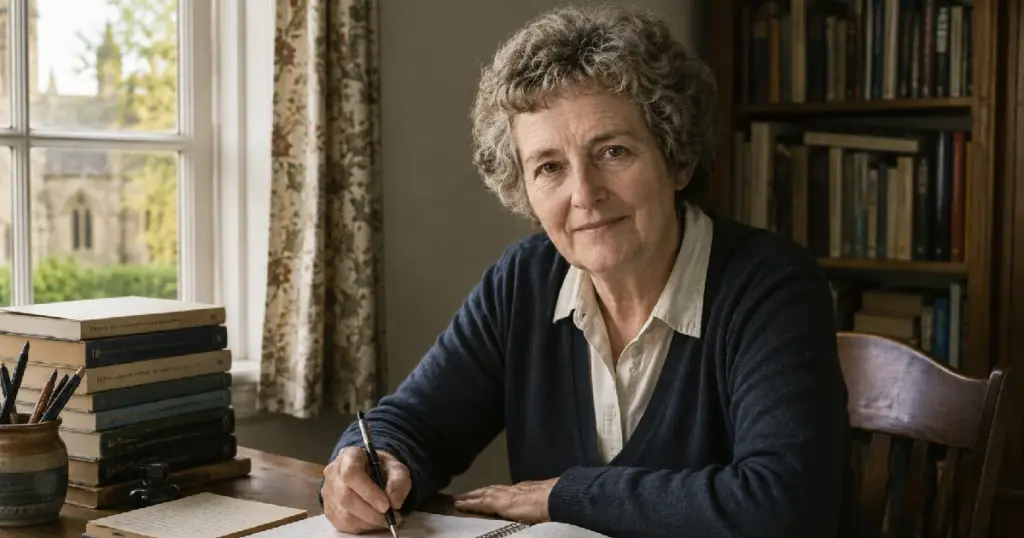
A Morbid Taste for Bones, the first Cadfael book, was published by Pargeter in 1977. Her age was sixty-four. Twenty novels and one collection of short stories, all set against the turbulent backdrop of the Anarchy—the bloody civil war between King Stephen and Empress Maud that left 12th-century England feeling constantly on edge—were produced over the course of the following seventeen years, which was nothing short of a sustained creative achievement. Pargeter skillfully incorporated actual historical occurrences into her made-up killings, demonstrating sincere scholarly interest. The burning of Worcester, the siege of Shrewsbury Castle, and Empress Maud’s transient political aspirations are not ornamental elements. They are structural, influencing Cadfael’s surroundings with such subdued power.
It’s difficult to ignore how carefully Pargeter crafted Cadfael’s moral compass. He doesn’t follow strict religious doctrine. Decades of seeing what people do to one another under duress have sharpened his lived understanding of human weakness, which is what drives him. It never feels like rebellion when he quietly assures a certain kind of justice that the legal system would not provide or bends a monastery rule. It seems to be wisdom. Throughout all twenty novels, there is a constant tension between the spiritual and the secular, between what the world truly needs and what the church demands.
By most accounts, Pargeter was an exceptionally disciplined writer. Despite translating Czech literature and writing under her own pen in a variety of genres, she managed to maintain Cadfael’s creative vitality for almost twenty years. Brother Cadfael’s Penance, the last book, was specifically written as a conclusion; she meticulously gathered the loose ends and tied them together as if she knew it was time. Shortly after it was published in 1995, she passed away after a protracted illness. From a distance, it seems as though she accomplished what she set out to do based on the documentation of her work.
When ITV adapted the show for television, Derek Jacobi played Cadfael with the kind of weathered intelligence required for the part, giving it a second audience. However, the books—quieter, more intimate, and more patient—remain the standard for many readers. Many people believe that Pargeter’s Cadfael contributed to the development of historical mystery fiction as a legitimate literary genre, which at the time wasn’t certain but now seems clear.
Additionally, a rose bears his name. David Austin, a breeder from Shropshire, created this cultivar, which was first displayed in 1990 and is still widely accessible. The fact that a fictional monk created by a Shropshire woman writing under a borrowed name became real enough to merit his own flower is a minor detail, but it says something.

Chloe Olliver is senior editor at vclib.org, where she leads editorial coverage of literary criticism, political commentary, cultural analysis, and the evolving relationship between literature and public life across New York City and beyond. With a career spanning the intersection of literary journalism, political commentary, and educational publishing, Chloe brings both rigorous research discipline, in-depth knowledge, experience, and an accessible editorial voice to subjects that most readers find thought-provoking and culturally significant.