
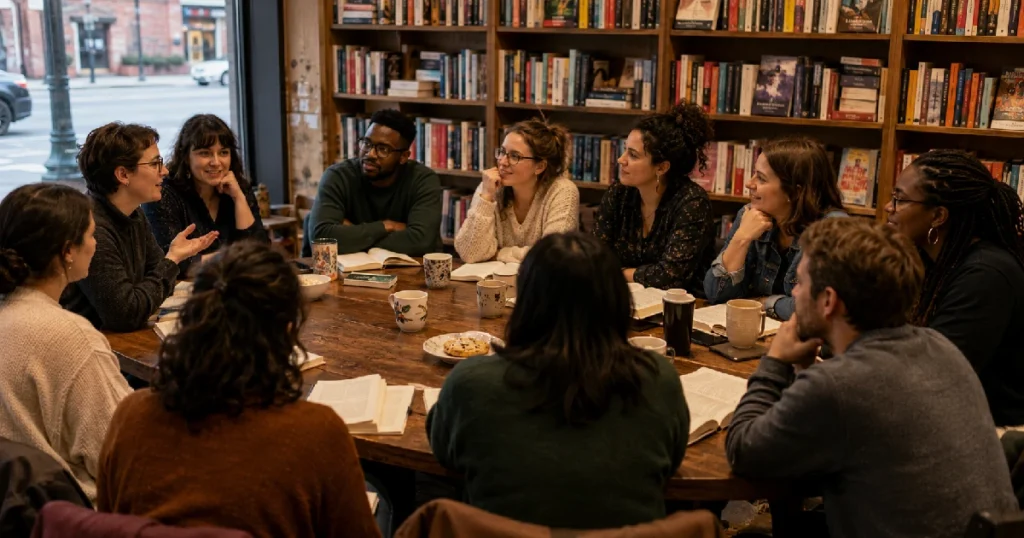
On the second Thursday of each month, twelve people congregate around a corner table in a coffee shop near a well-known independent bookstore in Chicago. The table was never intended to accommodate so many people. They quarrel over the decisions made by fictional characters in the same manner that you might quarrel over those made by real people. There’s always someone crying. Every time, someone brings a snack that nobody requested. And the following month, every single person returns.
It’s simple to write this off as a specialized pastime, reserved for retired educators and those with an unusual quantity of tote bags. However, there seems to be more going on with book clubs at the moment. Reading groups are expanding at a rate that would have seemed unthinkable even five years ago. They can be found in living rooms, on Zoom calls, in the back corners of bookstores, and on Discord servers with thousands of members.
Why is a worthwhile question. Furthermore, no single explanation can adequately capture the complexity and humanity of the true answer.
The issue of loneliness is a part of it. Many people experienced a sudden surplus of loneliness and a shortage of what sociologists sometimes refer to as “third spaces”—the areas between home and work where people used to congregate without a purpose—after the pandemic. Bars, churches, gyms, and community centers have either become less prevalent or feel more transactional than they once did. It turns out that one of the few social structures still in existence that provides a non-monetized, non-performance-driven reason for people to show up is a book club. You perused a book. You discuss it. No one is making any pitches.
It would be a mistake to undervalue what transpired on TikTok. The #BookTok community, which has amassed hundreds of millions of posts over the past few years, accomplished something truly unexpected: it made reading seem cool and approachable to people who had previously written off literature as being controlled by Pulitzer committees and English departments. The pretense was stripped away when a reader reacted dramatically to a plot twist or a 24-year-old sobbed on camera about a book they loved. Books no longer carried the unseen burden of “you should read this.” They came with the more straightforward and contagious invitation, “this wrecked me, and I think it’ll wreck you too.”
It is difficult to overestimate how much that change reduced the barrier. A person who dreaded assigned reading in high school and connected books to deadlines and grades could now watch someone discuss a romance novel with the same fervor typically saved for a season finale. The reading list became a dialogue rather than a curriculum.
And people are realizing that the real purpose is to have conversations.
A book club’s unique enjoyment isn’t really about the book itself. or not just about the book. It’s about what the book reveals—the viewpoint you hadn’t thought of, the argument you didn’t anticipate, the odd moment when someone explains a character’s choice and you realize they’re talking about themselves. Books allow people to express emotions like grief, ambition, loneliness, and desire that they might not otherwise be able to articulate. The novel serves as a vehicle for the actual dialogue.
Perhaps this is what people have always known about reading communities, but it seems more pressing now. The book club feels almost radical in contrast to the current cultural moment because of its noise, speed, and sense that everything is being processed too quickly for meaning to build up. You take a seat. You read a lengthy piece. Gradually, you talk about it with other people. Right now, that’s not a minor issue. That is a small act of defiance.
Additionally, the demographics of new members are changing. It may seem paradoxical that Gen Z, who are often described as screen-addicted and attention-fractured, are joining book clubs in such large numbers until you spend five minutes genuinely conversing with members of that generation. The performance of social media—the ongoing curation, the metrics, and the constant fear of being observed—wears many of them out. In contrast, a book club is genuinely low-stakes. You may have only read half the chapters when you arrive, and no one is snapping pictures of you to share later. Instead of feeling optimized, the connection feels earned.
Additionally, a lot of people are realizing that adulthood can be a social desert. After college, making friends is infamously challenging in ways that nobody tells you about. You become close to people, such as neighbors and coworkers, but you never really become friends. For that crossing, a book club provides structure. common language. recurrent communication. the source of recalled arguments and inside jokes. Although it’s often the beginning of deep friendship, it’s not a replacement for it.
This is not particularly difficult. Individuals are lonely. People long for a sense of community. People are sick of feeling worse while staring at their phones. Despite its age and occasional lack of glamour, the book club proves to be fairly adept at simultaneously addressing all three of those issues. Perhaps the nice byproduct of something much more fundamental is that it’s also returning a population of readers to bookstores, libraries, and publishing houses.