
The Book of Azrael frequently comes up when fantasy romance readers discuss the novels that truly shocked them, the ones they weren’t prepared to love as much as they did. The book didn’t have a significant marketing campaign or a celebrity endorsement when it was first released in March 2022 by Amber V. Nicole through her independent imprint Rose & Star. It came via BookTok, circulated among readers who couldn’t stop talking about it in comment sections and recommendation videos. It’s important to consider what exactly made this one stick because that kind of momentum is more difficult to create than it appears.
On paper, the setup seems fairly familiar. In return for her sister Gabby’s freedom and security, an immortal enforcer named Dianna has served a despot named Kaden, the self-described King of the Otherworld, for a millennium. Kaden desires the Book of Azrael, an antiquated artifact that is said to unlock the realms and grant its owner near-total power. In the meantime, following a devastating war, a god named Samkiel—better known in darker circles as the World Ender—is pulled back into the world he had withdrawn from. There are about 500 pages of mythology, violence, political scheming, and a slow-burning romance that merits every page after these two collide, as enemies-to-lovers protagonists must. Enemies-to-lovers is a popular genre. Nicole approaches it in a different way.
The specificity of Dianna’s harm distinguishes her from the typical morally dubious heroine archetype. For aesthetic purposes, she is not dark. The book doesn’t absolve her of the terrible things she has actually done—following orders, yes, but still following them. She carries out Kaden’s order to kill Drake Vanderkai, a vampire prince and one of her few true friends. The scene is not presented as a triumphant moment. It depicts the fracture that occurs when obedience becomes unsustainable and something beneath Dianna starts to shatter. The true story here is seeing that crack spread over 500 pages, transforming her from a tool of someone else’s will to something she chooses for herself.
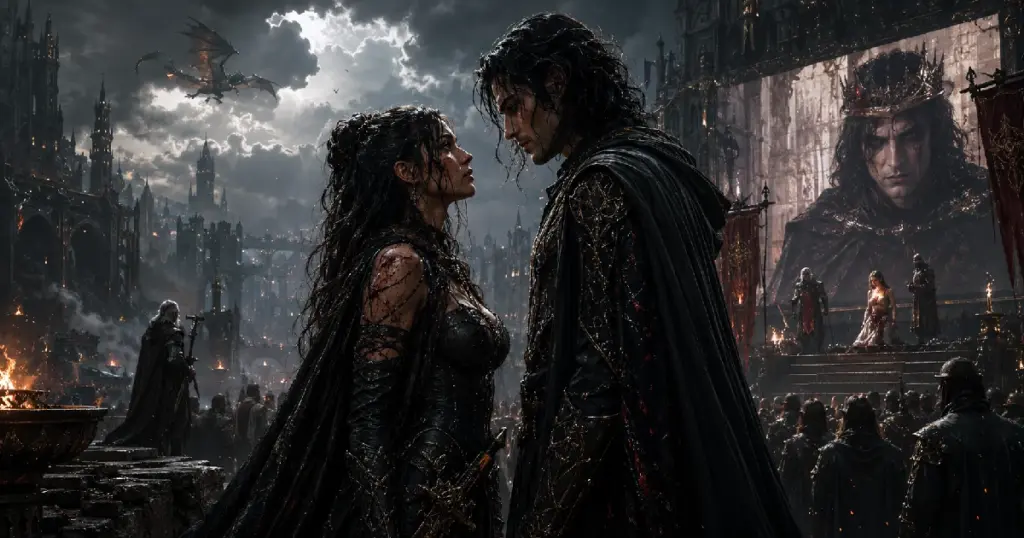
Liam is broken in a different way. There’s something subtly striking about a character with godlike power who is essentially barely holding it together, and he bears the weight of what he can destroy far more than what he hasn’t been able to save. Although his PTSD isn’t discussed clinically, it is evident in the way he moves through scenes and in flashbacks that show a nearly unrecognizable earlier version of himself. He and Dianna’s romance is successful because neither of them is acting healthily. They are two individuals who are aware of each other’s harm and have carefully and against their better judgment chosen to remain together.
Although it requires patience, the worldbuilding is worth mentioning on its own. Nicole immerses readers in a multi-realm cosmology involving Ig’ in the first few chapters.Vampire princes, divine hierarchies, celestial archives in a location called Ophanium, Morruthens, and something called the Hand—all at once, with little to no plan. Some readers might find that confusing enough to stop reading before the pieces begin to make sense. That would be a mistake, but it makes sense. Once the architecture, which is based on myth-splicing that feels more invented than borrowed and features creatures and politics that don’t neatly map onto anything familiar, is revealed, the world becomes truly rich.
Nicole takes the biggest chances in the last act. Losing control over Dianna, Kaden kills Gabby on live television, taking away the one thing that had always kept Dianna in check. The act is so planned and public that it almost serves as a statement. Dianna is not strengthened in the traditional sense by the grief that ensues. She is unmade by it. The book ends in a devastating, purposefully unresolved, and, if you’ve been paying attention, fully earned place as the Ig’Morruthen she’d spent centuries trying to contain simply takes over. It’s the kind of conclusion that makes readers become evangelists.
Reading this gives me the impression that Nicole had something to prove. Not to critics or publishers, but to the genre itself. The author of the Book of Azrael moved as though she had a clear idea of what she wanted to say and had constructed all the necessary framework to support it. It remains to be seen if the series will continue to be of that caliber in later books. However, the initial entry holds up—and then some.