
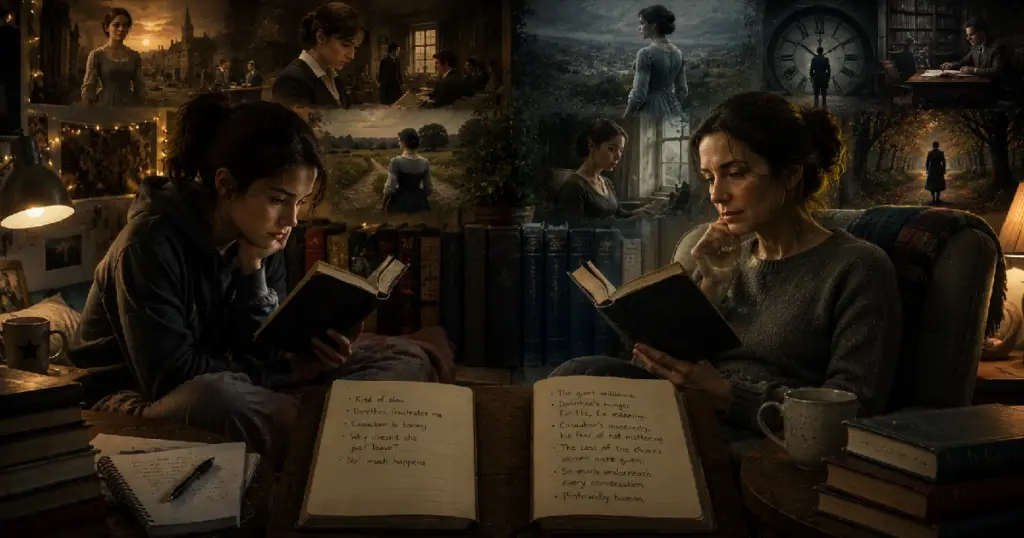
Returning to a book read decades ago and finding it nearly unrecognizable—not because the words have changed, but because the person reading them has—is a specific experience that regular readers are aware of but seldom discuss candidly. At forty-three, the novel that at seventeen seemed sluggish and unduly preoccupied with adult issues reveals an emotional architecture of startling accuracy. It turns out that the character whose choices appeared perplexing and self-defeating was acting in accordance with perfect psychological logic. Simply put, the reader lacked the experience necessary to recognize it.
This is neither sentimentality nor nostalgia. The way some books are written to contain more than a young reader can access, encoding layers of meaning that only become apparent when the reader has lived long enough to recognize them, is something more structural. George Eliot was aware of this. Middle-aged readers have always been the most devoted to Middlemarch, which Virginia Woolf described as one of the few English novels written for adults. At thirty-five, Dorothea Brooke’s compromises, her intellectual hunger colliding with the boundaries of what her society would permit, and her decision to enter into a second marriage that appears inexplicable from the outside all resonate differently than they did at twenty and fifty. The book remains unchanged. The ability of the reader to identify what it is describing continues to increase.
To characterize this phenomenon in a broader sense, philosopher Nassim Taleb created the idea he named the Lindy Effect: the longer something survives, the more likely it is to continue surviving. Fifty years after it was first published, a book that is still widely read has demonstrated a certain kind of resilience—it has survived cultural changes, shifting literary trends, and entire generations of readers with varying priorities and concerns. It continues to resonate with people whose lives are very different from the ones for whom it was originally intended. That perseverance is not coincidental. It implies that the book discovered something essential enough about the human experience that is not obscured by outward distinctions such as time period, social structure, or technology.
In his essay On the Reading of Old Books, C.S. Lewis presented a version of this claim, arguing that old books can reveal a modern reader’s blind spots in ways that new books cannot. Every era has preconceived notions about gender, class, progress, what a life ought to be like, and what suffering entails that are so ingrained that the people who inhabit them are unaware of them. The majority of those presumptions are invisible in a modern novel because it shares them with its readers. An earlier book presents them in a different way; at times it exposes them directly, at other times it just depicts how the world was before them, and the difference between then and now serves as a sort of mirror. The reader’s own unquestioned beliefs become somewhat more apparent.
The impact of surviving time on the reading experience itself is another issue. A book that was released last month is surrounded by marketing, social media debates, early reviews, and the unique cultural concerns of the time. All that noise is removed from a novel that was published a century ago, leaving only the book, the reader, and whatever sincere dialogue is still possible between them. The books that are based on something sturdy are the ones that support this type of reading. The impact of those that relied on timeliness tends to wane; what seemed urgent at the time of publication frequently appears outdated a generation later. Because of this, there are very few books on the bestseller lists of any given decade that people are still discussing thirty years later. There are differences and sometimes conflicts between the mechanisms that make a book last and those that make it sell quickly.
It’s difficult to ignore how rereading differs from first reading. When a reader returns to a book, they already know what will happen—the betrayals, the deaths, the results of different plans and hopes—and this knowledge alters everything. Upon initial reading, details that were not visible acquire significance. It turns out that a seemingly incidental sentence in the first few chapters was actually announcing something crucial. In a way that was not possible when the story was still in progress, the author’s architecture becomes apparent. Because of this, some books encourage rereading in ways that others just don’t; the structure must be significant enough to merit analysis, and the language must be accurate enough to reveal something new upon closer examination.
Whether you come across the most influential books at age twenty or sixty, they all share a dedication to something more enduring than topicality: the specific ways that love, ambition, and fear interact within a human being, the texture of consciousness, and the mechanics of grief. Slowly, if at all, these things change. The book, in a sense, meets the reader where they are, and a reader with enough life experience to identify them brings something to the book that a younger reader cannot. Every stage of the exchange is unique. Because of this, some books don’t age; instead, they just wait for the reader to catch up.