
There is a particular type of novel where the setting takes on an unusual role, ceasing to serve as the story’s container and clearly becoming a part of the narrative. The passion between Heathcliff and Catherine does not occur on the Yorkshire moors in Wuthering Heights; rather, it is an expression of that passion, wild, windswept, and outside the bounds of social convention, just as those two individuals are. If you take away the moors, you take away a crucial component of the emotional logic of the book. Atmospheric fiction excels at fusing place and meaning in a way that makes it impossible to separate them without losing both.
The “unheimlich” or uncanny, according to Freud, is the moment when the familiar becomes strange, when what ought to feel safe becomes subtly menacing, and when the everyday world turns upside down to reveal something hidden beneath. The most atmospheric novels take advantage of this psychological mechanism, frequently without the readers’ full awareness. Rebecca’s ancestral home serves as an example of this. The serpentine drive, the blood-red blooming rhododendrons, and the sea visible beyond the woods make Manderley, which is believed to be based on the actual Menabilly estate in Cornwall, objectively beautiful. However, there is a problem in every room. Despite being dead, Rebecca, the first wife, appears to inhabit the furnishings, the walls, and the entire estate. Du Maurier recognized that atmosphere serves a psychological state and is not merely a description. Manderley doesn’t appear to be haunted. It’s much more effective because it feels haunted.
This idea served as the foundation for Carlos Ruiz Zafón’s entire career. The Shadow of the Wind creates a world that is both romantic and oppressive by utilizing post-Civil War Barcelona, complete with foggy streets, maze-like old quarters, and the fictional Cemetery of Forgotten Books, where an entire library of neglected novels waits in organized darkness. The Barcelona in that book has the appearance of a city viewed through glass; it is constantly a little far away and overwhelmed by the burden of its recent past. The peculiar experience of discovering the real city subtly filtered through Zafón’s version of it is frequently described by readers who have strolled through Barcelona’s actual Gothic Quarter. The best atmospheric novels accomplish this by colonizing the actual locations in which they are set, making future visits to those locations equivalent to visits to the book.
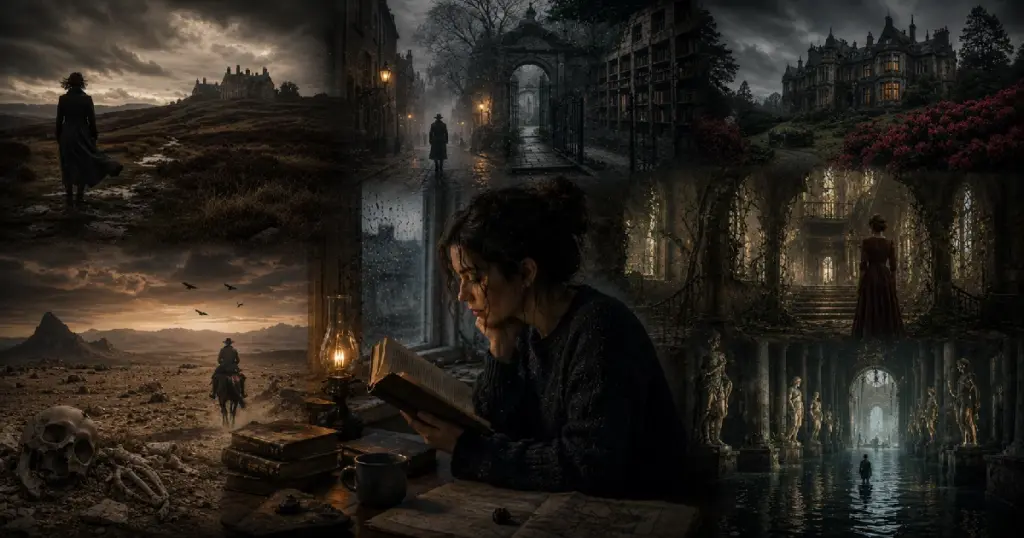
The setting of Silvia Moreno-Garcia’s Mexican Gothic is a dilapidated hacienda in the mountains of 1950s Mexico, damp with fungal decay, with dimly lit hallways and organic wallpaper that at first seems symbolic but, unsettlingly, doesn’t. The novel’s horror builds up through texture, such as the house’s scent, the unique light coming through its windows, and the way some rooms seem to be inhabited by an indistinct entity. It fits into the Gothic fiction tradition that dates back to Shirley Jackson’s Hill House and Poe’s Usher, all of whom recognized that the best architectural horror is precise rather than ambiguous. When a house is sufficiently described, it becomes truly menacing. A general description of a house remains on the page.
The exposed, brutal openness of the Texas-Mexico border in the 1850s, rather than the enclosed Gothic space, is how Cormac McCarthy’s Blood Meridian creates atmosphere. In that book, the desert is depicted with a kind of horrifying beauty: alkali flats that stretch to unpromising horizons, skies that are as apathetic as the violence taking place beneath them. The landscape McCarthy creates feels truly mythic, not metaphorically but structurally, as if this specific area of the earth exists slightly outside of historical time, belonging to a world ruled by older and more violent laws. His prose is lapidary, with each sentence cut to hold light the way a stone does.
Susanna Clarke works at the other end of the tonal spectrum. Piranesi is arguably the most subdued book on any list of atmospheric fiction, with its narrator meticulously listing the countless hallways of a home with thousands of statues and tides that rise through lower floors twice a day. Instead of being menacing, the mood is contemplative, haunted by a melancholy that requires the entire book to fully comprehend. What Clarke accomplishes is something uncommon: an eerie environment that feels neither dangerous nor secure, just different, as though the rules of physics have been swapped out for a new set that the reader is still learning about and the narrator has fully accepted.
It’s difficult to ignore the fact that the most atmospheric books either successfully or unsuccessfully withstand adaptation in ways that are illuminating. Because atmosphere in prose is constructed from language itself, from the rhythm and texture of sentences that describe space in ways no camera angle can replicate, films set in Manderley never quite capture the sense of dread the house creates on the page. Because the reader creates the house, the moor, or the desert from words, the area is partially theirs, created to their own specifications using their own imagination. The reason atmospheric fiction sticks in people’s minds is because of this involvement. These worlds are more than just books. They remain built because you construct them yourself.