
One of those authors who holds a peculiar place in literary history is Mary Webb, who is hardly known to the general public but greatly admired by those who discover her. Her second book, Gone to Earth, was published in 1917 and was named Rebecca West’s book of the year. It is set in the isolated hills and old forests of Shropshire. The introduction was written by renowned author John Buchan. It was included in the first batch of Penguin Books in 1935, along with books that millions of people would later read. However, Webb herself passed away in 1927 at the age of 46, receiving little recognition during her lifetime. Her writing frequently went out of style, which speaks more about the attention span of the literary establishment than it does about the caliber of the work.
Hazel Woodus, the protagonist of the book, is the daughter of a Shropshire harpist, beekeeper, and coffin maker, a combination of occupations that already gives you an idea of the kind of world Webb is creating. After the death of her gypsy mother, Hazel was raised loosely by a cold and aloof father in a remote cottage with few visitors, leaving her half-wild. For company, she has turned to animals and the natural world; her closest friend is a fox cub that she refers to as Foxy. The way she navigates her world has an almost medieval feel to it; she is superstitious, sensitive to old tales of the Black Huntsman, and genuinely afraid of the social machinery of respectable rural life and the men who work there.
The trap Hazel enters is defined by two men. Edward Marston is the kind and cautious young minister of God’s Little Mountain, a small chapel on a hilltop. He is drawn to Hazel’s wildness in the same way that kind people are occasionally drawn to things they can’t quite grasp. John Reddin, on the other hand, is a hard-living, fox-hunting squire who finds Hazel on a road at night and declares, with the self-assured entitlement of men like him, that she is his. Webb’s description of their differences is still accurate: “Edward appealed to her emotions, while Reddin stirred her instincts.” It’s a brief sentence with a lot of information.
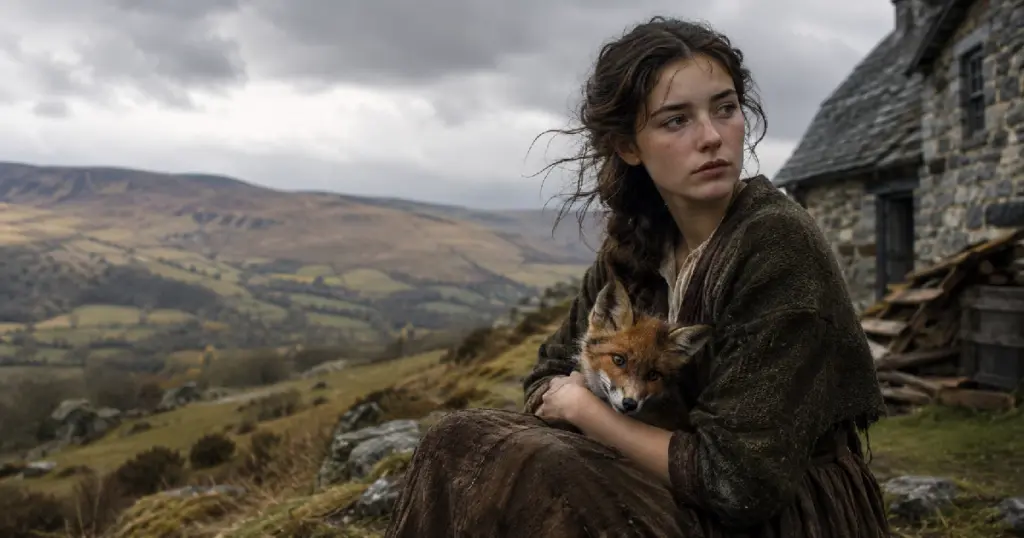
Webb’s insistence on writing about cruelty not as a dramatic exception to everyday life but as its quiet operating principle is what sets her apart from her contemporaries and gives Gone to Earth a strikingly modern feel that a 1917 novel has no apparent right to have. From the fox hunt to the church to marriage itself, Hazel is appalled by the dominance of the powerful over the weak.
Beneath the lyrical surface of the book, Webb argues that civilization is based on the suffering of helpless creatures, both human and animal. Critics have frequently drawn comparisons between Thomas Hardy’s observations—the same tragic inevitability, the same love of the landscape, and the same sympathy for people who don’t conform to society’s expectations. However, Webb’s voice is uniquely her own; it is more fable-like than Hardy and occasionally more like Emily Brontë, with prose that alternates between the earthy and the magical in ways that can surprise you.
The rural areas of Shropshire in Gone to Earth are not ornamental. Undern Hall, Reddin’s gloomy, musty estate, which Webb characterizes as having a profound sadness within its walls, contrasts with the beauty of the open hills and verdant tracks in the novel, which does a great job of reflecting Hazel’s inner state. The weather doesn’t feel like atmosphere when the winter storm rises around Undern near the end of the book. It seems like a gathering. Webb writes, “A tortured dawn crept up the sky,” and you think the sky can do that.
Webb presents a category problem for literary historians, which may contribute to her relative obscurity. She was too feminine and rural to be fully taken seriously by the critical apparatus of the time, too poetic for straight regionalist fiction, and too grounded in the land for the modernists who were gaining ground in London at the same time she was writing. Her 1924 book Precious Bane eventually gained posthumous recognition after Stanley Baldwin publicly praised it, sparking a brief resurgence of interest. However, revivals for underappreciated authors are rarely long-lasting, and Webb has spent the majority of the century since her passing in the role of a writer’s writer, admired by those who come across her and passed down like the best-kept secrets.
Even though there is melodrama in Gone to Earth, the quality of attention Webb gives each creature in the book—human, animal, and landscape alike—is what sticks with you when you read it now. She observes them all with the same cautious, somewhat dejected gaze.