
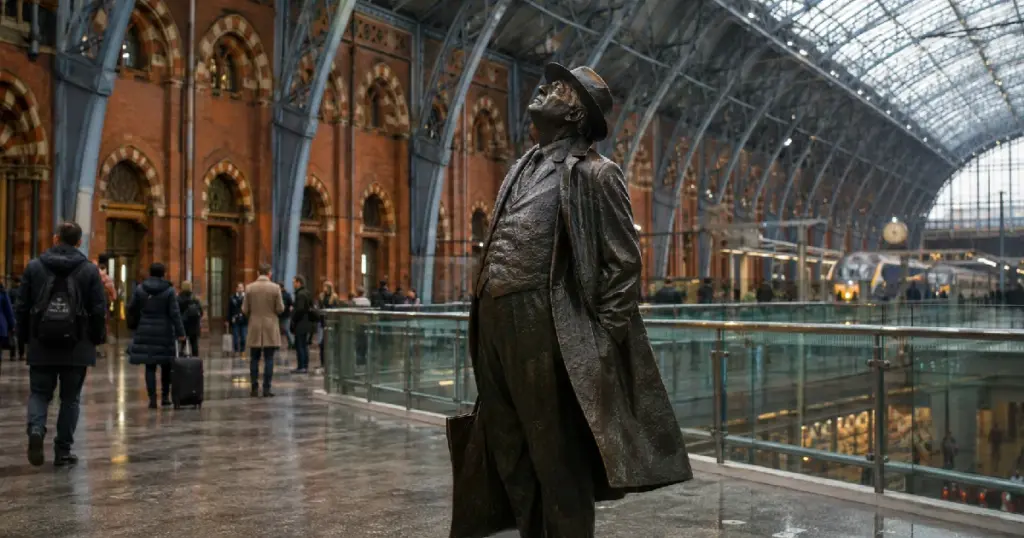
He can be found walking through St Pancras International on a gloomy London afternoon. He is life-sized in bronze, with his coat open and his eyes raised toward the towering Victorian ironwork, as though he is still in love with it. Since its installation on that concourse in 2007, the statue of John Betjeman has been the most fitting homage to an English poet ever. Not a plaque. Not a glass-covered portrait. He refused to allow the wrecking crews to take a man who was caught in the middle of the building. That provides you with the majority of the information you require.
Betjeman was born in August 1906 in north London to a family of silverware makers of Dutch descent. He grew up in the multi-layered warmth of a city that was still somewhat Victorian, complete with gas lamps, church bells, and the sound of steam trains coming from bedroom windows. The poems, campaigns, books, and broadcasts that came after might all have been influenced by this early immersion in a world that was already starting to disappear. He always wrote as if he were witnessing something disappear. He never completely lost the sense of urgency in that.
Oxford was not the victory one might anticipate. A young C. S. Lewis was his tutor at Magdalen College, and the two famously hated each other. Lewis thought he was idle. Lewis, in Betjeman’s opinion, was cold, exacting, and completely inappropriate. He eventually tried a paper in Welsh as a last-ditch effort after failing his divinity exam twice, and he left without a degree. Although he joked about it in public, the failure affected him privately for the remainder of his life. Nevertheless, Oxford provided him with a circle that included Louis MacNeice, Evelyn Waugh, and Auden—names that would go down in the century’s literary annals. It’s a good comfort.
The books written by John Betjeman cover more ground than the public perception occasionally indicates. Most readers start with The Collected Poems of 1958, and for good reason—it sold 100,000 copies and made him a national celebrity almost immediately. Even the literary establishment was somewhat taken aback by the magnitude of the public reaction, even though critics had long suspected his talents. Readers who had never been particularly interested in poetry found something in those poems, such as the Ovaltine, the bicycle gears, and the rural gaslit towns. He wrote about faces and places, just as he told teenage radio interviewers in 1962. not concepts that are abstract. Abstractions, never.
His 1960 autobiography in blank verse, Summoned by Bells, is a different kind of accomplishment. With the kind of exact, sensory detail Philip Larkin called “almost Proustian in its accuracy,” it chronicles his life from a childhood in north London through the perplexing years at Oxford. The distinct light of Highgate’s early mornings, the exact anxiety of adolescence, and the smell of a preparatory school dormitory are all captured in poetry that doesn’t seem to require much work. This book stands out among all of John Betjeman’s works. The best way to describe it would be to say that it feels more like recovered memory than literature.
His poetry often overshadows his architectural writing, which is a real loss for anyone interested in his way of thinking. In his 1952 book First and Last Loves, he made the case for the Victorian structures that postwar Britain was cheerfully tearing down, portraying them as manifestations of a society’s spiritual life in brick and stone rather than as artifacts. In 1972, London’s Historic Railway Stations served as a warning as well as a celebration. By then, he had already lost the battle of Euston Arch, which had gone badly, but the longer campaign for St. Pancras was successful. It is difficult to avoid feeling the weight of what might have been rubble when standing beneath that remarkable Gothic hotel on a wet morning.
Looking back, it seems that the organizations that ought to have known better consistently misjudged Betjeman. When the post of Poet Laureate became available in 1967, he was rejected because, according to one civil servant, he was too fond of tennis lawns and cathedral cloisters. He was amusing but unimportant, according to the Oxford professor who was consulted. It’s the kind of verdict that doesn’t hold up well. Despite Cecil Day-Lewis’s passing five years later, Betjeman was appointed and held the position until his own death in 1984. By then, he was arguably the most well-known figure in Britain outside of the royal family thanks to his television appearances, which attracted as many viewers as possible with his unique brand of kind, heartfelt attention.

Chloe Olliver is senior editor at vclib.org, where she leads editorial coverage of literary criticism, political commentary, cultural analysis, and the evolving relationship between literature and public life across New York City and beyond. With a career spanning the intersection of literary journalism, political commentary, and educational publishing, Chloe brings both rigorous research discipline, in-depth knowledge, experience, and an accessible editorial voice to subjects that most readers find thought-provoking and culturally significant.