
At some point in the third chapter of Whalefall, it becomes clear that Daniel Kraus is not pulling a practical joke. The storyline seems straightforward: a teenage boy dives by himself off Monastery Beach near Monterey and, while looking for his father’s remains, is swallowed by a sperm whale. It sounds like the kind of pitch that makes people laugh uncontrollably. However, the book becomes devastating somewhere between the whale’s first stomach chamber and the frigid Pacific water.
Divers have a reputation for Monastery Beach. It has taken lives and drops off abruptly and erratically. You can sense that Kraus picked that spot on purpose. He seems to have studied this coastline with real stakes in mind, much like a diver studies tide charts. Jay Gardiner goes into that water with more than just scuba gear. He is harboring the specific kind of guilt that results from failing to say what was necessary before someone vanished forever.
Mitt Gardiner, Jay’s father, was the type of man who filled a space and made his son feel a little smaller. The local community respected and admired this commercial diver and whale-watching boat captain, but in private, he could be cruel and domineering. Early in the book, there is an incident involving alcohol, a knife, and pressure that a father shouldn’t put on Jay. Eventually, Jay moves out. Mitt is then given a mesothelioma diagnosis. Then Mitt walks off a boat loaded with diving gear and disappears before Jay can decide whether to forgive, confront, or just show up.
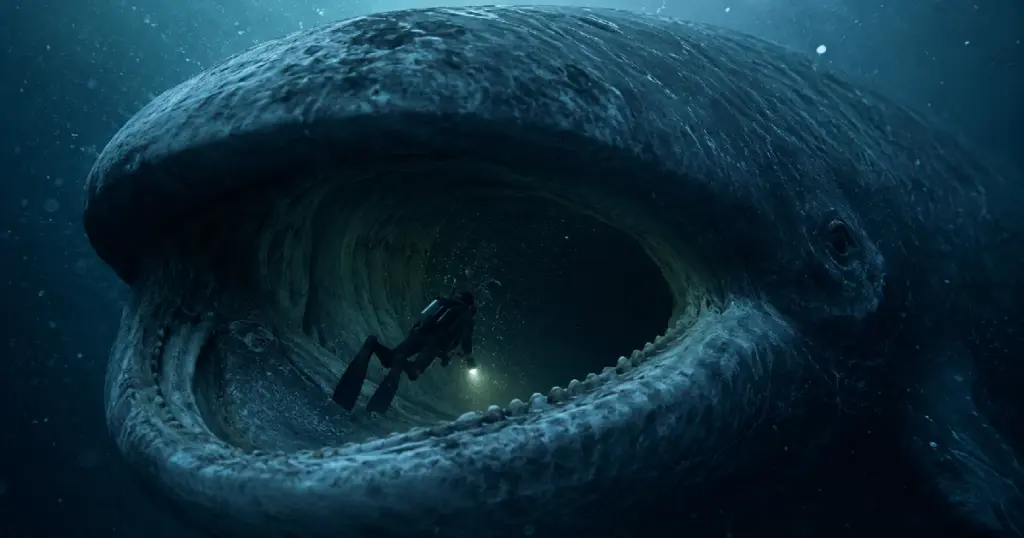
With great care, Kraus incorporates this backstory into what appears to be a survival thriller with a tight deadline. Jay has about an hour of oxygen left. That hour feels terrifyingly short and impossibly long inside a sixty-ton whale. The remarkable physical descriptions are reportedly supported by science, which somehow exacerbates them. the acid in the stomach. the strain. Only the bioluminescence of a jellyfish, which Jay uses as a lantern as he climbs toward the whale’s throat, breaks the darkness. It’s difficult not to be impressed by the sheer audacity of creating a scene like that and making it seem earned rather than ridiculous.
However, something more subdued than the survival plot powers the book’s emotional engine. Jay hears his father’s voice during his ordeal. It’s not clearly explained—Kraus rejects the simple supernatural explanation—and it appears to be connected to the whale in some way, as though Mitt’s remains and the animal have become intertwined in ways that defy reason but not emotion. They converse with each other. They quarrel. Something akin to peace is eventually achieved. The New York Times review pointed out that there are times when the psychological burden feels applied rather than felt, so it’s possible that some readers will find these scenes overbearing. However, even when there is a slight strain in the conversation between the living and the dead, the goal is evident and sincere.
In actuality, Kraus has written a book about how difficult it is to mend a complex relationship after someone has passed away. Jay is unable to express regret face-to-face. He can’t ask his dad why. All he can do is plunge into the shadows and discover whatever kind of resolution lies at the bottom. In this interpretation, the whale takes on the characteristics of a confessional: it is small, hazardous, nauseating, and ultimately the only location where the truth is revealed.
The allusions to 127 Hours are appropriate. That is the extent of the claustrophobia. A dead man who continues to speak, a son who continues to listen, and a relationship that refuses to remain buried just because one half of it already is are all aspects of Whalefall that Danny Boyle’s film didn’t need to have. Jay’s final escape plan, which involves using batteries and steel wool to produce a tiny explosion inside the whale’s stomach, is both incredibly unlikely and, in some ways, the only possible conclusion. In this book, survival is not elegant. It’s desperate, chemical, and full of things you’d prefer not to consider.
It’s still unclear if Whalefall will receive the widespread readership it merits or if its premise will deter more wary readers. It would be unfortunate. Beneath the whale, there’s a truly poignant book about fathers, grief, and the conversations families can’t seem to have. Kraus penned something peculiar, distinct, and vibrant. Climbing in is the least we can do.

Chloe Olliver is senior editor at vclib.org, where she leads editorial coverage of literary criticism, political commentary, cultural analysis, and the evolving relationship between literature and public life across New York City and beyond. With a career spanning the intersection of literary journalism, political commentary, and educational publishing, Chloe brings both rigorous research discipline, in-depth knowledge, experience, and an accessible editorial voice to subjects that most readers find thought-provoking and culturally significant.