Most people have used this phrase at some point without really thinking about it. “Big Brother is watching.” Perhaps during a discussion about government overreach, privacy regulations, or surveillance cameras. Like idioms, it emerges organically, almost instinctively. The fact that those three words originated from a 1949 novel written by a man named Eric Arthur Blair, who was dying of tuberculosis in a farmhouse on a Scottish island when he finished it, is something that is easy to forget and that very few people take the time to think about. More than 70 years later, George Orwell was unaware that he was creating a phrase that would still be used on a daily basis. All he was trying to do was write the truth.
Books influence culture in this way. Incorporating themselves into the language, moral presumptions, entertainment, and arguments of societies that have largely forgotten where the ideas originated, they do so gradually and eventually permanently rather than loudly and conspicuously. It’s an odd kind of influence. diffuse, sluggish, and almost impossible to identify its origin. However, it is more profound than most people realize.
Probably the most obvious example is language. Shakespeare created between 1,700 and 2,000 words that are still used by English speakers, including bedroom, lonely, generous, obscene, and many more, while writing for an audience that crammed into a wooden theater in Southwark to watch plays in the afternoon. Orwell introduced doublethink, thoughtcrime, and the term “Orwellian” to the twentieth century. By writing Catch-22, Joseph Heller gave society a catchphrase for every impractical bureaucratic trap that has ever existed. Because these words were assigned in school, they didn’t spread. They proliferated because they gave names to things that people already knew but were unable to articulate. That’s what good writing does; it gives previously inarticulate people language, and once that happens, the language tends to stick around.
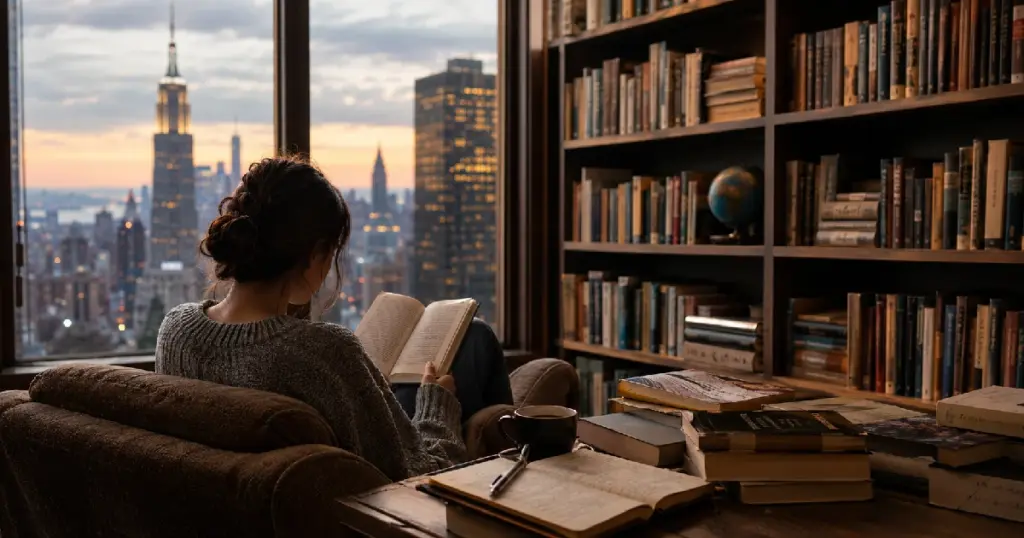
Additionally, fiction does something more subdued that functions below the level of particular phrases or lines that can be quoted. It establishes standards. The general outline of what a romance should feel like, what a hero’s journey should look like, and what justice should ultimately look like are all derived from stories, many of which started out as books before moving on to television, movies, and other media. In 2025, the majority of viewers of Netflix shows or popular movies are taking in narrative structures that have been honed over centuries of novel writing. The medium was altered. For the most part, the underlying architecture did not.
Walking through any reasonably sized bookstore, it’s difficult to ignore how many sections have grown over the last ten years, especially those devoted to memoirs and books on grief, identity, and mental health. The expansion is not coincidental. It corresponds with a wider cultural shift in what people feel comfortable talking about in public, which was influenced in part by the books themselves. The conversation shifts when enough people read about someone else’s struggle with addiction, depression, or a challenging upbringing and find something relatable. Private things become public. Speakable eventually becomes policy. There is a long and indirect gap between a book quietly published by a small press and a shift in the way society discusses mental illness.
Compared to most, Rachel Carson had a clearer understanding of this mechanism. The American chemical industry took the threat posed by a single book so seriously that they spent a significant amount of money trying to discredit Silent Spring when it came out in 1962. Carson had written about how pesticides affect bird populations and ecosystems with enough detail and emotion that regular readers, not scientists or regulators, could relate to it. A policy paper did not give rise to the contemporary environmental movement. It was largely inspired by a woman who sat down to meticulously record what she had seen. The United States had an Environmental Protection Agency within ten years.
The fact that books are prohibited has some merit. Things that don’t matter are not banned. Removing a book from a classroom reading list or school library is, in a sense, an acknowledgment of the power of literature. People’s perceptions of what is normal, what they are permitted to question, and whose experiences they are exposed to have all historically been influenced by what they read. That isn’t a defense of any specific book. It’s an observation about what book bans reveal about those who engage in them.
Even readers who haven’t actually read the books in question are affected. This is where things start to get really weird. “Frankenstein” is still used as a shorthand for a creation that turns destructively on its creator by someone who has never opened Frankenstein. Even someone who has never read a word of Kafka can understand what it means to describe a situation as Kafkaesque. Concepts break free from their initial containers. They are assimilated into movies, condensed into memes, incorporated into common speech, and then transmitted to individuals who will never come into contact with the original source. This is how culture functions: it accumulates and spreads, and by the time it reaches you, the majority of it is invisible.
More than any other medium, books slow things down long enough for complexity to endure. A sentiment can be conveyed through a tweet. An image can be carried by a video. An argument can be carried over three hundred pages in a book, building cautiously, qualifying, doubling back, and reaching a destination that could not have been reached more quickly. It has nothing to do with other formats. It’s an observation about what is lost when a society ceases to accommodate the long form. Certain concepts just cannot be compressed. And the cultures that cease reading them eventually discover that they have lost access to the way of thinking that those concepts enabled—typically without realizing it until the absence begins to manifest.