
Mervyn Peake is often found tucked between more well-known spines, slightly out of place, waiting for someone obstinate enough to take him off the shelf. It has a secondhand bookshop feel to it. The son of a medical missionary, he was born in 1911 in Kuling, China, in a walled compound full of artisans making exquisite porcelain. Given what he would eventually create—a massive, crumbling castle bearing down on a village of carvers who dedicate their lives to creating exquisite objects for an aristocracy that hardly notices them—this detail seems almost too convenient. After his family left China in 1922, Peake never went back, but he also never completely forgot the architecture of his early years.
The Gormenghast author is remarkable for his complete defiance of simple description. He was more than just a novelist. He was a painter who had Royal Academy exhibitions. His illustrations of Alice in Wonderland and The Rime of the Ancient Mariner are still regarded as some of the best ever created. John Betjeman described his poetry as exceptional. In the immediate aftermath of World War II, he was one of the first British citizens to see what was left of Bergen-Belsen. He also taught life drawing at Westminster School of Art and designed theater sets. He was clearly marked by that last experience. He drew what he saw and penned poetry while grappling with the peculiar guilt of using pain to create art. It’s difficult not to wonder how much of that moral unease found its way into Gormenghast’s shadowy hallways.
After his applications to become a war artist were repeatedly turned down, he started writing Titus Groan, the first book of what would become his defining work, while serving in the British Army. That has an almost poetic quality: a man with a painter’s eye creating an imaginary world in place of the front canvas. From those wartime notebooks, Gormenghast Castle emerged as something truly unique in English literature. A vast, dilapidated Gothic building controlled solely by ritual, inhabited by grotesques so vivid they almost seem to have been painted instead of written. Titus Groan, the 77th Earl, is followed in the trilogy Titus Groan, Gormenghast, and Titus Alone from birth through rebellion to an odd futuristic exile, but the castle itself serves more as an organism with its own slow, corrupted pulse than as a backdrop.
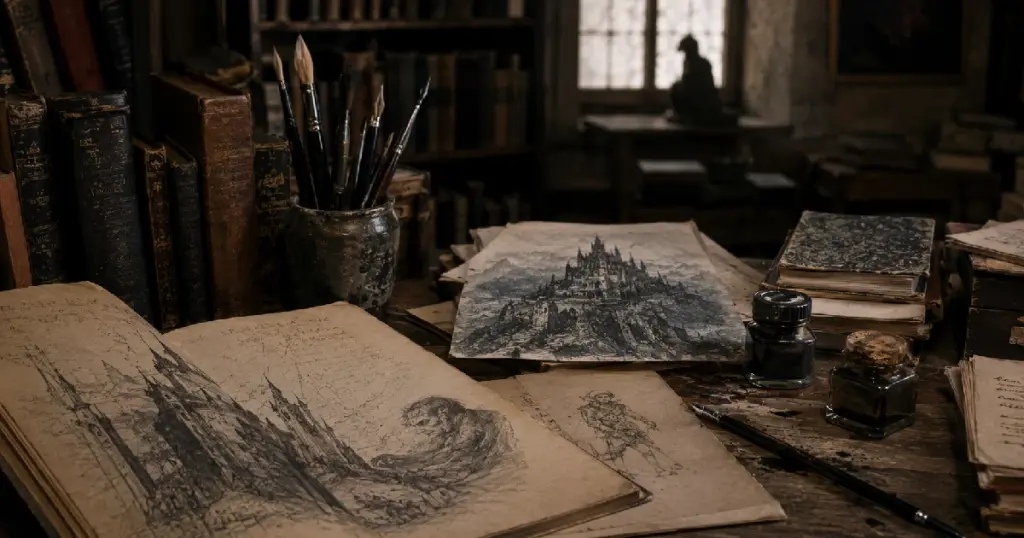
Whether Peake ever got his due while he was alive is still up for debate. In discussions of his work, the analogy to Tolkien frequently comes up, and it reveals more about classification than quality. The series was hailed by Harold Bloom as one of the greatest fantasy works of the 20th century. Anthony Burgess and Michael Moorcock both supported it. The author’s oldest son, Sebastian Peake, once said his father was either too good or too young. Eight years prior to The Fellowship of the Ring, in 1946, Titus Groan made his debut. Rationing was still in place in Britain. The atmosphere wasn’t quite prepared for something so bizarre and unyielding.
Peake’s books had already come and gone without quite catching fire, and by the time Tolkien arrived, there was a different hunger in the air.
The density of observation Peake brought to every aspect of his made-up world is what gives the Gormenghast books their true strangeness and vitality. Characters like Steerpike, the cunning kitchen boy who uses murder and manipulation to gain power, feel more like studies in a certain kind of vicious human ambition than fantasy villains. Dickens might have sketched Dr. Prunesquallor, the castle doctor, on a good day. He has a hyena laugh and a secretly formidable intelligence. Peake seemed to be releasing a population he had been studying for years rather than creating a plot.
His later years were devastating in a way that seems almost intended to highlight everything he wrote about in his books: the slow erasure of self, the cruelty of institutions, and the frailty of the inner world. By the late 1950s, he was exhibiting symptoms of what would later be identified as a Parkinson’s disease-like illness, possibly brought on by a childhood viral infection in China. He would start drawing and then lose track of what he was doing. His focus broke. At the age of fifty-seven, he passed away in 1968 after entering nursing homes in 1964. Ironically, the Gormenghast trilogy started to gain a cult following during those last years after it was published in paperback in the US.
Going back to those books now gives me the impression that Peake was writing more than just fantasy. The intricate, meaningless, and completely forgotten rituals of Gormenghast have an almost sociological weight to them. The characters who blindly submit to them and the lone young man who can’t bear it are identifiable in a way that goes beyond genre. It’s possible that the books’ resistance to easy popularity stems from the fact that they are too complex, bizarre, and devoted to their own internal logic to provide the comfort that most readers look for in epic fantasy.