
When you enter a house where a child is growing up surrounded by books, the atmosphere is instantly different. On the kitchen counter are books. On the bathroom shelf, a paperback spine was visible. A pile that hasn’t quite reached the bookcase is on the floor next to the couch. It doesn’t appear to be a curriculum. It doesn’t appear to be an intervention. It appears to be everyday life, and it turns out that’s exactly the point.
Joanna Sikora of the Australian National University’s research, which was published in Social Science Research, looked at data from 160,000 adults in 31 countries and came to a conclusion that is still a little shocking to consider: the difference between parents who were barely literate and those who had a university degree had about the same impact on a child’s educational progress as growing up in a home with about 500 books. On average, both advanced kids’ education by 3.2 years. It was not necessary to read the books from cover to cover. They didn’t require discussion or assignment. Researchers came to the conclusion that their mere presence conveyed messages about a household’s values, which children quietly absorbed over years.
According to the study, books didn’t have to be in the hundreds to have an impact. The impact of even 20 books in a home was quantifiable. When home libraries expanded from a few to about 80 books, the biggest effects on literacy became apparent. These gains persisted until collections reached about 350 volumes, at which point they leveled off. A similar pattern was seen in numeracy. It’s the kind of discovery that causes you to reevaluate what early advantage truly entails: shelves rather than tutors, flashcards, or enrichment programs. stocked shelves. A child can see, touch, and grow up next to books.
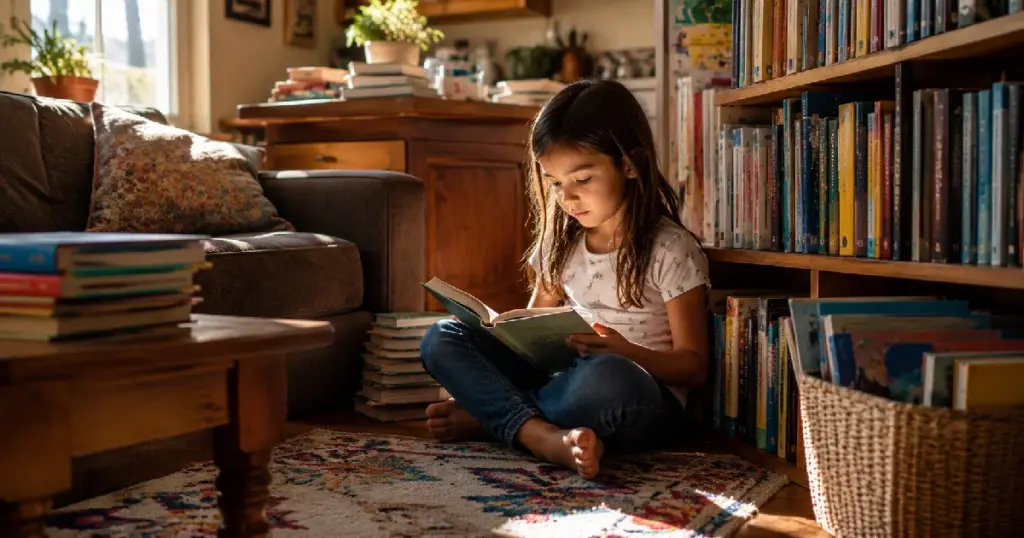
“Book-oriented socialization” is a term used by the researchers that sums up something significant. Children’s observations are just as important as what they read. Children learn about how people navigate the world when they observe adults picking up books, see reading as a normal and natural activity, and live in environments where books are just there. Long before any formal instruction starts, they are developing what one researcher refers to as a “cultural toolkit”—a collection of instincts and habits that influence how they interact with concepts, language, and learning. This may be one of the reasons the effects last so long into adulthood, manifesting decades later in people’s professional communication and handling of complex information.
The vocabulary section on its own is very important. Early book exposure exposes young children to a far greater variety of words than they would normally hear in casual conversation. Even in homes with higher levels of education, spoken language tends to be more limited. In contrast, children are introduced to words in context through books, where they are used by characters to navigate real-world situations rather than as definitions to commit to memory. It is more difficult to duplicate this type of absorption through direct instruction when it occurs over thousands of hours of exposure. It compounds as well. Richer vocabulary makes it easier for a child to read, which encourages them to read more and come across more words, which expands their vocabulary. The loop begins with whatever is on the shelf at home and runs in both directions.
It’s difficult to ignore the implications for kids without access. Children’s books can be extremely hard to come by in lower-class neighborhoods, not because families don’t want them, but rather because they are expensive. The research makes the equity stakes of that scarcity quite clear. A child who grows up in a home with few or no books has a quantifiable disadvantage that persists over decades and manifests itself in literacy, numeracy, educational attainment, and employment. This gap is specifically addressed by Little Free Libraries, public library programs, and summer book distribution initiatives. In this context, they are more significant than they may seem.
When elementary school teacher Justin Minkel made arrangements for each of his students to bring home forty books from the second and third grades, he conducted a kind of unofficial experiment. He discovered that the influence extended to parents, siblings, cousins, and friends who visited and discovered books in previously unreachable locations. Once established, a home library seems to have a way of spreading its impact. That observation seems accurate. Contrary to what some people believe, reading is not a private experience. They leave their mark on those in their immediate vicinity.
Beyond academic measurements, there is something noteworthy about the impact books have on a child’s inner life. Children are introduced to unfamiliar situations and people through literature, which challenges them to follow along, care about the results, and comprehend motivations that are different from their own. When children engage in such creative activities on a regular basis throughout their early years, they develop empathy in a way that is both gradual and long-lasting. It’s not overly dramatic. It doesn’t make an announcement. However, it exists and is gradually molding the child into an adult.
The average number of books in the study’s childhood home was 115, but that number concealed significant variation, ranging from an average of 27 in Turkey to 212 in Norway. It implies that many homes are already nearer the threshold than parents might think. It’s possible that a few dozen more well-positioned and easily accessible books are accomplishing more than anyone realizes. Not as a course of study. as a component of the background, furnishings, and everyday ambiance of a child’s upbringing.