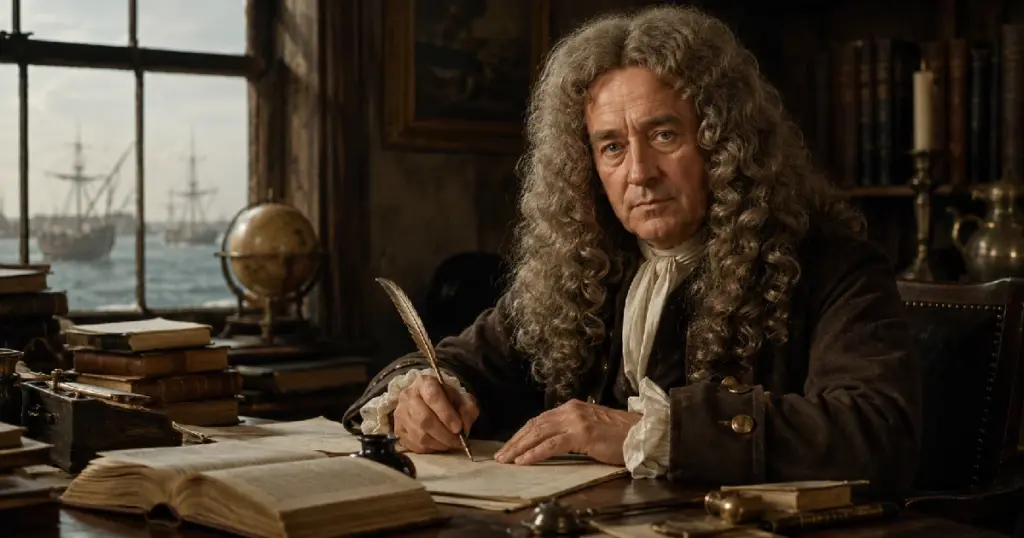
The fact that Daniel Defoe was almost sixty years old when he published Robinson Crusoe is somewhat noteworthy. By that time, he had already experienced at least one bankruptcy, served as a government spy, started and edited one of the first modern magazines, and authored about three hundred works over a number of decades. However, the island is what the majority of people recall, if they recall anything at all.
The title of the 1719 book, The Life and Strange Surprising Adventures of Robinson Crusoe, of York, Mariner, was so long that it essentially summed it up. Because it was presented as the authentic memoir of a sailor who had survived 28 years alone on a Caribbean island, readers in London purchased it with the same fervor they might apply to something genuine. As usual, Defoe did not claim to be the author of the first edition. He gave the fiction room to breathe.
The distinction between invention and lived experience may have never been so successfully blurred by any other English writer. The tale of Alexander Selkirk, a stubborn Scottish sailor who was stranded on a Pacific island for four years following a disagreement with his captain, served as a loose inspiration for Defoe. Barely able to speak, the real Selkirk returned home strange and gaunt. Defoe took that unvarnished, unsettling reality and turned it into a much more structured narrative about Protestant discipline, ingenuity, and the methodical, slow building of a life from nothing. To be honest, it’s still unclear whether that change reveals more about Defoe or what readers in the early eighteenth century needed to believe.
It wasn’t just his storytelling that set Defoe apart. It was the way the story was told. He had been a traveler and a merchant who had lost money while transporting goods across international borders. You can tell that Crusoe is a writer who truly understands how trade and labor operate when he lists the tools he rescues from the shipwreck or explains the precise process of making bread from barley he has grown himself. With theology woven throughout, the book reads more like a lengthy, comprehensive manual for surviving than a romantic adventure.
Defoe would have been exposed to the unique texture of urban disaster at a young age, having grown up in London during the Great Fire of 1666 and the Great Plague of 1665. James Foe, his father, was a devoted nonconformist and a tallow chandler of Flemish ancestry. He was a religious dissenter in a nation where doing so still carried significant political risk. Instead of sending young Daniel to Oxford or Cambridge, the family sent him to Charles Morton’s Academy at Newington Green, a school created especially for people who are not members of the established church. Morton’s curriculum was particularly broad and useful. It’s difficult to ignore how much Defoe’s education influenced everything he wrote later on, including his fascination with economics, his ease around social misfits, and his preference for detail over abstraction.
In retrospect, his entry into trade in the 1680s appears to have been marked by his typical overconfidence. He brought in tobacco, woolens, and wines. Given what he would later write, his investment in a diving scheme to recover treasure from shipwrecks is somewhat ironic in retrospect. By 1692, he was bankrupt to the extent of £17,000 due to a combination of poor investments, disruptions from the war, and what his peers might kindly refer to as an excess of ambition. He would manage the fallout from that collapse for the majority of the remainder of his life, writing in part to make ends meet.
There were waves of political writing, some bold and some careless. The Shortest Way with the Dissenters, his 1702 pamphlet, was intended as ironic satire, mocking radical Anglican voices by posing as one. He was arrested for seditious libel because the government didn’t seem to be in the mood for irony. In 1703, he stood in the pillory three times. According to multiple accounts, the crowd threw flowers instead of trash, indicating that he had friends in high places. After negotiating with Robert Harley, a Tory politician who saw the potential of a writer of Defoe’s caliber, he was eventually set free. As part of the arrangement, Defoe continued to write while obtaining political intelligence, or spying, to put it more bluntly.
The Review, a magazine he wrote mostly by himself from 1704 to 1713, existed throughout all of this. Defoe wrote essays on public affairs, trade, and politics three times a week, sometimes more. It is regarded as one of the forerunners of contemporary journalism. Nine years of that, mostly without institutional support and under financial strain. It’s difficult not to be impressed by its sheer production, even though you have a sneaking suspicion that some of his motivation came from basic need.
Three years after Robinson Crusoe, in 1722, Moll Flanders revealed a distinct yet connected obsession. Moll is about a woman navigating poverty, crime, and social pretense across multiple identities and marriages, whereas Crusoe is about survival and isolation. Readers who anticipate Georgian piety are still taken aback by the lightness with which the moral ambiguity is handled. Defoe appeared to have a sincere interest in individuals who don’t neatly fit into the categories that society assigns them.
He reportedly went into hiding from creditors once more before passing away in London in April 1731. The great novelist of survival, still struggling at seventy, seems almost too fitting for the conclusion. However, his legacy ended up in a different place than his bank accounts. He owes the novel as a form a great deal. Before Defoe, it wasn’t clear that everyday people with ordinary or extraordinary lives could be the subject of serious fiction. You begin to realize that what transpired on that made-up island was never truly about the island itself as you follow the long tail of that influence through Dickens, Stevenson, Golding, and beyond.
