
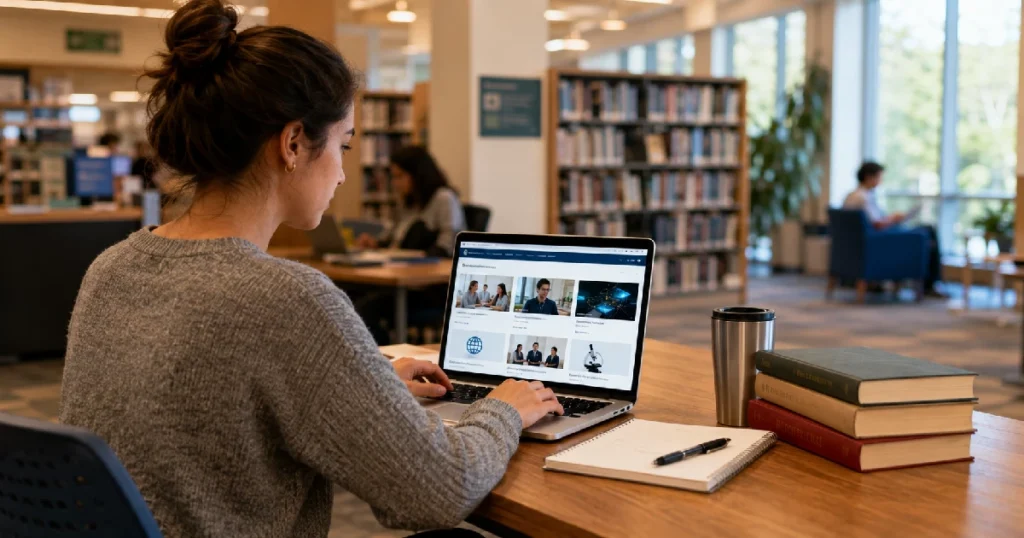
Paying $39.99 a month for an online learning platform seems almost ridiculous when the solution to your professional development issue could be found in a building you most recently visited to return a mystery novel. Many locals are unaware of the educational databases, online courses, and research tools that Valley Cottage Library offers. The discrepancy between what people are aware of and what is actually available there is, to be honest, astounding.
If you walk by the circulation desk on a Tuesday afternoon, you’ll see that the majority of people use the library for the following purposes: printing documents, picking up holds, and letting children use the computers. What you won’t see is a collection of digital resources that, if you were to purchase standalone subscriptions, would cost the average learner well over $500 annually. This is because it operates entirely online behind a login screen. The annual cost of a Rosetta Stone subscription alone is approximately $179. The monthly cost of LinkedIn Learning is $39.99. You’re getting close to what some people spend on a community college semester when you include one or two research databases. If you have a valid library card, many of these resources are available for free at places like Valley Cottage.
Perhaps the most underutilized term in contemporary adult education is “free.” Not the ambiguous, subject to conditions kind of free that is often found on trial subscriptions. the genuinely free variety. The type where you enter your library number to access a complete course catalog without seeing a credit card field. Although most people have at least heard of e-book borrowing, platforms like Libby have already gained widespread recognition. However, the deeper learning infrastructure is often overlooked. Academic journals, business skills classes, creative software tutorials, and language learning resources are not incidental extras. For an increasing number of people who have mastered the system, they are the whole point.
Particularly, career switchers appear to have caught on. When someone moves from retail to healthcare administration or from ten years in logistics to data analytics, they encounter a particular type of financial strain: they need credentials and skills, but they are frequently making the change because of financial constraints. It’s not always possible to watch their income stagnate while paying $300 or $400 to upskill. But a library card is. One of those things that makes the entire institution feel subtly vital in a way that’s difficult to describe until you see it up close is witnessing how this plays out—the modest, unglamorous way people rebuild careers through free digital access.
Additionally, students are making use of these resources in ways that their schools may not have predicted. When a junior in high school adds a research database to their biology coursework, they are doing more than just improving their grade. She is learning how to read journal articles, assess sources, and tell the difference between a study and a study headline. These abilities typically appear everywhere else, but they don’t always appear on a transcript. The amateur genealogist searching for census records, the watercolor painter seeking an organized lesson on perspective, and the home cook seeking culinary theory instead of just recipes are all examples of hobbyists. All of these people have always benefited from libraries. The menu was subtly expanded by the digital layer.
One could legitimately argue that the majority of people still envision libraries as actual locations that are characterized by their tangible holdings. That’s not incorrect; the programs, the reading rooms, and the stacks all matter. However, as a picture, it is becoming more and more lacking. A single library card membership now offers digital resources that are more akin to a carefully chosen subscription bundle than an additional catalog. The framing is still lagging behind. Even though a significant portion of the library’s value now resides in a browser tab at midnight, people still think of “the library” as the physical structure.
Valley Cottage’s situation is instructive because, while it is not unique in providing these tools, it is unique in being a tangible, accessible example of something that most communities already have but largely overlook. Valley Cottage is a part of the Ramapo Catskill Library System, which gives locals access to a wider range of resources with just one card. There is the infrastructure. The courses are filled. The databases are operational. There isn’t a supply gap. It’s in awareness, and addressing awareness is far less expensive than addressing access.
Considering all of this, it’s difficult to ignore the fact that a library card has emerged as one of the strangest deals in American culture. There is no cost for the card itself. The building behind it has a comparatively low and widely dispersed cost to taxpayers. However, the return is truly disproportionate in terms of learning resources, career assistance, research access, and the basic dignity of being able to study something seriously without having to pay a platform for the privilege. The premise of the majority of paid subscription services is that you won’t remember to cancel. The premise of a library card is that you will continue to visit. That is a completely different kind of offer.
It might be worth spending an afternoon looking at what Valley Cottage Library has recently made available online. as a useful audit rather than a nebulous self-improvement project. There is no filler in the courses. The databases are substantial. Additionally, the login screen does not request your credit card on any platform.