
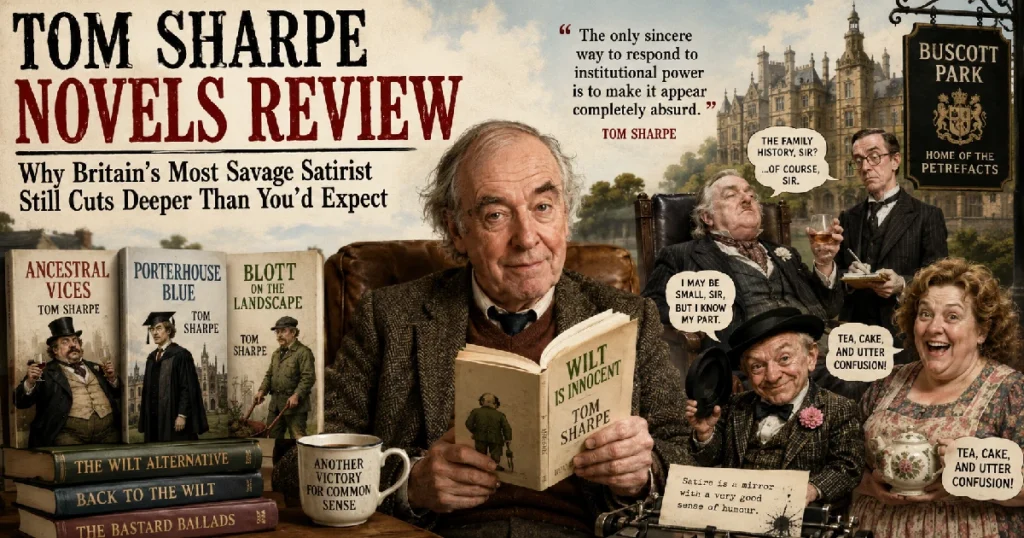
There’s a certain kind of laughter that comes out of nowhere—not the courteous chuckle at a joke at a dinner party, but the helpless, slightly alarmed kind that escapes when you’re reading on a train and all of a sudden realize that everyone is staring and the carriage has gone silent. That laugh comes from Tom Sharpe’s novels. Regularly, almost brutally.
Tom Sharpe (1928–2013) worked as a social worker and teacher in South Africa for a part of his early career, which undoubtedly sharpened whatever was already inside of him. The satire that emerged when he returned to England and started writing was harsh. It was not the sophisticated humor of someone making jokes from a safe distance. It was more akin to someone who had thoroughly examined institutional power, including its absurdities, self-delusions, and small-time cruelties, and concluded that the only sincere way to respond was to make it appear completely absurd.
The 1980 book Ancestral Vices is still arguably the best example of what Sharpe was capable of when everything came together. On paper, the setup seems almost academic: Lord Petrefact, one of the richest men in Europe, calls Professor Walden Yapp, a devoted socialist with strong opinions about class and exploitation, to look into and record the Petrefact family history. Sharpe may have selected this specific collision—idealistic academic meets grotesque capitalist patriarch—because no other combination so effectively reveals the conceit of both parties. What starts out as a fairly logical arrangement quickly devolves into something completely different from what either party had anticipated.
There is a sort of gleeful disdain for Lord Petrefact himself. He reads less as a character and more as a composite caricature of every domineering patriarch who ever sat at the head of a boardroom table believing the world owed him deference. He is conceited, haughty, and capable of maneuvering even from his sickbed. Sharpe nevertheless keeps him humorous. The trick is that. A poorer author would have allowed Petrefact to turn into a villain. If anything, Sharpe keeps him on the verge of self-parody, which is more disturbing. Some of the most subtle comedic moments in the book are provided by his confidante Croxley, who is devoted, patient, and subtly enraged. One such instance is a dinner scene that is incredibly well-timed.
It’s still unclear if Sharpe intended Willy Coppet, the dwarf who plays a major role in the mayhem in Buscott, to be merely comedic relief or to have more significance. Now that I’m reading him, the character seems to be both at once: a comic figure with a subtle outrage about whose lives are used as props in other people’s tales hidden beneath the slapstick. Rosie, his wife, serves as the book’s warm, slightly chaotic heart. She is cheerfully unaware and in some ways the most morally straightforward character in the whole book. She is unquestionably the funniest part of it, and she does it with such ease that Sharpe never seems to strain.
The domestic setting is what gives the Wilt series its distinct texture. Henry Wilt is the type of character that readers either instantly recognize or refuse to acknowledge they recognize. He is a liberal studies lecturer at a technical college who is stuck in a career that is going nowhere and a marriage that has the atmosphere of a low-grade siege. Sharpe puts him in situations that are progressively more bizarre and insane: an inflatable doll, a police investigation, or a series of misconceptions that are so complex that they take on the characteristics of their own architectural style. Because Wilt writes without disdain, the novels are successful. He hasn’t exactly been made fun of; rather, he’s been treated with the same amount of pity as someone who keeps going through the same door.
In Porterhouse Blue, Sharpe is transported to the historic quadrangles of a fictional Cambridge college, where the targets seem even more intimate. The novel’s depiction of institutional resistance to change—the dons, the customs, the gradual stifling of anything truly novel—reads like someone who has actually spent time inside those walls and come out with conflicting emotions. Similar energy is used by Blott, the groundskeeper in Blott on the Landscape, an underappreciated character who ultimately proves to be far more capable of chaos than anyone gave him credit for.
George Orwell comparisons are unavoidable and not wholly inappropriate. Both authors were aware that satire is most effective when it refuses to give anyone a clean slate. Sharpe, however, continues to laugh at Orwell’s depressing conclusion—the boot stamping on the human face, forever. It’s not exactly a relaxed laugh. Ancestral Vices, Willy Coppet’s journey, and the novel’s concluding arrangements all contain elements that linger in your memory in an uncomfortable way. Nothing is really resolved by the laughter. For a while, it simply makes the underlying discomfort easier to bear.
The accuracy with which Sharpe calibrated his targets is difficult to ignore. Both capitalists and socialists make his novels appear pretty awful. Academics are self-serving. The nobility is corrupt. The police lack competence. Ordinary people struggle in the middle, mostly perplexed by those who say they are acting in their best interests. What prevents the books from dating as badly as they might have is their constant refusal to let any ideology have the final say. The distinctive features of 1980s England, such as the desktop computers, the colonial-era homes, and the unique suburban texture of England prior to the invention of mobile phones, have become nostalgic. However, there has been little change in the dynamics.
Sharpe wrote with a delicate touch that belied his meticulousness. The plots move quickly, the language is understandable, and the characters make their identities clear right away. Sometimes novice readers find him to be a simple pleasure, only to discover later how much was truly going on beneath the surface. In retrospect, that seems to be exactly correct. The best satire never makes a big deal out of it. It allows you to laugh first, saving the more difficult thought for later, when you’re setting down the book and the carriage has once again become silent.