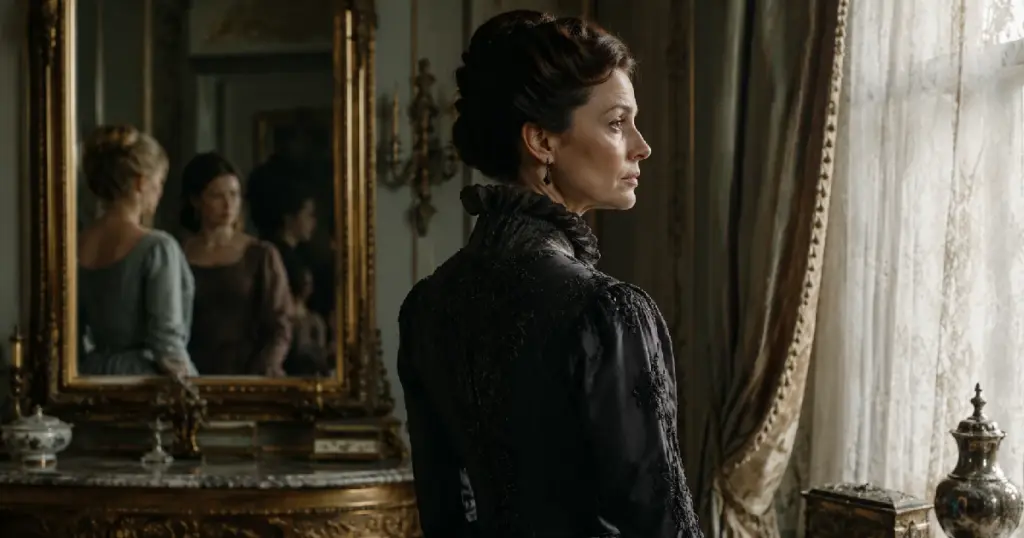
When a story is told incorrectly long enough that the correction feels more like a reckoning than a twist, there is a certain satisfaction that results. That’s what Rachel Hochhauser’s Lady Tremaine accomplishes—not cunningly or with a wink, but with the kind of steady, slow authority that only comes from a writer who truly feels her subject merits the page.
Everyone is already familiar with its shape. The ball, the glass slipper, the flawlessly timed fairy godmother. Cinderella is kind, meek, and mistreated. Lady Tremaine is ruthless, cunning, and icy. The moral architecture of the story feels almost geological because it has been told so many times; it is timeless and unchanging. To her great credit, Hochhauser does not attempt to dismantle it. She takes a more subdued radical action, going to the rear of the house and knocking on a completely different door.
Born Etheldreda Verity Isolde Tremaine Bramley, the daughter of a brewer, Her Lady Tremaine grows up in a society where her father’s occupation is respectable but never quite sufficient. There is only one possible course for a woman in her situation, and she is aware of it at an early age. Marriage is more about strategy than romance, and in her time and social standing, strategy is essentially just another word for survival. Her calculated thinking may initially seem unsettling to some contemporary readers. But the whole point is that calculation.
The depth Hochhauser adds to Ethel’s first marriage is what sets Lady Tremaine apart from lesser revisionist fairy tales. Henry Tremaine, a golden-boy merchant’s son she meets over years of hunting seasons, is more than just a useful plot device; their courtship is gradual and molded by shared afternoons of falconry. It has an almost tender quality. And since readers already know how this ends, that tenderness is devastating in hindsight. Grief over his passing doesn’t appear as a plot twist; rather, it develops like the weather.
When Hochhauser presents Elin, the unmothered daughter of Lord Bramley and the future Cinderella, it is difficult to ignore the accuracy of what she is doing. Here, the book exercises caution and even generosity, recognizing that young Elin is not being malicious in her refusal to help out around the house; rather, she is clinging to her own gentility as the last thing she has after losing her father. Ethel has a deep understanding of grief. However, there is a limit, and it feels less like villainy and more like exhaustion to watch Ethel reach it—watching a woman who has fought for every bit of stability she has and buried two husbands gradually lose patience for a girl who won’t do anything.
The analogy to Wicked by Gregory Maguire is not coincidental, nor is it incorrect. The question of what happens when you look away from the officially recognized hero is a common theme in both books. In both situations, they discover that the alleged antagonist has a complete life and logic that the original narrative just could not accommodate. Maguire did it darkly and wittily. Hochhauser exercises a kind of painful self-control. Both are devastating in their own way, but they have different effects.
Ethel’s self-awareness regarding desire is where the book transcends its clever inversion. She is aware that a marriage can be violent even in the absence of a violent man, in the abstract way that women in her era were compelled to understand. That’s what she says. Nevertheless, she made the decision to pursue desire, first in Henry and later in the life she is attempting to create for her daughters, Matilda and Rosamund, who appear in the book as the one thing she does not doubt or compromise. Ethel serves them with everything she does, even the actions that appear cruel on the outside. When you realize what the machinations are really protecting, they take on a different appearance.
Hochhauser purposefully leaves open the question of whether Elin, who goes on to become Cinderella, who receives the prince, and who receives the fairytale, is truly worth saving. Even Ethel is unsure. There is a tension between her and her stepdaughter that never quite goes away, and she didn’t go into court with her out of pure love. The novel is not flawed by this ambiguity. It is the most sincere and human aspect of the book. Families don’t always fix themselves. Not all women are able to forgive others on time.
On the shelf of literary fiction that explores women’s lives from the inside out rather than the outside, Lady Tremaine is seated comfortably next to Weyward and Clytemnestra. It is, in the best sense of the word, a corrective—the kind of book that forces you to reexamine something you believed you understood and discover you were only ever seeing half of it.