
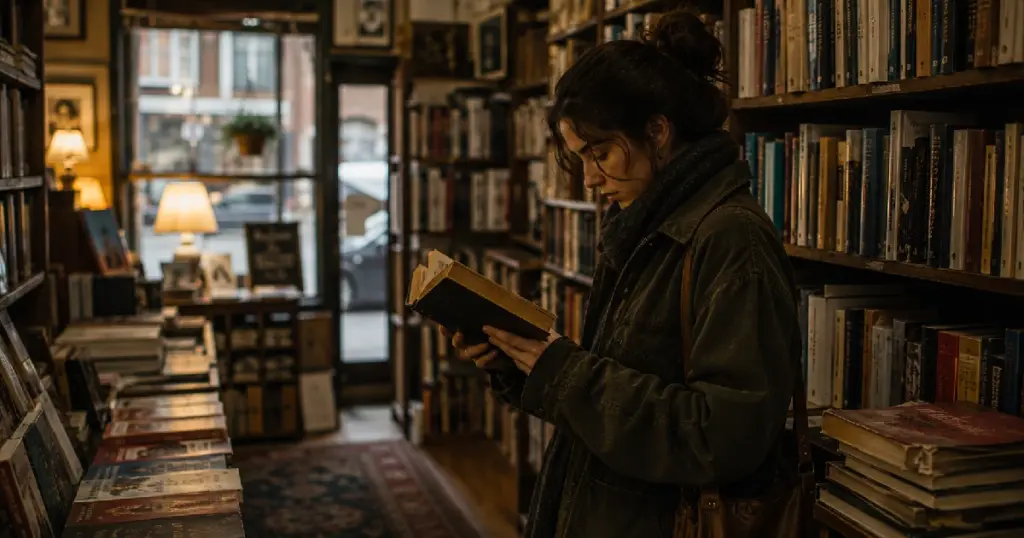
There are books that no algorithm will ever turn up somewhere in a used bookstore, the kind with a handwritten sign on the door and shelves that lean slightly inward from the weight of too many decades. Barnes & Noble does not have a TikTok shelf. They have not been subjected to a ring light on BookTok. They operate completely outside of the recommendation loop, just in case someone happens to be searching for something they haven’t yet been able to identify. These books appeal to a certain type of reader. Additionally, it’s becoming more difficult to explain what they discover there without coming across as overly idealistic.
The freedom to read a book that no one else is discussing is genuine and unique. It’s not the freedom to be contrarian for its own sake or to necessarily find something better. It is more akin to having the freedom to form an opinion before one has been formed for you. The reader arrives already carrying a version of the experience when a novel follows a wave of discourse, such as tweets, podcasts, morning show segments, or reading group consensus. None of that is present in the book you discover in a dusty stack in a store on a side street. Each page is truly unfamiliar. No one else has a place at the table; the relationship is between you and the text.
Thirty years ago, Sven Birkerts wrote in The Gutenberg Elegies about what he called the loss of “interiority”—the inner life that slow, in-depth reading fosters and that is gradually undermined by the cacophony of networked information. At the time, he was ridiculed by critics for being a Luddite and a paper-clinging curmudgeon. His argument is more difficult to reject in light of the current state of affairs. He maintained that the internet was a completely different kind of reception, frenetic, hyperlinked, and resistant to the prolonged inward drift that a novel demands, rather than merely a different medium for the same information. He wrote that a book on a shelf is a universe unto itself. It’s different when the same text flickers on a screen.
The extent to which the algorithm has permeated reading culture is difficult to ignore. BookTok is a real phenomenon; it has boosted actual physical book sales, encouraged younger readers to return to print, and fostered welcoming and passionate literary communities. It’s all worth acknowledging. However, the unintended consequence is a sort of homogenization, a reduction in what is worthwhile reading to what appeals to the appetite of the moment. According to a recent Literary Hub article, it’s helpful to know what you like, but a lot of what people read these days is determined by what sells, or at least by the notion of what sells. Most of the books that don’t fit that shape vanish.
George Orwell’s Nineteen Eighty-Four contains a passage that has a different significance today than it did when the majority of people first read it in school. Winston Smith writes his private thoughts in a place that the surveillance equipment cannot fully access by holding his paper diary just out of sight of the telescreen. According to Ed Simon’s article in Literary Hub, the telescreen in that book is outdated in comparison to the smart speakers, behavioral data, and recommendation engines that track each click that readers encounter today. Winston Smith knew instinctively that a printed book, especially one that is completely outside of the digital ecosystem, provides a space that the algorithm is unable to access. You don’t need to watch what you do with it to read it.
Additionally, reading a book that no one is discussing has a more subtle effect on the mind. You are left to construct your own interpretation from the ground up without the support of other people’s responses, which is more difficult, slower, and satisfying than it may seem. These books require more of the reader because they don’t offer an external framework, such as the obscure history of a forgotten philosophy, a novel from a small press that never made it, or a decades-old memoir from someone who lived on the brink of something important. What it means is up to the reader. It’s not always cozy. Discomfort might be a component of the value.
Over the past 20 years, the number of Americans who read for pleasure has decreased by about 40%; this figure is frequently mentioned but infrequently absorbed. It’s still unclear if the social media-driven reading renaissance will permanently reverse that decline or if it will only draw attention to an ever-tinier selection of acceptable books. The books that are sitting outside of that band—unreviewed, unBookTokked, and inadvertently discovered on the wrong shelf—seem to be waiting more for recognition than for discovery. There’s a distinction. Discovery suggests that something is concealed. Anyone willing to look somewhere the algorithm isn’t pointing can easily find these books.
Quietly and without fanfare, that type of reading is evolving into a modest act of self-reliance. It’s not very dramatic. Just making the straightforward decision to focus on something the feed didn’t recommend, creating ideas that are wholly unique to the individual thinking them, and enjoying the unique quiet that only an untracked page can offer.