
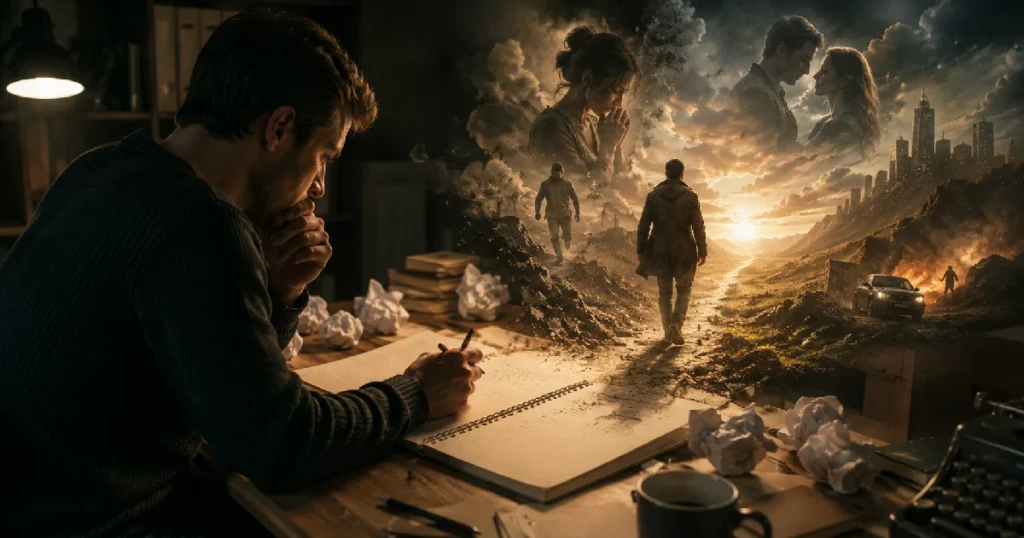
One sentence sounds like a story, but it’s not. “I awoke. I had breakfast. I departed for my job. There is a protagonist in it. There is a series of events in it. It even has what appears to be a beginning, middle, and end if you squint at it long enough. However, no one would read it. No one would recall it. There would be no emotion at all.
Most writers become stuck in that space between what appears to be a story and what actually works as one. Furthermore, it’s a gap that proves to be more intriguing than any structural formula. For many years, writing instructors have taught the three-act model, treating it as if it were a load-bearing wall. However, the reality is more in line with what Aristotle discovered in a room somewhere in ancient Greece a few thousand years ago: a story’s structure does not define it. It’s transformation.
The beginning of a story is more than just the first event in a sequence, according to Aristotle’s Poetics. It is the emotionally compelling beginning event that throws a person’s life off course. This distinction is more important than it seems. Because once you realize that, you begin to realize that the majority of what early drafts refer to as “story” is actually just reporting. A series of connected events. Nothing is wrong. No one is evolving. According to one author, a pickle description technically has a beginning, middle, and end. It’s not a story because of that.
Something must go wrong for something to truly become a story, which is both easier and more difficult than any formula. There must be a person who desires something, a force that keeps them from obtaining it, and a struggle that gradually and unavoidably transforms the person. The engine is tension. not unexpected turns in the story. Not a very clever structure. Just the pounding, mounting burden of unmet desire. It’s possible that authors reject this notion because it sounds almost too direct, too robotic for something as intimate as fiction. However, observe what happens when a reader becomes engrossed in a book at midnight and is unable to put it down. That is not the function of structure. That’s tension at work.
The five essential elements of a story—a means of orienting the reader, a crisis that turns the character’s world upside down, an escalation of consequences, a moment of discovery, and ultimately an irreversible change—do not need to be checked in the correct order. They are more akin to components that must be mixed under the correct circumstances to create something new. Steven James, whose craft writing has focused on these concepts for years, compares it to baking a cake: the transformation that takes place in the oven is what matters, not the individual ingredients. Perhaps that image is a little neat, but the idea is still there. Stories are about change. Completely stop.
The difference between what James refers to as “pebble people” and “putty people” is more difficult to teach and even more difficult to implement. Unaltered, a pebble bounces off the wall. Putty absorbs the impact and transforms into something new. Pebble people going through the motions make up the majority of failed stories, which feel flat even when the plot is technically busy. They experience things. Many things, at times. However, they are essentially the same person at the end as they were at the start. And without being able to identify it, readers sense that absence. They’ll claim that the plot moved slowly or that they didn’t relate to the character, but what they really mean is that nothing was changing anyone.
A story’s central crisis need not be dramatic in the Hollywood sense. George is let go. Amber’s son disappears. Larry’s physician gives him unexpected news. What counts is that the character’s typical life, however that may be defined, is disturbed in a way that is not easily undone. The plot revolves around the character’s transition from their previous selves to their new selves. Whether you’re writing romance, crime fiction, or literary novels, this is true. Instead of the underlying need for a crisis, genre shapes its texture.
It’s difficult to ignore how much writing advice concentrates on the negative aspects of this issue. These techniques—such as midpoint reversals, three-act structures, and save-the-cat moments—exist because they have assisted writers in organizing their work, and there is nothing wrong with that. However, when they are viewed as the source of a story’s life rather than as a means of characterizing what a living story occasionally looks like, they become problematic. An octopus can survive without a skeleton. The specific type of story you’re trying to tell doesn’t always require the bones, and insisting on them can stifle what you’re really trying to create.
Watching someone they care about go through something they couldn’t avoid and come out as a different person is what readers want, and this seems to hold true across cultures, eras, and formats. They wish to guess the conclusion of the story and be mistaken. They want the resolution to feel both unexpected and inevitable, like a door that opens precisely where it should have. Perhaps the closest thing to a universal law in storytelling is that blend of the unexpected and the earned. It’s not a recipe. It’s an emotion.
Therefore, no single component is the secret ingredient. It’s the connection between all of them—the tension that arises when resistance and desire collide, the gradual transformation of a person under duress, and the epiphany that transforms everything. Readers from various nations, languages, and eras can recognize something true when those things are truly present. Not because the story is universal in some abstract way, but rather because everyone has experienced the pressure of wanting something and not being able to obtain it in a very particular, tangible, and obvious way.
That can be followed by structure. It ought to come after that. The length of the middle, the number of acts, and the positioning of reversals can all be determined by the needs of the story rather than the formula. Because the recipe doesn’t matter to the cake. It doesn’t give a damn if it tastes good.