
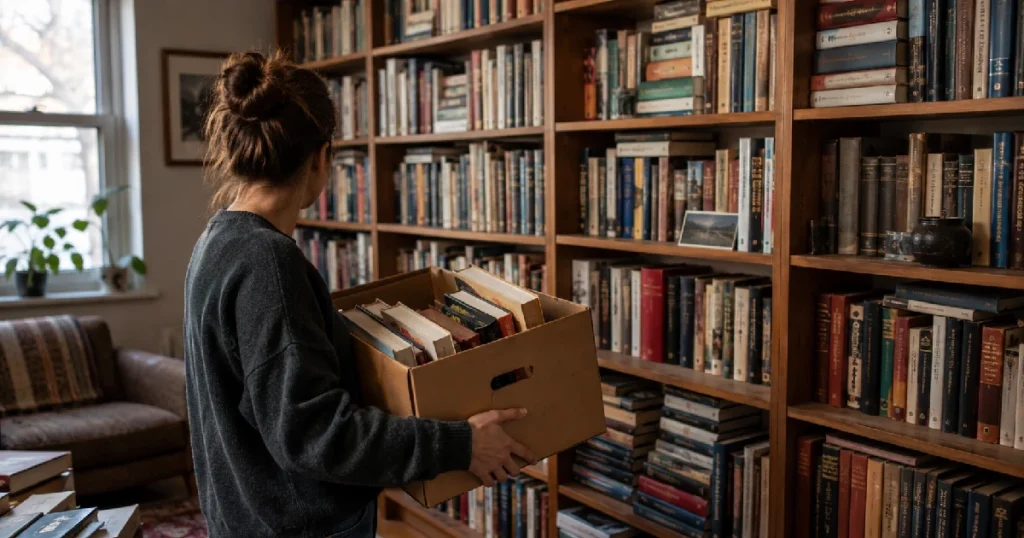
Standing in front of your bookshelves with a cardboard box makes you feel a certain kind of dread. You’ve convinced yourself that this is the right course of action because the attic is full, the shelves are bowing, and there is no more space. However, there is a resistance. Not sentimentality, precisely. Something more in line with instinct. The books are placed inside the box. They then reappear a few days later. Almost everyone who reads regularly experiences it, and it’s not a sign of weakness. In fact, it could be wisdom.
Books are not like consumer goods, according to Umberto Eco, one of the most well-known and well-stocked book collectors of the past century. They are more akin to medications in that, although you don’t take everything in the cabinet at once, you are grateful that it is available when you need it. “Those who buy only one book, read only that one and then get rid of it,” he said, “simply apply the consumer mentality to books.” He implied that the rest of us know that a book that is just sitting on a shelf is not a waste. The book is on hold.
One story effectively illustrates the practical case for holding on, which is easier to make than most people realize. On a Tuesday, a writer removes a weather book from a church fair haul; they haven’t read it and probably never will. A commission to write a book about British weather arrives by Friday. It is necessary to buy another copy. The original has vanished. The lesson is straightforward and somewhat humorous: the difference between “probably unnecessary” and “suddenly essential” can be measured in days, and you cannot predict when a book will become exactly what you need.
It’s difficult to ignore how frequently this reasoning applies throughout a functional library. When a research chapter requires them, books with footnotes that have been unread for years suddenly become essential. On a back shelf, half-forgotten novels provide the perfect example at the perfect time. It’s not irrational for a writer to keep everything. They are keeping an archive. The distinction between a tool shed and a showroom is similar to that between a functional library and a neat one: one is for use, while the other is for viewing.
What is lost when books disappear is another issue. When Summer Brennan tried Marie Kondo’s well-known organizing technique on her collection of over 500 volumes, she discovered something unexpected between the pages: boarding passes, letters, pictures, a fragrant fig apricot soap wrapper, and her own 1998 New Year’s resolutions. Stories had not been the only thing kept in the books. Her life had been stored by them. “Our books don’t really belong in the category” of belongings that need to be sorted and discarded, she wrote. She contended that they should not be treated the same way as outdated sweaters or kitchen appliances because they are more akin to mementos, which are containers for life’s moments.
Particularly on a sunny spring weekend when the shelves seem to close in, Kondo’s strategy has a certain allure. She contends that unread books should be thrown away and that the best time to read a book is when it first comes into your possession. It’s a clean philosophy. It’s also not quite right for serious readers. Emptying the pantry of everything you won’t be eating for dinner tonight is about as sensible as throwing out every book you haven’t read because you haven’t had a chance. It is rarely possible to plan the timing of your appetite, whether it be for food or ideas.
Linda Grant had to learn this the hard way. She had to make difficult choices regarding her collection after moving from a four-story house to a two-bedroom apartment, giving up titles she had persuaded herself she could live without. When she got to the new apartment, she measured the shelves and discovered there was more room than she had anticipated. Too many books had been discarded. The missing ones could not be fully recalled because a replacement ordered online is not the same as a specific copy of a particular edition obtained at a particular time. There is a loss in the transaction. It’s the same book. It’s not the ownership experience.
This may be the reason why readers have never fully embraced the minimalist vision as they have in other spheres of life. The tastefully vacant apartment serves as an aesthetic, offering a sense of liberation, a spotless surface, and nothing in the way. However, it makes the assumption that things are interchangeable and that you can retrieve anything you lose. Books disagree with that presumption. In ways that go beyond the words within, they build up associations, identifying themselves with the owner.
A book can remain unread for a millennium until the right person discovers it, according to a quote by George Steiner. It’s probably a little over the top. However, the fundamental idea is sound. The book on the shelf is fulfilling its purpose. It’s waiting for the time when you’re ready or when it turns out to be exactly what you were searching for. It’s not tidying to get rid of it before that time comes. You’re taking a risk against yourself, and the chances aren’t very favorable.