
There is a particular type of fatigue that currently lacks a clear term. It shows up after you’ve been scrolling for forty-five minutes without reading anything, or after you’ve closed fifteen browser tabs that you opened with the best of intentions but never got around to. It is the sensation of being somewhere without moving, of having eaten without getting anything, of being surrounded by voices and yet oddly, blatantly alone. For more than ten years, fiction has attempted to articulate that experience. Some of it has been remarkably close.
The books that are now collectively referred to as “the very online novel” came out at a time when literary culture was still debating whether or not the internet was a suitable topic for serious fiction. There was a long-standing, largely unspoken belief that digital life was somehow less authentic than real life; that friendships formed over direct messages were less meaningful than those formed over coffee, and that spending hours in front of a phone screen was more closely related to real life than it was a part of it. The sociologist Nathan Jurgenson once referred to this presumption as “digital dualism,” but it has quietly crumbled under the weight of how most people now live. One broken paragraph at a time, fiction has also been dismantling it.
For some reason, when this topic comes up, most critics turn to Patricia Lockwood’s 2021 book No One Is Talking About This. The first half reads less like a novel and more like a simulation of the mental state that results from spending years online. It is fragmented, associative, fluent in the private language of memes and platform-specific humor, alternating between genuine wit and a kind of hollow momentum that keeps going because stopping would mean facing the void beneath. Lockwood refers to the internet as “the portal,” and his word choice is exact. A portal leads to another location. By definition, it doesn’t remain where you are. The first half of the book depicts the unique cognitive texture of that life with a fidelity that feels almost intrusive. The unnamed protagonist of the book lives partially inside that elsewhere, navigating panels, speaking engagements, and the accumulated texture of two decades of internet culture.
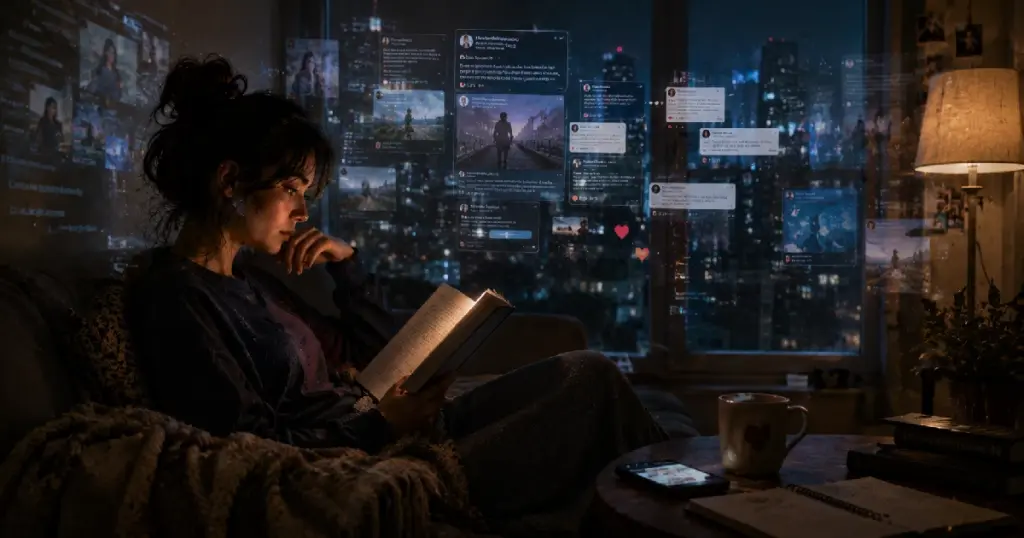
The second half of the book, when the protagonist’s sister gives birth to a child with a rare syndrome and the portal recedes, is what elevates the work beyond a technical exercise. Although it doesn’t have to be, the contrast is not subtle. The emotional register of the book’s second movement earns Lockwood’s question in a way that pure formal experimentation probably couldn’t. Lockwood is making an argument, or at least posing a question, about whether humanity survives the scroll, about what remains when the feed goes quiet.
Fake Accounts by Lauren Oyler takes a sharper, more satirical approach to the same subject. The novel takes place over the course of a darkly humorous trip through Berlin after the narrator learns that her boyfriend has been operating a well-known conspiracy-theory account on the internet, showcasing a fake version of himself to thousands of followers. Oyler is examining a particular aspect of digital identity: how individuals create personas for online consumption, how those personas deviate from what is genuinely true, and how confusing it becomes when the divide between the two abruptly closes. Perhaps the purpose of the purposeful irony in the prose is to alienate certain readers. The storyteller is alienating. The internet is the same. In certain uncomfortable ways, the form aligns with the content.
Several People Are Typing by Calvin Kasulke adopts a completely different strategy, placing its narrative inside a PR firm’s Slack workspace during the pandemic. While his physical body continues to go about its everyday business without him, one character’s consciousness becomes trapped in Slack, literally unable to leave the platform. It sounds absurdist as a premise, and it is, but it also captures something that is actually true about remote work and the pandemic in particular: how a person’s social reality can consist entirely of a screen, a job, and a string of notifications for months at a time. The question of whether that qualifies as presence or absence is posed fairly directly in the novel. Whether Kasulke intended the book to be a comedy or a horror novel is still up for debate. It serves both purposes.
All of this fiction raises an issue that critics have started to bring up but have not yet fully addressed: why does so much of it emphasize isolation over connection? After all, the internet does both. It creates feelings of belonging and loneliness in roughly equal amounts, sometimes at the same time. Grief, illness, and specialized interests give rise to forum communities. Through platforms that would not have existed in any previous era, queer people in hostile environments connect with one another. Years before they meet peers in real life, poets share their work on Tumblr. All of this is often filtered through a single alienated consciousness in the literary portrayal of internet life, which captures something genuine but misses something else: the genuine kinship, the communal noise, and the unique warmth of being understood by strangers who share exactly your corner of the internet.
It’s difficult to ignore the fact that even the most formally ambitious novels about the internet frequently rely on a single narrator who interprets everything else as content. In 1929, Russian literary theorist Mikhail Bakhtin wrote about polyphony in fiction, which is the notion that a truly democratic novel permits several independent voices to coexist without any one consciousness absorbing them all. Theoretically, the internet ought to be the ideal topic for that kind of book. Literary fiction hasn’t quite reached that point in practice yet. One of the few novels that truly dissolves the main authorial voice into a chorus of unverifiable, contradictory viewpoints is Dennis Cooper’s The Sluts, which was written in the mid-2000s and is set entirely within an online forum. This is arguably how the internet feels from the inside out.
Although it isn’t specifically about the internet, Raven Leilani’s Luster touches on the subject. Simply put, technology is present in the same way that it is for today’s youth: it is ambient, unquestioned, and shapes the nature of relationships, work, and desire without explicitly stating itself as a theme. In contrast to novels that treat the internet as a subject to be studied rather than an atmosphere to be breathed, the main character exists in the technological uncertainty of modern youth not as a commentary but as a condition, which in some ways makes the alienation feel more real.
Beyond their clear variations in tone and structure, these books all aim to be honest about a way of life that evolved more quickly than the vocabulary used to describe it. Interiority, the texture of thought, and what it’s like to be a specific person going through a specific moment in time have always been strong points of the book. All of that is made more difficult by the internet, which divides attention, distorts time, and creates connections that feel like isolation and isolation that feels like connection. Fiction is still figuring out how to manage all of that at once. The issue is not resolved by the best of these novels. They find it exactly, which is another and possibly more helpful thing.