
If you ask any writer where the real work is done, most will tell you that it’s in the middle, that vast, ambiguous area where characters defy your intentions and plot threads proliferate, where entire chapters are written and then subtly removed. Writers clearly suffer in the middle. However, if you speak with the readers, they will tell you a different story. They hardly ever recall the middle. The way it ended is what they recall.
The last pages of a book hold a disproportionate amount of significance in a reader’s memory for a reason. The experience of the conclusion filters everything that came before it, including the skillfully crafted scenes, the character development, and the thematic architecture. A powerful one enhances the book as a whole. A weak one does the opposite, undermining two hundred pages of otherwise excellent work. Although it’s an unfair arrangement, writers are forced to work within it, and those who are aware of it typically create enduring fiction.
The most enduring piece of advice regarding endings is “inevitable yet unexpected.” It can be found in writing guides, screenwriting seminars, and literary criticism. In the words of Oscar-winning screenwriter William Goldman, “give the audience what it wants, but not in the way it expects.” What appears to be a paradox is actually a fairly accurate explanation of how the best endings function. The Great Gatsby concludes in the only possible way. There is no other place for that book to go, both thematically and emotionally. However, the car accident’s randomness, Tom’s particular brutality as retaliation, and Daisy’s abrupt disappearance don’t seem to have been anticipated. It still lands on the tenth read. It’s not by accident that rightness and surprise come together. It is the product of a writer who was aware of his destination and skillfully crafted the journey so that the final destination is simultaneously startling and clear.
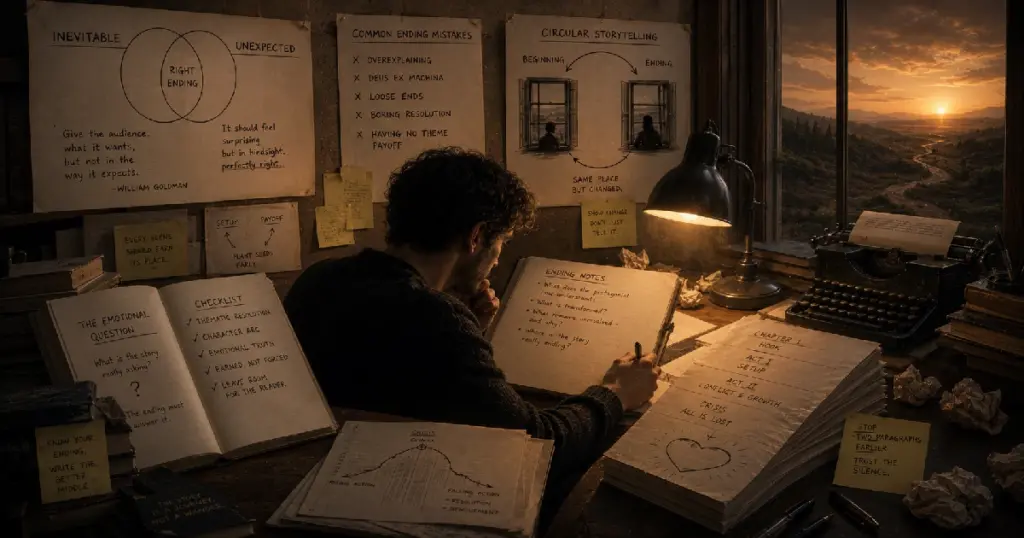
One of the most frequent errors made by working writers is the tendency to overexplain an ending, which is almost always a sign of something that occurred earlier in the manuscript rather than an issue with the ending itself. In an article about the revision process for her first book, Leigh Himes talked about spending months rewriting two pages that explained why her protagonist made a pivotal decision—arguing with her agent, defending the pages to her publisher—before realizing the explanation wasn’t necessary because she hadn’t done the work earlier in the book to make the decision feel inevitable. The moment was resolved in a single line when she went back and made revisions to the manuscript with that knowledge. An ending is typically not the issue if it needs a lot of explanation. The two hundred pages that come before it are.
This relates to something that seasoned screenwriters have long recognized and novelists occasionally oppose: knowing your ending before you start does not limit creativity; rather, it is the prerequisite for it. Every scene in the middle has a purpose when the destination is evident. Decisions that could otherwise seem random, like which details to include, which conversations to focus on, or which pictures to repeat, suddenly have purpose. Knowing what needs to bloom allows the writer planting seeds to know which seeds to plant. Whether or not their authors intentionally planned it, the best stories typically follow this structural logic, so working backward from the conclusion is not a trick.
The technique known as “circular storytelling,” which involves mirroring the beginning of a narrative in its final moments, is one of the more underappreciated methods for effectively concluding a story. This could be a recurring image, a scene that has been returned to, a passage of speech that now has a different meaning, or a gesture that echoes a previous one with a different weight. When done subtly, the effect gives the impression that the story is finishing itself rather than the author. At the end, the protagonist who stood at a window in the first chapter, gazing out at something they couldn’t quite identify, returns to that window, but this time they are seeing instead of just looking. Compared to pages of explicit resolution, that shift, recorded in the same physical space, can convey more emotional information.
Since the deus ex machina issue is more prevalent in modern fiction than authors would like to acknowledge, it is important to be open about it. The term literally means “god from the machine” because ancient Greek playwrights would use a crane to lower a god onto the stage in order to resolve impossible dramatic situations. The gadget has never truly disappeared. The convenient coincidence, the unexpected inheritance, and the outside force that resolves an issue that the protagonist ought to have resolved on their own are just new costumes. Even though they are unable to pinpoint the exact source of their annoyance, readers often feel deceived by this forgiveness. The work must be done by the protagonist. Although it cannot be the solution, an external force can act as a catalyst.
Additionally, there is the issue of precisely where to stop. It makes sense, but it is typically counterproductive, to continue after the pivotal moment of impact—to describe the years that follow, to confirm what happens to every character, to leave no loose thread unaddressed. In a piece about endings, Grant Faulkner recalled hearing that the best way to conclude a story is to end it two paragraphs earlier than you would think. Because it tackles a genuine aspect of how endings function, that advice has endured. Any amount of narrative epilogue is not as interesting as the reader’s imagination when it is triggered at the appropriate moment and then let loose. The silence that follows the story is an integral part of the narrative, and a writer who relies on that silence frequently creates an ending that resonates for a longer period of time than one that fully explains itself.
When you read the endings that stick with you for years, it’s difficult not to feel that something almost intuitive is happening in the best of them—something that defies easy breakdown. And that’s most likely accurate. However, the intuition is typically trained intuition, developed from an awareness of what endings actually accomplish: they resolve not only plot but also emotion, providing an answer to not only events but also the question the story has been posing since its first pages. The writer with the best chance of reaching a worthwhile conclusion is the one who keeps that question in mind throughout—who knows what the reader has been waiting to understand, even before they realize it.