
On a Saturday afternoon, stroll into a respectable bookstore and observe what’s going on. A person is reading the back of an unknown paperback while crouching close to the ground. Without any specific system, an adolescent is taking items off a shelf. A woman by the window has been standing there for ten minutes without moving, seemingly content with the situation. Nobody is in a hurry. No recommendation is given to anyone based on their past actions. The whole thing runs on a logic that Silicon Valley has spent two decades trying to make obsolete — and somehow it’s still there, still full of people.
Barnes & Noble opened sixty new stores in 2023. Nearly three hundred independent bookstores opened across the United States in that same year. These are not the numbers of a dying medium finding its last few customers. They look more like the numbers of something that went quiet for a while and is now, somewhat defiantly, coming back. It’s still unclear exactly why, and anyone who claims to have a clean answer is probably oversimplifying. But there are a few threads worth pulling.
The writer Paul Vacca put his finger on something important in an essay a few years back, drawing on a concept Donald Rumsfeld — of all people — accidentally made useful. Rumsfeld had divided knowledge into three categories: the known known, the known unknown, and the unknown unknown. In this case, the third category is crucial. It talks about the things we don’t know we don’t know, like the books that would change the way we think about something, the writers who would become significant to us, and the topics we didn’t realize we were interested in. Despite its incredible scope, the internet is structurally inadequate for providing these. Your trail is followed by the algorithm. It creates a picture of what you already enjoy and provides you with slightly different versions of it. According to Vacca, it’s a “smooth serendipity”—movement that feels like exploration but mostly stays near familiar territory.
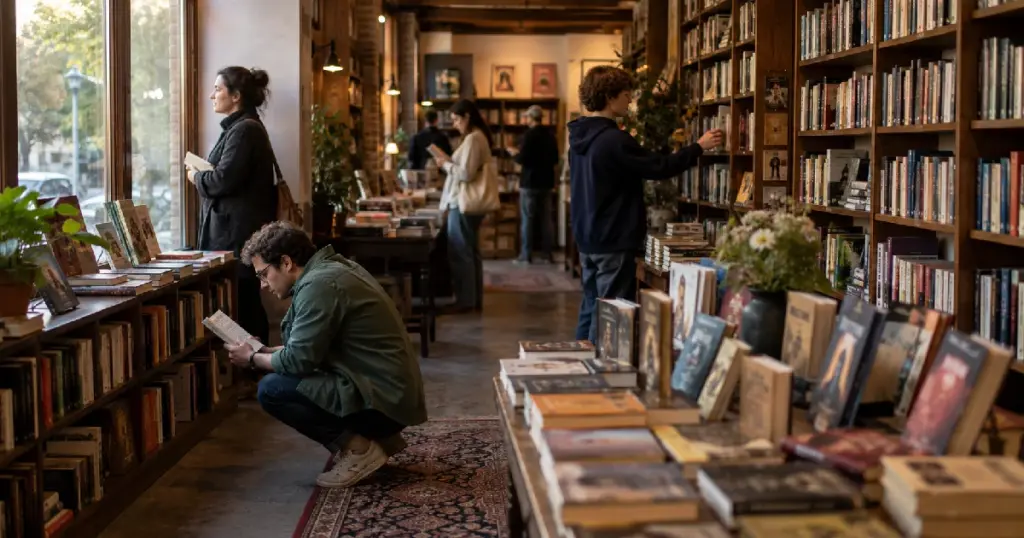
A bookstore operates in a different way. You enter with one goal in mind and emerge with three, at least one of which was unexpected. That isn’t an inefficiency accident. That’s the whole idea. The person behind the counter at a well-run independent shop is not aggregating your purchase history and cross-referencing it with customers who bought similar items. They’re making a judgment — about what’s interesting, what’s underread, what deserves to be pressed into someone’s hands this week. That kind of curation involves taste, which is a thing algorithms still haven’t convincingly replicated, though they keep trying.
There’s also the matter of what screens do to a body over the course of a day. Most people working in offices or spending significant time on phones already know this without needing a study to confirm it — the eyes get tired in a specific way, attention starts fragmenting by mid-afternoon, the brain starts skipping rather than reading. A physical book doesn’t emit blue light. Notifications are not sent by it. It is unaware that you have seventeen open tabs. Even though it’s difficult to measure, picking one up after hours of screen time feels genuinely different in the body.
Although it’s easy to make fun of a bookstore’s sensory aspect—the “smell of old paper” as a marketing slogan has practically become a cliché—the underlying point it makes is genuine. Books in physical form have texture and weight. A digital library lacks the visual logic of a shelf of them. There’s something about dog-earing a page, going back several chapters to double-check a detail, and realizing how far you have left to go that makes you feel differently about the content than scrolling. Studies on retention consistently demonstrate that printed pages are easier for readers to understand and retain than screens. This is most likely not a coincidence.
Beyond their retail role, bookstores have evolved into what sociologists and urban planners refer to as a “third place,” where people congregate without a clear transactional goal. This is how libraries have always been. This is what cafés have been. At their best, bookstores have strayed into the same area, holding readings, book clubs, author events, and discussions about their merchandise with strangers. Observing this in a reputable independent store gives me the impression that it’s filling a void that people were unaware of until it began to reappear.
It would be dishonest to pretend the economics are simple. It’s challenging to run a physical bookstore, and many cherished ones have closed over the years due to rent increases and the ease of next-day delivery. It is genuinely unclear if the current momentum is a long-term cultural shift or something more transient. However, something more than nostalgia is suggested by the fact that new stores continue to open and that people continue to show up on Saturday afternoons to crouch close to the floor with no specific purpose. It implies that no matter how quickly a book is delivered, it is impossible to fully replicate what a bookstore offers by clicking from a sofa.
Jeff Bezos created something truly remarkable. That isn’t really up for debate. However, what he created is optimized for knowing what you want before you enter. The bookstore’s ability to show you things you didn’t know you wanted is its oldest and most enduring advantage. That could be more valuable than it seems in a world that continues to improve its ability to predict us.