
A group of women on a death march up a haunted mountain witness a giant creature made entirely of human legs emerge from a pond and devour a fourteen-year-old girl in a scene that occurs about two-thirds of the way through the Modelland book. The girl’s arms are then placed on the creature’s head, and the musical instruments integrated into its body begin to play a melancholic tune. The story continues after a brief pause. Really, nobody says anything about it.
That’s the best way to describe what it’s like to read a young adult fantasy book written by Tyra Banks in 2011. Perhaps no book released in the past 20 years has been so magnificently and stubbornly itself. When the Modelland book came out in September 2011, right in the middle of the period when every famous person was putting their name on a teen book, it did something that none of those ghostwritten cash-ins were able to do: it became genuinely, utterly unforgettable.
The narrative centers on Tookie De La Crème, a girl so invisible that she has been lying in her school hallway for 39 days in a row to see if anyone will notice her. No one has. She lives in a world called Metopia, where Modelland, an enigmatic mountaintop academy where seven exceptional young women are selected annually to become Intoxibellas—fashion-powered semi-deities with superpowers ranging from shapeshifting to making people want to buy things—obsessively rules. One morning, a Scout emerges from a nearby lamppost, changes into a woman wearing a metallic jumpsuit, and carries Tookie away. The adventure, whatever it is, starts.
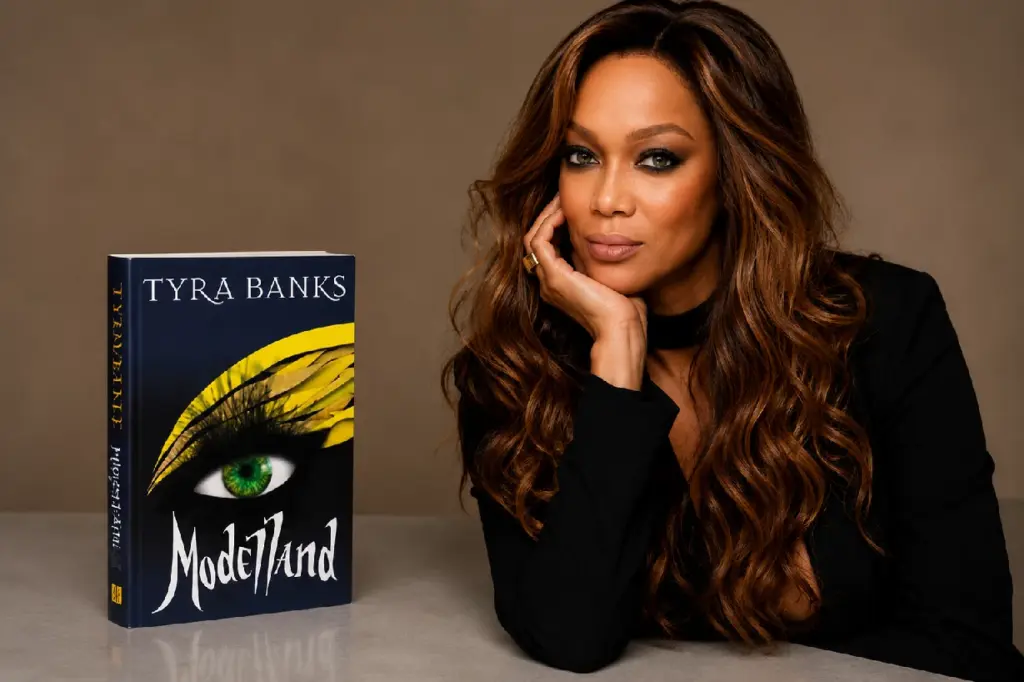
Drawing from what appears to be a direct pipeline from her imagination to the page, Banks creates a vast and serious world. Puns are used to rename nations: Brazil becomes Terra BossaNova, Australia becomes Digideroo, and India becomes Chakra. A dissertation could be written about the character names alone: Tookie’s mother is Creamy De La Crème, whose full maiden name is Cremalatta Defacakes, which is revealed toward the end of the book. One character, Ci~L, has a tilde in her name, and it takes several hundred pages to figure out how to pronounce it correctly (see-ell, since her mother “could see love”). Reading all of this gives me the impression that Banks wasn’t attempting to be humorous. She simply genuinely inhabits a more complex and unfamiliar mental universe than the majority of us.
Beneath the chaos, the Modelland book contains genuine, worthwhile ideas that make it extremely difficult to classify. The book’s main points—that girls who don’t fit a rigid mold should be seen, that beauty is arbitrary, and that the modeling industry is cruel and exploitative—are genuine. Banks obviously thought so. There are times when that message really shines through the clutter, especially during a mid-book argument in which Dylan, the only overweight girl in the school, lashes out at her friends for arguing about “unique features” and “atypical beauty” while neglecting the one thing that truly makes her an outsider. The scene is raw and awkward. Emotionally, everyone goes for ice cream right after and doesn’t talk about it again.
The school itself, Modell and the Academy, functions as a whimsically disguised site of enthusiastic cruelty. Before waking up in their new uniforms, new students undergo a hazing ritual known as Thigh High Boot Camp, where they watch their own faces rot and melt off (a trick), are attacked by sentient jewelry (a lesson about counterfeit goods), and have a giant sewing needle pierce their skull. Teachers seem to get away with making sexual remarks about fifteen-year-olds. Modelland took in all the “different” people who would otherwise be imprisoned and experimented on, according to a doctor with rollerskate feet for legs. This is an incredibly poignant piece of worldbuilding that is then completely abandoned and never mentioned again.
Whether any of this was deliberate satire or just the product of an incredibly active mind without editorial restraints is still up for debate. According to Banks, her initial manuscript was more than a thousand pages long. She also claimed that her hair fell out as a result of the stress of writing it. Both facts seem entirely plausible.
The book has a significant and loving reputation among what readers refer to as the “bad book” community—those who seek out entertainingly flawed writing with the same fervor others reserve for fine literature. Those who have read it seem to believe that Modelland stands alone. It’s not as bad as a careless cash-in. It’s bad in the same way that a fever dream is bad: it’s exhausting, internally consistent, and hard to ignore. I wanted to “take a bullet” for it, according to one review. That makes sense.
For a reader who enjoys following the author’s intentions, witnessing this book’s existence is an odd experience. It’s obvious that Banks has sincere opinions about the modeling business, including how young women are categorized and discarded and the discrepancy between the ideals of beauty culture and reality. The toxic nature of the industry is acknowledged in the book. Additionally, it genuinely wants you to want to go to Modelland. There is never a resolution between those two impulses. For six hundred pages, they merely circle one another, with sporadic interruptions from a leg-eating monster.
A trilogy was supposed to begin with the Modelland book. The third and second parts were never released. There may be thousands of pages of supplementary material out there that explain the true motivations of Hunchy the lizard mutant, whether the underground city beneath the school ever rose up in rebellion, and the significance of the Obscure Obelisks. We might never find out, too. In any case, everything that exists is complete in its own chaotic way: a book that defies all reasonable expectations, a cautionary tale about beauty that wants you to be beautiful, or a vision of hell that loves itself without conditions.
This was written by Tyra Banks. the entire thing. You are able to tell.