
There is a moment that occurs in libraries that very few people discuss. You enter with one goal in mind, such as a reference, a fact, or a quiet hour, and you depart with something completely different. Not necessarily a book. A notion. When you pushed through the front door, there was something restless and half-formed. It occurs too frequently to be a coincidence.
In a recent interview, author Douglas Westerbeke, whose first book became a quiet bestseller, stated bluntly that if he hadn’t been spending so much time at the library, he probably wouldn’t have written anything at all. “It changed my life trajectory,” he stated, “just by its very existence.” Saying that about a building is amazing. However, if you take the time to consider why bright minds continue to gravitate toward these locations, it begins to make an odd kind of sense.
Steven Johnson challenges the romantic myth of the unexpected breakthrough—the lone genius in the shower, the apple falling from the tree—in his incredibly readable book Where Good Ideas Come From. According to him, the majority of revolutionary concepts are “slow hunches.” They simmer. For them to eventually come together into something cohesive, they require exposure, time, and the proper kind of friction. Even though no one intended for libraries to be used for that process, it turns out that they are nearly perfectly engineered for it.
Ray Bradbury was aware of this. In a UCLA library basement, he punched dimes into a rented typewriter to write the first draft of Fahrenheit 451, a book about the destruction of books. After spending nine dollars and eighty cents, he had a tale to tell. Bradbury himself recognized the irony there. The establishment designed to protect knowledge turned into a warning about what happens when we stop appreciating it. That was not a setting he picked at random. Being physically surrounded by books while writing about their erasure, in his opinion, gave the work something it wouldn’t have otherwise.
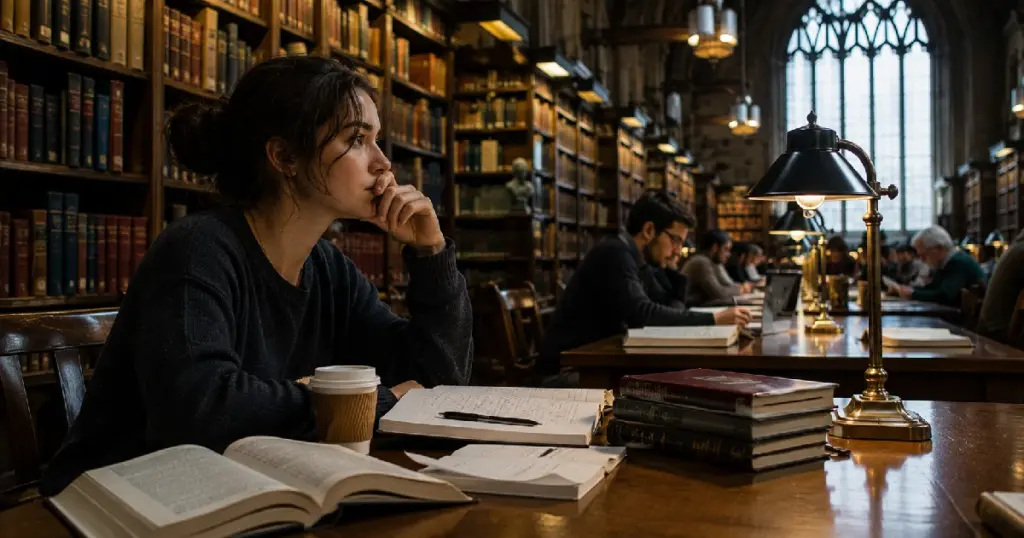
That intuition suggests something that sociologists have spent decades attempting to explain. What urban theorists refer to as a “third place,” separate from both home and work, is a unique category of space that libraries occupy. They bear neither the performance pressure of the latter nor the social obligations of the former. You don’t have to explain yourself if you spend three hours with a college student, a retired engineer, or someone writing their first screenplay. It turns out that this peaceful coexistence is not insignificant. Just by being close to one another and sharing a common environment, ideas can flow between people even when no words are spoken.
A library’s physical design also has an odd effect on the brain. Finding a book on migratory birds next to a volume on medieval navigation, for example, while searching through stacks for a specific title can result in an unintentional collision that is rarely produced by targeted digital searches. Your request is fulfilled by an algorithm. You get what you didn’t know you needed from a shelf. This seems to have come naturally to Madeleine L’Engle, who wrote twenty-five books while serving as a volunteer librarian in a Manhattan cathedral. The library was more than a place to work. It was a contemplative setting.
Exaptation is a helpful idea that is taken from biology. It refers to the process of using something for a purpose for which it was not intended, such as Gutenberg’s adaptation of wine press technology to produce movable type. This kind of lateral thinking has always been subtly made possible by libraries. One of the oldest libraries in Europe, the Bodleian Library in Oxford, is the setting for key scenes in Philip Pullman’s Book of Dust trilogy. The structure itself contains centuries’ worth of accumulated knowledge, and something about that weight seems to push creativity in unexpected directions.
It is difficult to improve on the directness with which Kristen Arnett, whose novels have garnered widespread critical attention, described it. According to her, libraries are places where you can be yourself and look for information about how you want to keep improving. Most settings don’t provide that pairing, which is the simultaneous occurrence of self-acceptance and self-expansion in the same space.
It’s possible that we’ve been viewing libraries incorrectly for a long time, viewing them more as places to store information than as places to think. The difference is important. Items are kept in a warehouse. A library does something more active with its unique blend of quiet and ambient life, its nearby shelves, and its peculiar democracy of who sits next to whom. It establishes the conditions necessary for a slow hunch to eventually discover the information it has been searching for.
According to a recent article by author and digital services librarian Andrew Weiss, libraries serve as humanizing institutions as long as they prioritize the needs of their patrons and stress community. Although it’s a subtle assertion, it has significance. The information itself is not what makes a library valuable in a time when most information is technically accessible everywhere. It’s the space. The unintentional meeting. The hour you spend searching for something and discovering something else.
In the company of everything that humanity has already discovered, brilliant ideas have always needed a place to develop gradually and without pressure. For centuries, libraries have quietly provided that. It’s odd that we continue to act shocked.