
Certain types of books are difficult to summarize. When you ask someone what The Remains of the Day is about, they will pause, try to find the right words, and finally say something like, “It’s about a butler who drives through the English countryside and thinks about his life.” which, in theory, is correct. However, it doesn’t really explain why the book lingers in the minds of some readers for decades, appearing out of nowhere in quiet moments like a genuine memory does, bearing the unique emotional weight of something that was actually experienced rather than just read.
This effect has been the foundation of Kazuo Ishiguro’s career. His narrators don’t tell you their stories directly; instead, they recall them, qualify them, and unintentionally share what they’ve been trying for years to avoid. Reading Stevens, the butler at the heart of The Remains of the Day, is more like watching someone remember in real time than following a plot as he drives his borrowed car through the gentle light of an English summer and revisits decisions he made, framing them as professional choices rather than human failings. It’s a slow experience. It builds up. And when it’s over, the sadness it leaves behind is not that of a fictional character, but rather the kind you associate with your own regrets.
This is more than just a literary device. Cognitive psychologists have started investigating what happens when fictional memories function similarly to autobiographical ones, both emotionally and neurologically. Osman Görkem Çetin’s research, which was published in Psyche in 2025, discovered that memories of fictional events can have the same emotional weight, clarity, and personal significance as memories of actual events. According to the research, people’s favorite fictional stories often correspond with the themes they find most significant in their lives. The narrative is not simply consumed; rather, it is assimilated into the self and stored somewhere with memories of childhood summers, challenging conversations, and the faces of departed loved ones.
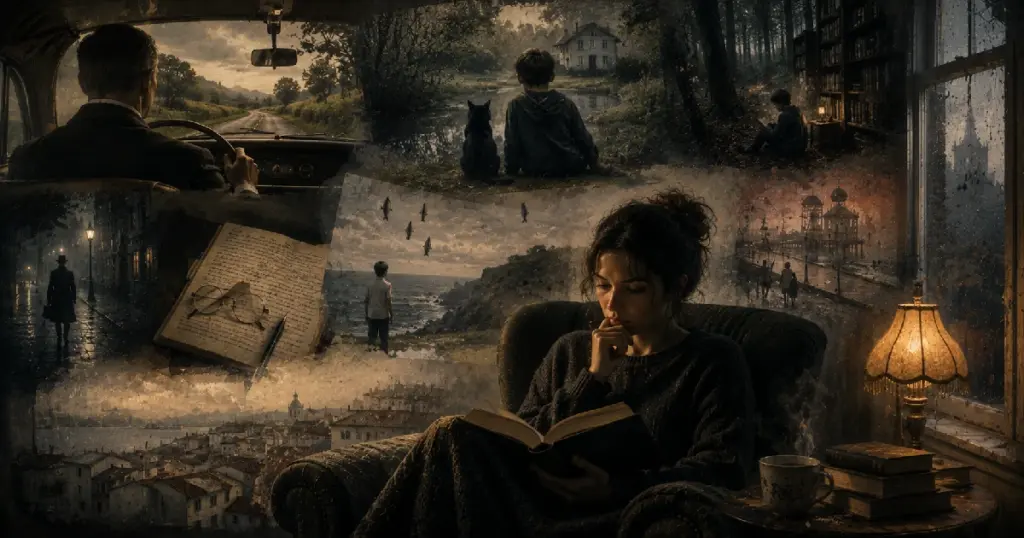
This is practically how Neil Gaiman’s The Ocean at the End of the Lane operates. A woman who lived at the end of the lane, a pond she called an ocean, and something that came through from somewhere else are just a few of the childhood events that an adult returning to the English countryside house where he grew up suddenly remembers. The novel is short, barely longer than a novella. The novel is organized more like a memory than a story. Details emerge and vanish. Instead of being causal, the reasoning is sentimental. It evokes a particular feeling when you read it: the sensation of regaining something lost, of touching the periphery of a memory that was never quite yours but feels entirely familiar. When you finish a book, you have the impression that you have remembered something rather than read it.
Murakami uses various tools to create a version of this effect. Unlike Ishiguro, Kafka on the Shore does not strive for psychological realism; instead, it allows the unconscious to run freely through the daylight world. Examples include fish falling from the sky, cats conversing, and a boy sleeping in a forest library and waking up to discover that something has changed around him. However, reading it as a whole is like waking up from a dream: it is atmospheric, emotionally cohesive, difficult to paraphrase, and lingers in a way that simple stories seldom do. The willingness to move at the speed of memory rather than the speed of story—that is, slowly, associatively, with extended periods of interiority between events—may be what these novels have in common.
The Book of Disquiet by Fernando Pessoa goes the furthest in this regard. It’s not really a novel; rather, it’s a collection of fragmentary prose pieces written over several decades, told from the perspective of a Lisbon bookkeeper who spends his evenings taking notes while observing the city from his window. There’s no storyline. No arc. Reading it is more like discovering someone else’s diary in a drawer and uncomfortably identifying whole passages as your own than it is like following a story. Pessoa gained insight into how the mind truly interprets experience—not in chapters but rather in flashes, impressions, and half-formed observations that come and go, sometimes reappearing years later with new significance.
Beyond their obvious literary merits, all of these novels have one thing in common: they eschew the conventional storytelling mechanics—the setup, the conflict, and the resolution—in favor of something more akin to how people actually recall their lives. The nature of memory is nonlinear. There are no compelling storylines in it. It mixes the important with the insignificant in ways that defy any editor’s sense of proportion, returning obsessively to some images and moments while leaving others completely blank. This type of fiction, which is atmospheric, nonlinear, and deeply introspective, mimics that rhythm so well that the brain may not always be able to distinguish between the self and the story. It’s difficult to ignore how uncommon that is and how significant it is when a book succeeds in doing so.