
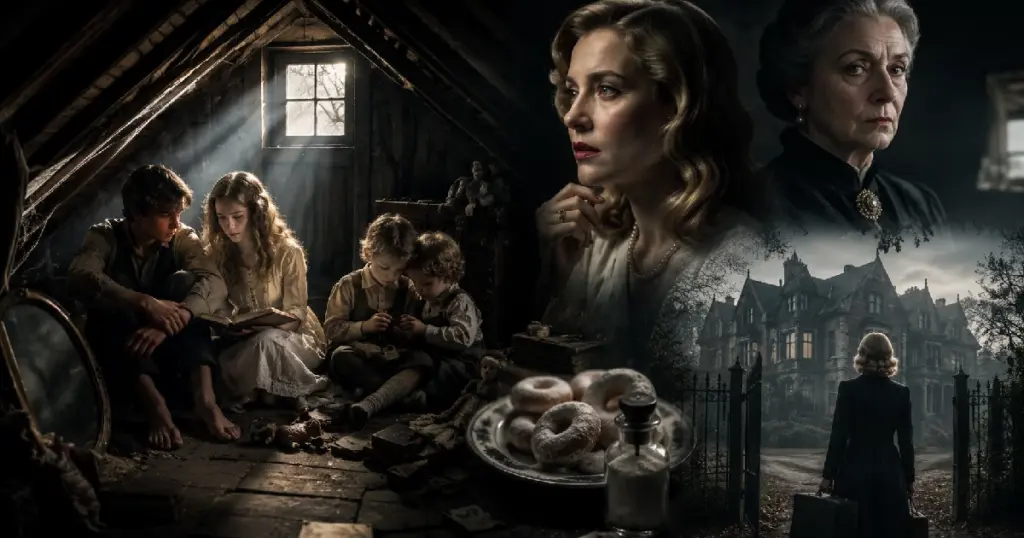
There’s a certain type of book that irritates you not because it’s flawless but rather because it’s peculiar and unsettling in just the right places. That kind of book is V.C. Andrews’ 1979 Gothic novel Flowers in the Attic. Within two weeks of its release, it was on bestseller lists, and for years afterward, V.C. Andrews was the second most popular author among teenagers in the United States. For a book that revolves around four children imprisoned in an attic, a poisonous mother, and an inflexible grandmother who views the kids as living examples of sin, that is an astounding fact. It obviously struck a chord, and it continues to do so.
At first glance, the story appears to be a tragedy of everyday life. Corinne Dollanganger’s four children—14-year-old Chris Jr., 12-year-old Cathy, and five-year-old twins Cory and Carrie—are left penniless after her husband Christopher perishes in an automobile accident. In an attempt to reclaim her position in her dying father’s will, Corinne returns to Foxworth Hall, the estate of her affluent family, in a desperate and vulnerable financial situation. Her father had disowned her years prior for marrying Christopher, his much younger half-brother. This is the catch, and it’s a big catch. Their grandfather is unable to see the children, which are evidence of that union. Corinne decides to conceal them in an attic, which gradually reveals her true nature as a mother. She assures me that it will only be for a night or two. A week, perhaps.
It’s not a week. Years pass. And it’s during that gradual intensification that Andrews displays her true storytelling prowess. With her strict religious ferocity, the grandmother quickly establishes herself as the book’s clear antagonist. She punishes Cathy for admiring herself in a mirror by whipping the kids, denying them food, and pouring tar into her long blond hair. She is terrible in a comprehensible, theatrical way. Corinne is the one who possesses the more subtle evil, the one that develops gradually. She shows up with promises of enormous wealth and gifts. She offers nothing substantial and speaks abstractly about love. There’s a feeling that Andrews recognized something genuinely sinister about the way generosity can be disguised as neglect—how a mother can continue to visit while also disappearing.
Chris and Cathy react to their unfeasible situation by coping and overcompensating, which is a common behavior of older kids who are thrust into parental roles far too early. They make the attic livable. They manage their grief, amuse the twins, and make a great effort to project an adult image. As the reader follows this story from Cathy’s point of view, they witness the tragic paradox of two kids acting so much like adults that they forget what childhood was.
In depicting this, Andrews may have taken inspiration from her own adolescence, which was characterized by a serious fall and a protracted medical ordeal during which doctors allegedly didn’t think she was in pain because she “looked too good” to be seriously injured. That feeling of being invisible has a recurring theme in Cathy’s narrative.
The most contentious part of Flowers in the Attic is still the incestuous feelings that arise between Chris and Cathy, and they should be given careful thought rather than being dismissed out of hand. The emotional breakdown of proper boundaries carries a tragic logic in the context Andrews creates: loneliness, trauma, unfulfilled grief, puberty without guidance, and the lack of any safe adult. It is portrayed more as a consequence than as titillation. The rape scene near the end of the book and the way Cathy’s narration turns it inward, as if she is somehow equally responsible for what happened to her, are what are truly unsettling, and Andrews may have made a mistake here. It’s important to name that moment clearly because it goes wrong.
Whether Andrews intended the complexity that literary scholars have since discovered in her work is still up for debate. However, the Flowers in the Attic book has been examined within the tradition of female Gothic fiction, which is defined by women who are both literally and figuratively confined to domestic spaces, motherless protagonists shaped by patriarchal forces, and ambivalent female sexuality. The image of Foxworth Hall’s attic is almost too ideal for that custom. It’s a place where girlhood is confined and made to develop in the shadows.
The discovery that Corinne has been adding arsenic to the kids’ powdered doughnuts—because her father’s will stipulated that she must have no children from either marriage to inherit—marks the novel’s climax. Cory passes away. His tiny body is interred in an unmarked grave under someone else’s name. Not because it’s graphic, but rather because it’s quiet, it continues to be one of the more genuinely unsettling scenes in popular fiction. The reader has already spent hundreds of pages witnessing a mother reduce her children to annoyances and eventually liabilities by the time it is verified.
Because greed is such a powerful intoxicant, Corinne developed an addiction to it at the expense of her own children. The book is astute enough to leave open the question of whether she ever really loved them. It does demonstrate that Chris and Cathy made an effort in spite of everything. In a dark attic, they cultivated flowers. After all, some flowers can grow anywhere, and the fact that readers have been revisiting this bizarre, unsettling, strangely moving book for over 40 years indicates that there may still be significance to that image.