
A certain type of writer creates a world so thoroughly, patiently, and over many decades that it is nearly impossible to imagine the landscape they describe ever existing without them. That type of writer was Winston Graham. However, he was largely ignored by the literary establishment, widely read, and oddly happy to stay that way for the majority of his career.
Graham was born in Manchester in 1908, a city that, in many respects, embodies the entirety of England’s industrial history. He had lobar pneumonia as a child, received his education near home instead of at the esteemed Manchester Grammar School his father had intended, and by the time he was in his teens, he had made the quiet but firm decision that he would become a writer. Something changed in Graham when the family moved to Perranporth, Cornwall in 1925, in part due to financial difficulties after his father’s stroke. He was influenced by the sea cliffs, the deserted mine shafts, and the lengthy and intricate social history of a nation that had both fueled and been left behind by the industrial revolution.
In 1934, his first book was published. The work that would come to define his life didn’t emerge for another ten years. The 1945 novel Ross Poldark featured a protagonist who, in many respects, captured the spirit of the post-war era: a man returning from battle to discover that the world had changed while he was away, attempting to reconstruct something respectable from the rubble. Graham might have had a deeper understanding of that emotion than readers were aware. The book was a huge hit. There were 27 reprints of it. Over five million copies were reportedly sold by Ross Poldark alone.
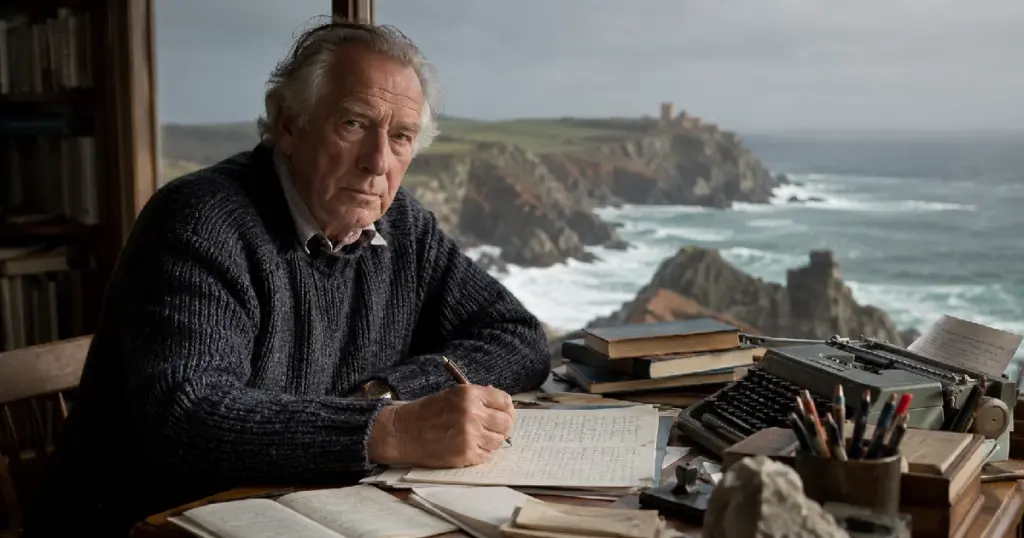
What came next was one of the more understatedly remarkable careers in British fiction of the twentieth century. Over the course of 57 years, Graham wrote twelve novels in the Poldark series; the final one, Bella Poldark, was published in 2002 at the age of 93. The length of time is impressive in and of itself, but perhaps even more remarkable is the fact that quality never gave way to formula. The tone and concerns of the later books changed, reflecting the feminist movement of the 1970s, post-colonial unease, the shadow of Waterloo, and animal rights—issues that Graham seemed to follow almost instinctively as they gained traction in society.
It seems that his wife Jean, whom he married in 1939 after meeting her in Cornwall when she was thirteen, was a truly influential figure in the work. She served as a model for Demelza, who is earthy, astute, and fiercely devoted. Jean saw everything and remembered everything, according to Graham’s daughter. With that knowledge, some scenes in the Poldark series take on a completely different significance. Compared to nearly everyone else, it’s difficult to ignore how delicately the Demelza character is handled.
Almost by coincidence, Graham was also a talented suspense fiction author. Published in 1961 and later adapted into a Hitchcock film, Marnie showed a psychological accuracy unrelated to historical drama. Interestingly, Graham’s agreement with Hitchcock stated that his name would not be featured in the movies. After receiving $50,000, he vanished from the credits. Whether this was contractual pragmatism or modesty, it says something about a man who once referred to himself as “the most successful unknown novelist in England.”
The literary establishment ignored the “successful” and mostly agreed with the “unknown.” Historical fiction, especially regional historical fiction, was not taken seriously in mid-century academic circles. The fact that Graham was a book-of-the-month club staple in America, a title that sold massive quantities of copies, was used against him in the exact locations where his reputation could have been established. There’s a feeling that the snobbery of British literary culture actually cost him a legacy that was automatically enjoyed by writers with greater connections but less readership.
Some of that was altered by the BBC adaptations. The Robin Ellis-starring series from 1975 was mocked by critics prior to its premiere and went on to become a cultural phenomenon. A completely new generation was introduced to Graham’s world in the 2015 revival starring Aidan Turner. However, it’s still unclear if he ever achieved both literary respect and television fame at the same address. Two months prior to the publication of his autobiography, in July 2003, he passed away at his East Sussex home.
The Royal Institution of Cornwall currently houses his manuscripts. Unpublished historical fiction, preferably with a Cornish connection, is eligible for a prize in his name, which is supported by Pan Macmillan and financed by his estate. For a man who spent 34 years absorbing a landscape until it absorbed him back, it seems like the ideal legacy. His imagination was shaped by Cornwall, and he made it unforgettable in return.

Chloe Olliver is senior editor at vclib.org, where she leads editorial coverage of literary criticism, political commentary, cultural analysis, and the evolving relationship between literature and public life across New York City and beyond. With a career spanning the intersection of literary journalism, political commentary, and educational publishing, Chloe brings both rigorous research discipline, in-depth knowledge, experience, and an accessible editorial voice to subjects that most readers find thought-provoking and culturally significant.