When Ulysses is brought up at a dinner party, people experience a certain level of confidence. They give a nod. They produce a knowing sound that falls somewhere between respect and acknowledgment. They may even comment on the Homeric parallels or Joyce’s use of stream-of-consciousness. The fact that they have never gone past page forty is something they most likely fail to mention.Declaring that you have read Ulysses is more about who you want to be perceived as than it is about literature.
This is the mutual fiction that has endured for generations between some novels and their purported readers. These are the books that people recommend to others with a straight face, keep on their shelves like trophies, and cite as authorities in debates. The part that is subtly omitted is the actual reading, the time spent sitting down with it for weeks, months, or even years. This could say as much about human nature as it does about challenging prose.
Almost every list of books that people say they have read starts with Ulysses. And it’s easy to understand why. James Joyce’s 1922 publication of the more than 700-page modernist maze is infamously difficult to read casually. It requires a level of sustained attention that most readers, no matter how well-intentioned, simply cannot sustain over the course of a typical reading life due to its shifting styles, internal monologues that tumble across pages without punctuation, and private jokes buried in classical allusion. But saying you’ve read it? That makes a good amount of money at no cost. For many people, their literary reputation seems to be based more on the books they are seen carrying than on the ones they have actually read.
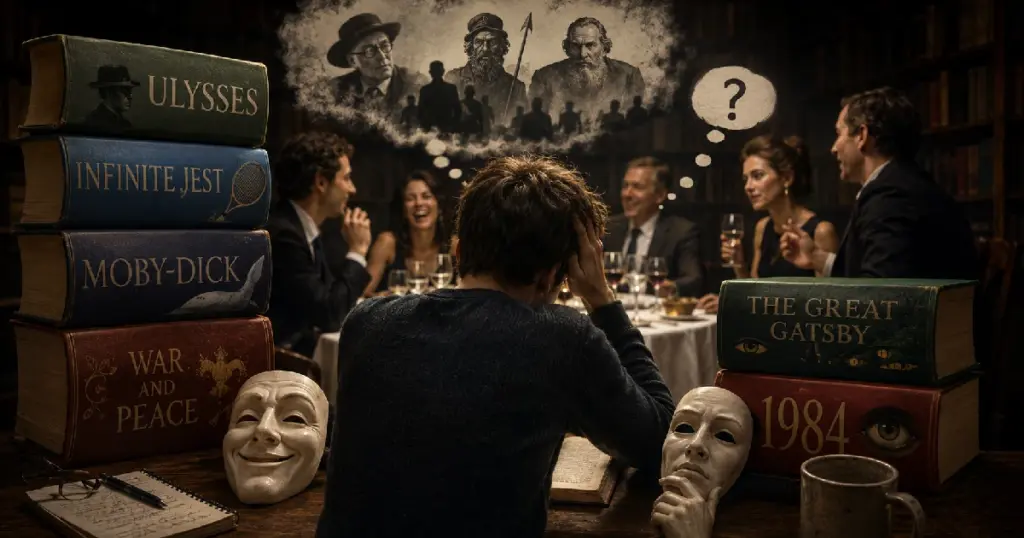
Infinite Jest by David Foster Wallace poses a somewhat different issue. Whether Wallace intended it this way or not, the book’s over a thousand pages and hundreds of endnotes make it difficult for the average reader to follow along. Seldom do readers who give up on it publicly acknowledge it. Rather, they say things like “I’m working through it slowly” or “I had to set it down for a while.” Technically, both claims are accurate. Both typically endure forever. With its reputation intact and its spine hardly cracked, the book can be found on shelves in living rooms all over America and Britain.
Moby-Dick by Herman Melville presents a different kind of difficulty. Many readers believe they already know the book without having read it because the general themes—obsessive captain, great white whale, existential doom at sea—are so deeply ingrained in culture. The lengthy, meandering chapters on cetology—technical, comprehensive sections on whale biology that are obviously unrelated to the drama they signed up for—are what they’re unprepared for. Melville most likely didn’t foresee the type of reader attrition these sections cause. The reader stealthily withdraws to a summary website as the whale is harpooned.In surveys of books people say they have read, Tolstoy’s War and Peace consistently ranks first. It is the unfinished shelf’s Mount Everest.
Perhaps the most socially beneficial unread classic of all is Tolstoy’s War and Peace. It is extremely difficult due to its length (about 1,200 pages, depending on the translation) and large cast of Russian characters, each of whom has several names. However, it also conveys a sense of seriousness and a readiness to discuss the major issues of human nature and history. People make claims because doing so benefits them. It is a completely different experience to actually read it, which requires a great deal of patience and occasionally confusion.
Then there is a class of books that are technically accessible and shorter, but they are nevertheless consistently misinterpreted. Although surveys indicate that many people who claim to have read The Great Gatsby in high school actually watched the 2013 film adaptation or worked through a plot summary, the 180-page book has no real excuse for being unread. Reducing the story to a party and a green light obscures the novel’s criticism of the American dream, its use of color symbolism, and its icy view of Gatsby himself. It’s still unclear if Fitzgerald’s true intentions have ever been effectively communicated in high school English classes.
Orwell’s 1984 holds an odd place. Its main ideas have completely permeated mainstream political discourse, and it is brief and easy to read. Words like “Big Brother,” “thoughtcrime,” and “doublethink” are frequently used by people who have never read the book from which they originate. Not everyone hasn’t read it, which isn’t always the issue. They have occasionally done so, but they have so firmly imposed their own politics on it that a version of the book that supports their preconceived notions has taken the place of the original text. That could be a completely different kind of not reading.
It’s difficult to ignore the intriguing message this phenomenon conveys about the social role of literature. These kinds of books serve as cultural indicators of intelligence, seriousness, and a particular kind of ambition. To that signaling, reading them—truly reading them—is optional. Pride and Prejudice topped the list of 412 books that participants in a Book Riot survey of 828 readers admitted to faking, closely followed by Ulysses and Moby-Dick. That survey was notably honest. It’s not as common as it ought to be.
There isn’t a clear treatment for this. These are the novels that draw pretense because of their reputation, which contributes to their difficulty and makes claiming them worthwhile. Quietly acknowledging, at least in private, that difficulty isn’t failure and that a book that is only partially or poorly read is still more engaging than one that is just mentioned could be helpful. Joyce wrote Ulysses over a period of seven years. It might not be totally unreasonable to ask readers to devote seven weeks to it.