
A certain type of author biography practically writes itself. the alcohol consumption. the unsuccessful unions. The neighbors still recall the screaming matches. the extended pauses during dinner. And then the masterpiece, somewhere amid all that rubble. When we read about it, we experience an odd attraction that we’ve never been able to adequately describe. It’s neither admiration nor sympathy.
We frequently, almost unconsciously, romanticize authors who were hard to get along with. Hemingway’s brutality toward friends and family has been recounted so frequently that it has become a part of the brand’s texture and ambiance. Classrooms teach Sylvia Plath’s suffering with a reverence that occasionally ignores the fact that there was a real person behind the bell jar. Somehow, Bukowski’s decades of drinking and mistreating others turned into proof of his authenticity rather than a warning sign. The creation of myths begins early and never truly ends.
The question of why is worthwhile. What is it about a challenging, destructive human being that causes us to use terms like “tortured genius” instead of just “unkind”? I don’t mean to be critical. A portion of it stems from a deeply ingrained cultural belief that authenticity and suffering go hand in hand, which we inherited from the Romantic era. It is assumed that someone must be telling the truth if they are in pain. Their words are more powerful if they are broken. Despite two centuries of evidence to the contrary, this alluring notion has endured despite being nearly completely false.
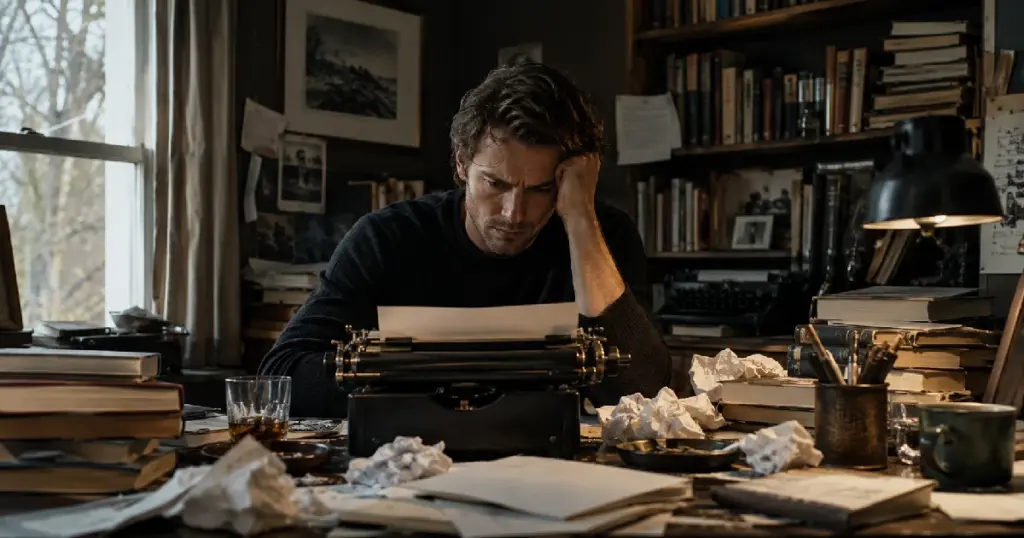
In a world where everything is packaged too neatly, there’s also something about the messiness itself that feels honest. Somehow, a writer who kept a quiet schedule and went to bed at a reasonable hour seems less real than one who drank excessively and said the wrong thing at every dinner party. Even though Jane Austen loved her brothers, attended dances, and led what could be charitably described as a typical social life, she hardly ever receives the somber portrait treatment. It’s difficult to ignore the fact that we prefer the chaos to the stability in terms of cinematic satisfaction.
Over time, this quietly turns actual harm into myth. The front matter of the biography typically doesn’t include the people who actually lived with these writers, such as the spouses, kids, and friends who took in the anger, silence, or financial catastrophe. They appear as casualties, footnotes, and proof of the artist’s wild nature. The way we allow creativity to be used as an excuse for cruelty is a peculiar form of absolution. As though a good sentence makes up for a terrible year spent being a bad partner.
Additionally, the romanticization is harmful, particularly to younger writers who are still learning what it means to do this kind of work. Some people will internalize the narrative that the best art comes from suffering, that a chaotic personal life is a sign of depth, and that rest, stability, and mental wellness are somehow indicators of creative mediocrity. Additionally, some of them will make decisions that cause them pain while claiming to be authentic. The fact that depression, which many of these well-known authors actually experienced, tends to make writing more difficult rather than easier is particularly ironic. No matter how much you’ve been through, the blank page doesn’t care. It remains motionless.
When we romanticize these characters, it’s possible that we’re actually reacting to the dedication rather than the actual suffering. They burned through whatever personal resources they had in support of the work because they felt like they gave everything and held nothing back. Even when it was expressed in a way that was actually harmful, such complete devotion is truly touching. However, there is another side of that story that we don’t often share: the writers who gave their all while also taking care of themselves, who were genuinely devoted to their work and fairly compassionate to those around them. They are real. They have always been there. They are simply more difficult for us to mythologize.
Naturally, publishing and the media have contributed to the myth’s survival. Commercially speaking, the story of the self-destructive genius is more compelling than that of a person who wrote every morning and took afternoon walks. The affairs and breakdowns are highlighted in biographies. Photographs of writers who appear gaunt and haunted are featured in documentaries. When we consume the suffering, we feel as though we are consuming something genuine, but in reality, we are consuming a carefully chosen version of it—the moments that could be turned into movie scenes, the quotes that sound prophetic, and the parts that take great pictures.
The ordinariness and the amount of excellent writing that truly occurs there are overlooked. The mornings are slow. The average drafts. The changes were made on a Tuesday afternoon when nobody’s personal lives were particularly interesting. Perhaps part of the reason we don’t discuss real writing is that it is more difficult to sell than dramatic crisis.
There is no clear-cut conclusion to this, no point at which the culture decides to give up. However, it is at least worthwhile to be truthful about the transaction, which is that we are selecting a form of entertainment over a more nuanced reality when we reach for the tortured writer narrative. The writers who were hard to get along with were frequently truly exceptional. They were occasionally actually dangerous as well. It is less satisfying to hold both of those things at once than the myth, and it is probably more equitable for all parties involved, including the writers themselves, who ought to be viewed as complete individuals rather than as helpful representations of artistic suffering.
Being brilliant doesn’t require bleeding. That doesn’t serve as motivation. We’ve known this for a very long time; it’s simply true.