
The Sound and the Fury’s first few pages don’t explain themselves. Benjy Compson abruptly shifts through time; a memory is triggered by a scent, which then permeates a scene from decades ago, leaving the reader frantically searching for a stable point of reference. Faulkner does not provide a map. He hardly uses punctuation. However, after reading that book for a while, an odd thing occurs: the confusion begins to seem real. Not perplexing. precise. For example, the book tells the truth about how memory functions, whereas all previous orderly novels told courteous lies.
Fragmented storytelling has always aimed for that feeling—the realization that broken form can convey more truth than neat form. It appears in books, movies, video games, and poetry, spanning genres and eras, and is preserved by authors and filmmakers who recognize that a story told in fragments can accomplish things that a linear narrative just cannot. The gaps are important. The quiet moments are powerful. What is omitted speaks.
Human memory is not a film reel that plays continuously from start to finish. It comes in flashes: a smell that invites an entire emotional landscape back into the present, a sound that opens a fifteen-year-old afternoon. That particular aspect of experience is reflected in fragmented narratives, which is likely why working with them feels so strangely personal. With its circling, reluctant approach to the central trauma, reading Toni Morrison’s Beloved evokes something akin to the experience of a mind unable to look directly at what it knows. There is no artistic flourish in the fragmentation. It is the structuralization of psychological content.
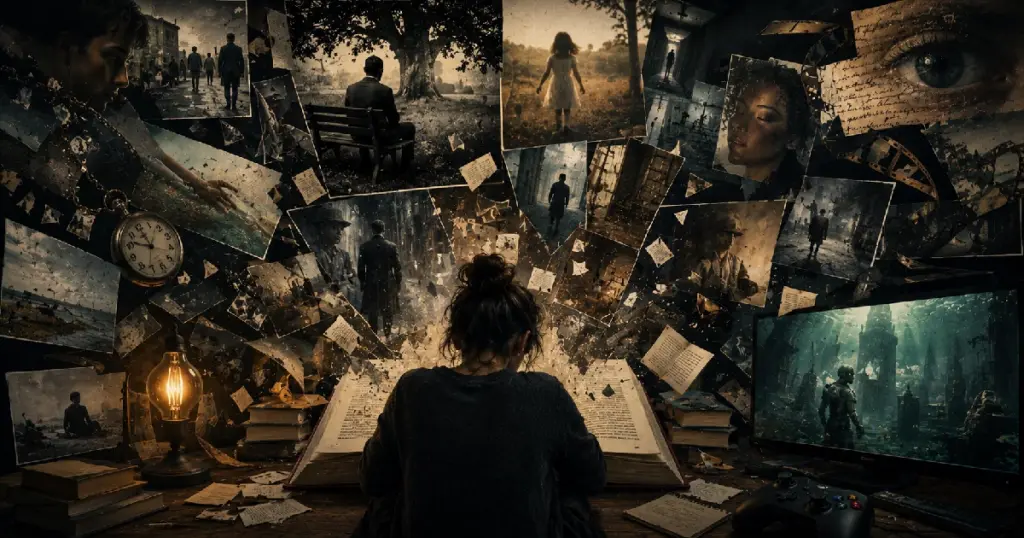
It’s intriguing how this method consistently transforms readers from passengers into participants. The meaning of a linear story is conveyed. A fragmented one withholds enough information that the reader must fill in the blanks, correct presumptions, and piece together a timeline that the author has purposefully dispersed. For decades, filmmakers have been aware of this. Reverse chronology and fractured timelines were key components of Christopher Nolan’s entire career, and audiences continued to attend because of the confusion rather than in spite of it. When a story declines to give everything up, a certain level of engagement begins. The audience starts working together. Because the interpretation is personal, so are the stakes.
This feature—the need for active engagement—may help to explain why fragmented storytelling has become so popular in video games. The backstory of films like BioShock is dispersed throughout audio diaries, environmental details, and partially destroyed documents. Instead of using exposition, players use archaeology to piece together what happened in Rapture. Because it transforms discovery into interpretation and interpretation into investment, the fragmentary format is ideal for the medium. Because the player had to put in effort to comprehend the world, it feels inhabited. A clean briefing at the beginning of a level would never be able to foster attachment like that labor does.
Most people are unaware of the length and strangeness of the literary tradition that underlies all of this. In order to reject what the French theorist Jean-François Lyotard referred to as “grand narratives,” those overarching explanatory stories that purport to make everything coherent, postmodern writers started employing fragmentation as a philosophical stance as well as a technique in the middle of the 20th century. In Slaughterhouse-Five, Vonnegut dispersed Billy Pilgrim throughout time to illustrate how a person’s relationship with chronology is affected by war. In One Hundred Years of Solitude, García Márquez looped the Buendía family through recurring cycles to imply that history circles rather than advances. The broken worldview was carried by the broken form.
What transpires in the gaps between pieces is also genuinely emotional. In ways that are difficult to fully explain, the critic Lydia Davis’ description of some incomplete and fragmentary works as the most credible expressions of grief rings true. A loss can be included in a sentence and then moved past. The wound is left open by a fragment. Written following the death of his eight-year-old son and published sixty years after his own death, Mallarmé’s A Tomb for Anatole is a collection of pieces that never find closure, resolution, or healing. The honesty lies in the incompleteness. Any attempt to complete it would render it untrue.
It’s difficult to ignore how the storytelling culture is subtly addressing this on a larger scale. A paragraph here, a clip there, a thread, a caption, a story that vanishes in twenty-four hours—the short-form, scroll-driven nature of how the majority of people now consume content is creating its own involuntary fragmentation. It is genuinely unclear if this creates the same resonance as intentional literary fragmentation. A story broken by intention is not the same as one broken by attention spans. Absence is a tool used in the first. The second simply runs out of space.
Control—a writer or director who precisely identifies and places the gaps—is what the best fractured narratives have in common. In Beloved, the pauses between scenes are intentional. Memento’s inverted chronology is not confusing in and of itself. When breaking the story is the only honest way to tell it and the form and content are so similar that they cannot be separated, the technique is effective. The realization that sometimes the most complete truth is the one that comes in fragments is the peculiar force that authors and readers are drawn to.